The Human Factor in Food Safety: The Biggest Risk You’re Overlooking
August 27, 2025
Smart HACCP Table of Contents
Every meal tells a story — a story that begins on the farm and reaches our tables as nourishment, comfort, and joy. But behind that story lies a vital question: what does it truly take to make our food safe? And who holds the responsibility for safeguarding that promise of trust, quality, and satisfaction?
“Food safety is not only a government and industry responsibility—it’s everyone’s business.” — Margaret A. Hamburg, former FDA Commissioner
These words remind us that real food safety starts with people. To make our meals truly safe, we must equip those who produce, prepare, and bring food to our tables with knowledge, systems, and the confidence to act.Technology surfaces the data; people decide what to do with it but it’s, turning that knowledge into trust and safety.
What is the Human Factor in Food Safety?
The human factor in food safety refers to the attitudes, behaviors, knowledge, and practices of people at every stage of the food supply chain—from production and processing to distribution and consumption. No matter how advanced the technology, the effectiveness of food safety always depends on human actions and decisions.
Qualified, motivated staff and committed leadership are essential. Management practices, workplace culture, and employee behavior directly shape food safety outcomes, going far beyond technical compliance to include the psychological and social drivers of human action.
Central to this is food safety culture—the shared values, beliefs, and norms that guide how people think and act about food safety. A strong culture ensures everyone understands risks, takes ownership of their role in prevention, and feels accountable. Importantly, this culture must evolve continuously, with clear communication and active buy-in at all organizational levels.
How Problems Arise: The Human Element as a Source of Risk
Despite stringent regulations and advanced technologies, human error remains a significant contributor to food safety incidents. These errors can manifest in various forms, often stemming from a combination of individual actions, organizational culture, and systemic issues. As the New Food Magazine article points out, 'We’re only human', 'we all make mistakes' – but when these mistakes lead to devastating consequences in food safety, the impact can be severe, ranging from widespread foodborne illnesses to significant financial losses and reputational damage for businesses.
Common Manifestations of Human Error:
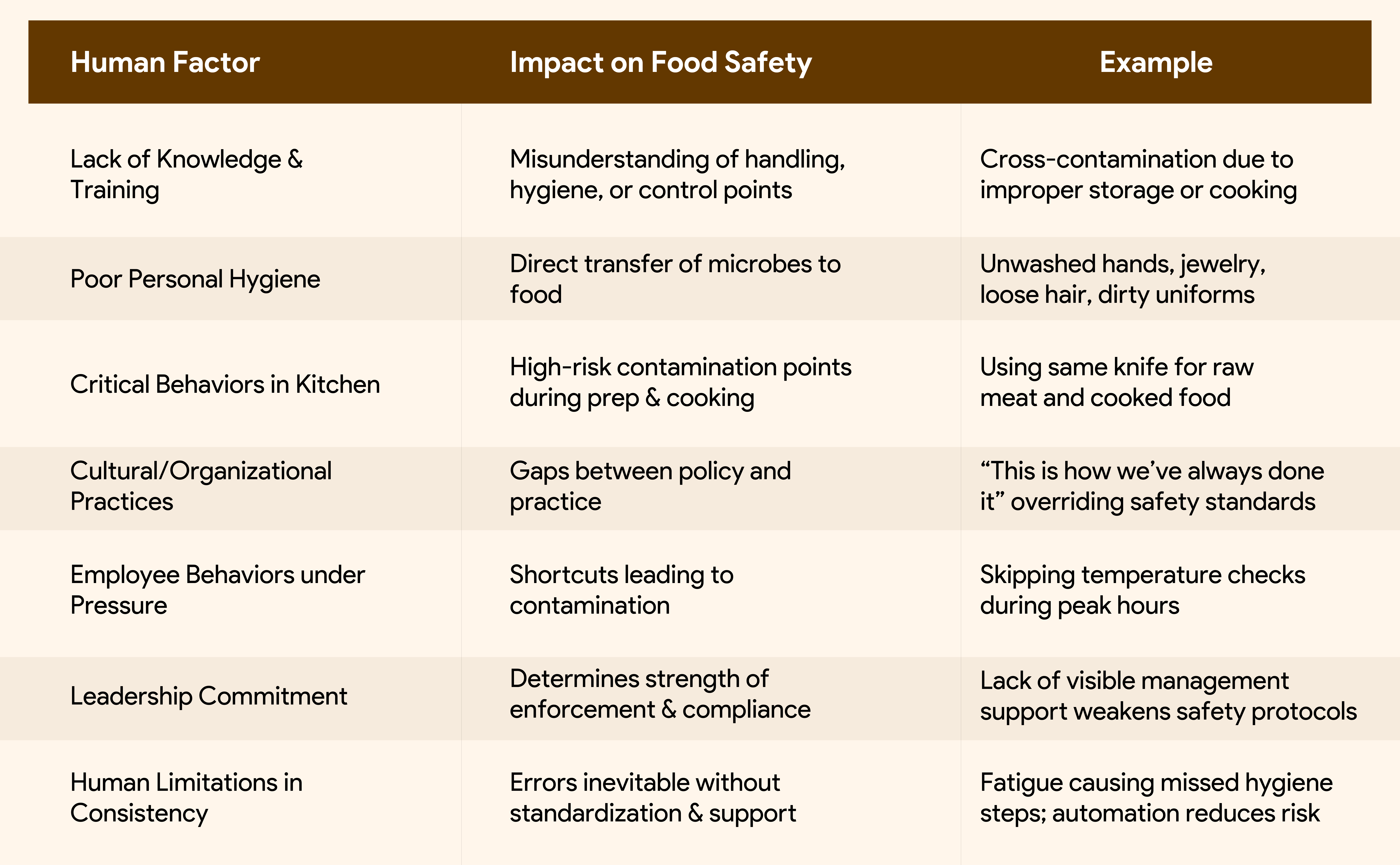
Lack of Knowledge and Training:
Inadequate or insufficient training can lead to a lack of understanding regarding proper food handling procedures,
hygiene practices, and critical control points. This can result in cross-contamination, improper cooking temperatures,
or incorrect storage, all of which are common causes of foodborne illnesses. For instance, microbial food poisoning
is frequently linked to human error in restaurants due to a lack of proper food handling knowledge.
Poor Personal Hygiene:
Personal hygiene is a cornerstone of food safety, extending far beyond handwashing alone. Safe food handling requires
clean and trimmed nails, restrained hair and beards, removal of jewelry, and the use of fresh uniforms or protective
clothing to prevent microbial transfer. Employees should avoid eating, drinking, or smoking in preparation areas and
promptly report any illness to minimize contamination risks.
Critical Behaviors in the Kitchen:
The kitchen is a critical area where human error can have catastrophic consequences. This includes improper washing
of ingredients, cross-contamination from raw to cooked foods due to shared utensils or surfaces, and failure to cook
foods to the correct internal temperatures. Runoff from raw meat, for example, can contain disease-causing microbes
that can easily contaminate other foods if not handled carefully.
Cultural and Organizational Influences:
In many facilities, practices are passed down informally through experience or tradition, sometimes at the expense
of compliance with updated standards. When “this is how we’ve always done it” becomes the guiding principle, it can
create gaps between policy and practice. These inherited behaviors can lead to complacency, inconsistent application
of procedures, or resistance to adopting new technologies and protocols.
Employee Behaviors and Their Impact:
No matter how advanced the equipment or how rigorous the policies, the behavior of employees ultimately determines
the integrity of food safety systems. Small actions — like neglecting proper handwashing, reusing a utensil between
raw and cooked products, or skipping temperature checks during a rush — can open the door to serious contamination risks.
These lapses are rarely due to negligence alone; they often stem from factors such as fatigue, production pressure,
unclear instructions, or lack of reinforcement.
Leadership Commitment in Food Safety:
Management sets the standard for food safety performance. Clear policies, consistent enforcement, adequate resources,
and visible commitment from leadership ensure that protocols are not only designed but effectively implemented. Without
this top-down accountability, even the most comprehensive systems risk being undermined at the operational level.
Human Limitations in Consistency:
No matter how skilled or dedicated, people alone cannot deliver absolute consistency in food safety. Human performance
varies with pressure, fatigue, and judgment, and without standardized processes, errors are inevitable. A structured system, reinforced with automation, provides the reliability and repeatability that manual effort alone cannot achieve. The New Food Magazine article suggests that reducing human interventions through automation can generate more accurate data and improve food safety, especially in highly regulated, low-margin industries.
These problems underscore the complex interplay between individual actions, organizational environment, and systemic vulnerabilities, all of which contribute to the human factor's impact on food safety.
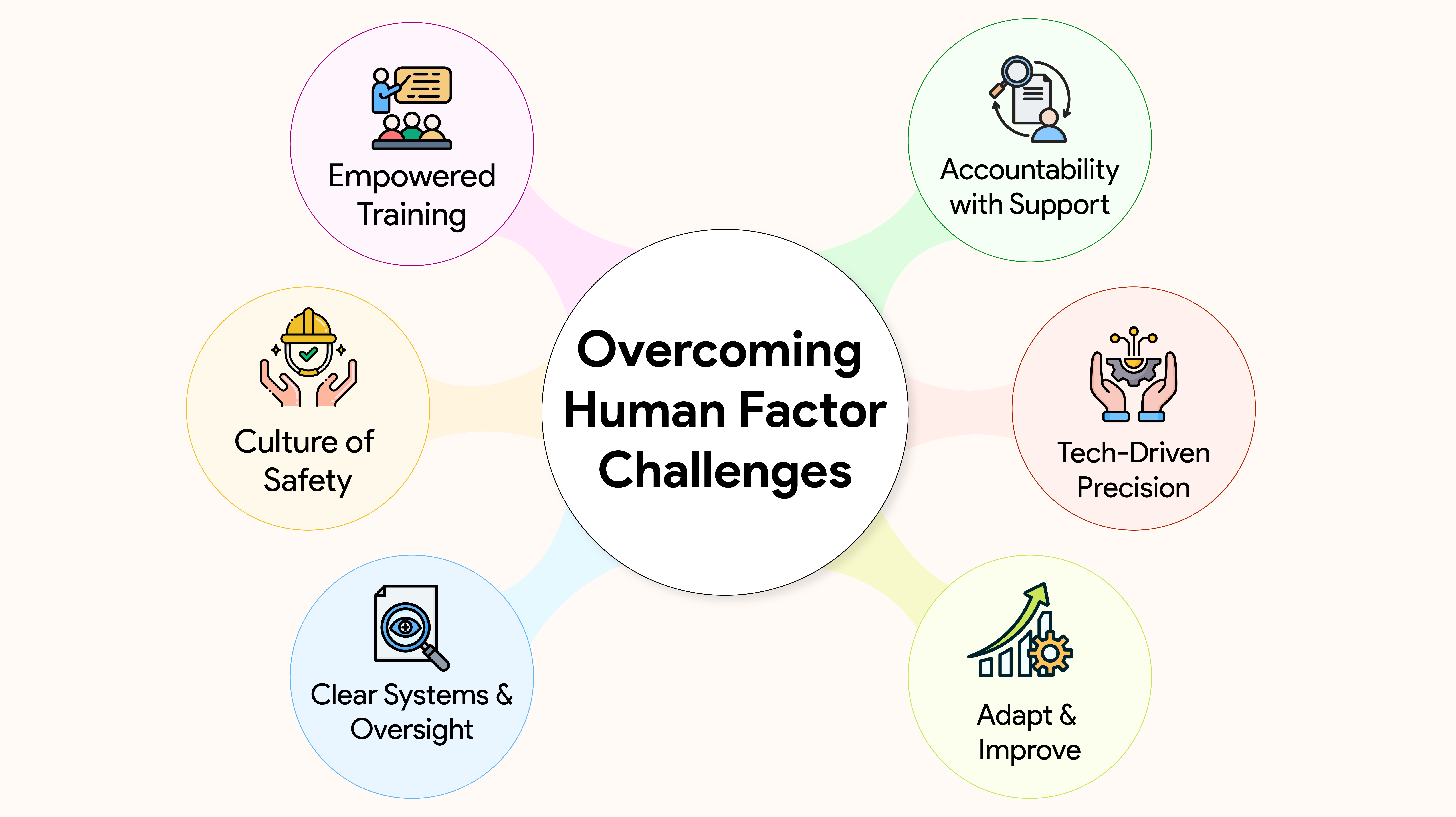
Solutions: Overcoming Human Factor Challenges
Addressing the human factor in food safety requires a multi-pronged approach that combines robust training, a strong food safety culture, effective management, and the strategic integration of technology. By focusing on these areas, organizations can significantly mitigate risks associated with human error and enhance overall food safety performance.
1. Comprehensive Training and Education:
Effective training is paramount to equipping food handlers with the necessary knowledge and skills.
This goes beyond basic instruction and should include:
Mandatory Food Handler Permits:
Requiring food handler permits ensures that individuals undergo standardized training covering essential food handling practices,
storage methods, and allergen awareness. This formalizes the learning process and sets a baseline for competence.
Continuous Education and Refresher Courses:
Food safety guidelines and best practices evolve. Regular refresher courses and continuous education programs are vital to keep staff
updated on the latest protocols, emerging risks, and technological advancements. This helps reinforce good habits and corrects
any deviations that may have developed over time.
Practical, Hands-on Training:
Theoretical knowledge must be complemented with practical, hands-on training. Demonstrations and supervised practice sessions
for tasks like proper handwashing, cross-contamination prevention, and temperature control can significantly improve adherence
to safety procedures.
Risk-Based Training:
Training should be tailored to specific roles and responsibilities, focusing on the most critical risks associated with each task.
For example, kitchen staff training should heavily emphasize safe cooking temperatures and cross-contamination prevention, while
serving staff training might focus more on allergen communication and order accuracy.
2. Fostering a Strong Food Safety Culture:
A positive food safety culture is the bedrock of effective food safety management.
It transforms compliance from a mere obligation into a shared value and commitment.
Key strategies include:
Leadership Commitment:
Senior management must visibly champion food safety. Their commitment sets the tone for the entire organization.
This includes allocating necessary resources, prioritizing food safety in decision-making, and leading by example.
Clear Communication and Expectations:
Establishing clear, concise, and consistent communication channels ensures that every employee understands their role,
responsibilities, and the rationale behind food safety procedures. Regular meetings, visual aids, and accessible
documentation can reinforce these expectations.
Employee Engagement and Empowerment:
Employees should be encouraged to actively participate in food safety initiatives, report concerns, and suggest improvements.
Empowering them to take ownership of food safety fosters a sense of responsibility and vigilance. This aligns with the
Solenis blog post's emphasis on communication and buy-in.
“Every employee is a food safety ambassador—their vigilance makes all the difference.”
— World Health Organization, Food Safety Campaign
Positive Reinforcement and Accountability:
Recognizing and rewarding adherence to food safety practices can motivate employees. Conversely, clear accountability
measures for non-compliance, applied fairly and consistently, reinforce the importance of safety protocols.
Promote Accountability Through Support, Not Fear:
Punitive approaches often drive employees to conceal mistakes rather than report them, leaving risks unaddressed.
Instead, organizations should foster an open, blame-free environment where employees feel safe to raise concerns,
admit errors, and discuss challenges. When dialogue is encouraged and learning is prioritized over punishment,
teams become more engaged, proactive, and committed to maintaining food safety standards.
Adaptability and Continuous Improvement:
A strong food safety culture is not static; it is adaptable and continuously seeks improvement.
Organizations should embrace a mindset of learning from incidents, near misses, and feedback to
refine their food safety management systems.
3. Effective Management Systems and Oversight:
Robust management systems provide the framework for consistent food safety practices.
Clarity in Roles and Execution:
A lack of standardized procedures is a major driver of human error. Standard Operating Procedures (SOPs) for all food handling,
preparation, cleaning, and storage tasks are essential. These procedures should be clear, easy to understand, and readily
accessible to all relevant personnel.
Regular Audits and Inspections:
Frequent internal and external audits and inspections help identify deviations from procedures, assess compliance, and
pinpoint areas for improvement. These should not be punitive but rather opportunities for learning and corrective action.
Incident Reporting and Analysis:
Establishing a transparent system for reporting food safety incidents and near misses is crucial. Thorough investigation and
root cause analysis of these incidents can reveal underlying human factor issues and inform preventive measures.
4. Leveraging Technology and Automation:
Technology can play a significant role in reducing human error and enhancing food safety.
Automated Monitoring Systems:
Implementing automated systems for temperature monitoring, inventory management, and process control can reduce the reliance
on manual checks, which are prone to human error. This ensures consistent adherence to critical parameters.
Digital Record-Keeping:
Shifting from paper-based records to digital systems can improve data accuracy, traceability, and accessibility.
Digital platforms can also provide real-time insights and alerts, enabling quicker responses to potential issues.
Smart Equipment and Sensors:
Utilizing smart equipment with built-in sensors can provide real-time data on hygiene, cooking temperatures, and storage conditions,
further minimizing the potential for human oversight or error.
As rightly said, “The cost of prevention is far less than the cost of a crisis.”
By strengthening culture, training, and technology, organizations can stay ahead of risks—building resilient systems
that protect consumers and earn lasting trust.
Why the Human Factor Matters for Smart Food Safe & How It Empowers People for Excellence
As we race ahead with smarter tech and stricter standards, let’s remember that food safety is a human story. Digital solutions make it easier than ever to track, train, and respond—but it’s only when every individual is engaged, educated, and empowered, that food safety becomes second nature rather than just a policy.
As we race ahead with smarter tech and stricter standards, let’s remember that food safety is a human story.
Digital solutions make it easier than ever to track, train, and respond—but it’s only when every individual is engaged,
educated, and empowered, that food safety becomes second nature rather than just a policy.
Smart Food Safe with its holistic approach helps close this gap by bringing together smart technology and careful human effort. Its solutions are designed to empower people in embracing food safety and quality at every touchpoint.
Comprehensive, Customizable Modules:
From automated document control to advanced HACCP management, each tool is built to support nuanced human decision-making,
facilitate clear communication, and ensure every stakeholder remains accountable. Custom training modules and competency
tracking elevate the entire team’s capabilities—not just their recordkeeping.
Real-Time Monitoring & Traceability:
Immediate visibility into food safety activities enables workers to respond to risks swiftly. Automated alerts, corrective action
tracking, and powerful analytics keep food safety top-of-mind for every employee, from line operators to managers.
Continuous Learning & Culture Building:
Digital platforms guide and remind teams, but Smart Food Safe also supports ongoing education and culture-building.
With mobile accessibility, interactive dashboards, and role-based notifications, food safety becomes a shared,
organization-wide value.
Audit-Ready Compliance and Accountability:
Automated recordkeeping, traceability, and supplier management take the friction out of being inspection-ready.
Staff can focus on why their actions matter and not just on what needs to be logged, hence ensuring everyone feels
responsible for safety outcomes.
Adaptability for Every Challenge:
Whether scaling up across multiple sites, responding to outbreaks, or adapting to new regulations, Smart Food Safe’s
digital tools flex alongside human leadership, simplifying transitions and ensuring nothing falls through the cracks.
Therefore, if we want safer food, we must empower the hands and hearts behind every plate:
consumers should demand clear standards and back brands that put safety first; leaders must invest in culture over checkbox
compliance by funding training, modeling the right behaviours, and designing systems that make the safe choice the easy choice;
and frontline teams need clear guidance, hands-on training, and the authority to speak up when something’s wrong.
Equip people with the tools, trust, and accountability they need, and prevention becomes everyday practice—and with it,
lasting consumer trust.
With Smart Food Safe as your partner, food safety becomes part of daily operations driven by both technology
and teamwork. The result? Fewer incidents, stronger compliance, greater trust, and the confidence that your brand always
puts safety first.
Let’s make food safety personal, proactive, and people-powered—every meal, every day.
Food Safety Software
Protect your brand before small cracks become big headlines
We use cookies to enhance your browsing experience, serve personalized ads or content, and analyze our traffic. By clicking "Accept All", you consent to our use of cookies. Cookie Policy
Cookie Preferences
Manage your cookie preferences below:
Essential cookies enable basic functions and are necessary for the proper function of the website.
Name
Description
Duration
Cookie Preferences
This cookie is used to store the user's cookie consent preferences.


 English
▾
English
▾


 French
 Spanish
 Portuguese