


 English
▾
English
▾
English
▾
English
▾
The persistent concern of microbial growth and potential cross-contamination throughout the various stages of the food supply chain continues to be a critical challenge within the realm of food production for both fresh and packaged foods, as discussed in a recent review article on ‘Linking Contamination to Food spoilage and Food Waste‘.
FATTOM is an acronym used in the field of food safety and microbiology to represent the key elements that influence the growth and survival of microorganisms in food. Each letter in the acronym stands for a specific environmental condition that can impact microbial survival. The factors represented by FATTOM are Food, Acidity, Time, Temperature, Oxygen, and Moisture.
As the prominence of digital food safety management systems rises due to their ability to offer greater visibility, accuracy, efficiency, and transparency in food safety practices, their adoption, integrated with features to ease the monitoring and control of FATTOM components, becomes essential for food businesses in an increasingly interconnected and tech-enabled world.
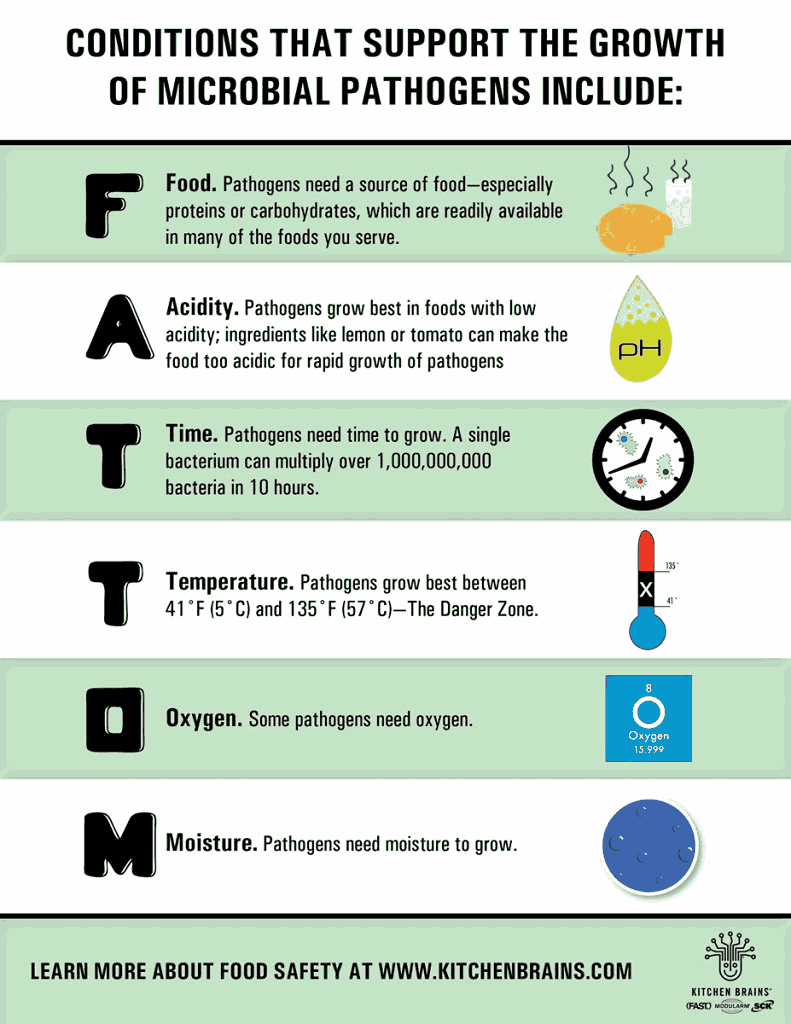
FATTOM is a significant concept in food safety management. Food ingredients, work-in-progress materials, finished food products, and the typical environment of food-related businesses create ideal circumstances for the proliferation of detrimental bacteria and other pathogens associated with foodborne illnesses. Controlling FATTOM as a fundamental food safety approach in the food industry enables responsible parties to comprehend the complex interplay of factors that affect microbial growth in food products. Let us break down FATTOM into six parts and understand how they affect the presence and growth rate of foodborne pathogens.
This element signifies that microorganisms utilize food substances as their nourishment source for development. Similar to humans, microorganisms also rely on the nutrients found in food for their sustenance. Various food items contain a wealth of nutrients that provide a suitable environment for microorganisms to grow.
Generally, foods that are more nutrient-rich, especially those abundant in proteins and carbohydrates, tend to be more susceptible to bacterial contamination, which can lead to food spoilage or instances of foodborne illnesses. Examples of foods that pose a higher risk due to their nutrient content include:
These foods share significant similarities in their nutritional composition. The inherent qualities and nutritional makeup of these foods position them as the primary focal point for microorganisms seeking a source of nourishment. These particular types of foods are more prone to contamination within a kitchen setting.
Microorganisms naturally exist in food products. Through preparation, pre-treatment, and cooking, the presence of potentially harmful bacteria in foods can be minimized, rendering them safe for consumption.
The pH level signifies the degree of acidity or alkalinity of a substance, rated on a scale from 0 to 14. A pH of 7.0 is neutral, while below 7.0 is acidic, and above 7.0 is alkaline. Bacteria thrive in slightly acidic to neutral environments (pH 4.6-7.5), with the optimal growth range being 6.6 to 7.5.
According to Food and Drug Administration (FDA) regulation, “acidified foods shall be so manufactured, processed, and packaged that a finished equilibrium pH value of 4.6 or lower is achieved within the time designated in the scheduled process and maintained in all finished foods”.
Food products are classified into three categories: low-acid, high-acid, or neutral, based on their pH levels:
Food acidity influences which foodborne pathogen is likely. Microorganisms vary in pH preferences for growth. This factor is crucial in the food industry to manage food poisoning bacteria growth and food quality alteration. Acidity control is a core principle in using fermentation for food preservation. When dealing with low-acid foods, enhance their acidity before canning, thoroughly cook low-acid foods, precisely gauge food pH using pH strips or a pH meter, and use appropriate organic acids by following the permissible acid limits.
This component pertains to the degree of heat that food is subjected to, regarding both storage and cooking temperatures. Temperature plays a pivotal role in influencing microbial activity within food as pathogenic microorganisms find their optimal growth conditions in the range of room temperature and the temperature danger zone, spanning from 40°F to 140°F (5°C to 60°C).
Generally, extreme temperatures, whether excessively high or low, prove inhospitable to most microorganisms. This principle underlies the practices of cooking and storage. Foods are heated to elevated temperatures, effectively eliminating potential bacterial threats. Conversely, foods are stored at cooler temperatures to impede or arrest the growth of any existing microorganisms.
Effective microbial inactivation via in-depth temperature management within the realms of food service, retail, and production can include:
It is also imperative to ensure that high-risk perishable foods do not remain within the temperature danger zone for over 2 hours; otherwise, disposal is recommended. Utilizing a calibrated thermometer to verify foods are cooked to the advised internal temperature is necessary. Systematic temperature logs should be maintained throughout the lifecycle of food preparation and storage. Consistently uphold appropriate storage temperatures for high-risk foods. Regulating storage temperatures for a specified duration also diminishes the probability of foodborne pathogen proliferation in food.
Microorganisms require time to multiply. Although the presence of a small number of bacteria typically entails a low risk, prolonged exposure under suitable conditions allows for their multiplication, increasing the contamination risk. High-risk foods should not stay within the temperature danger zone for more than 4 hours. The extended presence of any food in this temperature range heightens the likelihood of bacterial impact on the product.
Within a food industry context, both ingredients and finalized products must consistently inhabit conditions unsuitable for microorganisms. Thorough vigilance is essential in monitoring foods and their storage settings to guarantee their safety and quality. Even foods housed in areas for hot or cold holding possess a maximum time limit for public display. Recommended heating durations for cooking or reheating food and regularly supervising product shelf-life to guarantee the use of fresh and safe ingredients should be followed.
Microorganisms can be categorized as either aerobic or anaerobic. Aerobic microorganisms rely on oxygen for survival, while anaerobic microorganisms perish in its presence.
For food handlers, discerning the specific pathogen of concern is crucial to determine whether the presence of oxygen supports bacterial growth or inhibits it. A prominent mode of oxygen control in food production or service settings is the vacuum-sealing of food. By extracting oxygen from the packaging, vacuum-sealed items are projected to exhibit extended shelf life. Another method to restrict oxygen interaction with foods involves utilizing airtight containers for storage. When sealed and stored in a refrigerator, these foods are less susceptible to contamination.
Diverging from microorganisms reliant on oxygen for survival, canned goods and vacuum-sealed products face distinct concerns. Certain microorganisms, such as the pathogenic bacterium Clostridium botulinum, can solely thrive within vacuum environments. Further methods to counter oxygen presence in foods include the utilization of oxygen scavengers, which effectively absorb oxygen within sealed containers.
Food manufacturers commonly provide the directive “store in a cool, dry place” on labels. This guidance aims to avert the absorption of moisture by foods from their surroundings, a factor that inclines their susceptibility to contamination.
Optimal conditions for the growth of most pathogens involve environments with high moisture levels. The susceptibility of a food item to decay is closely connected to its moisture content and the level of water activity. This principle underscores the practice of food drying. As a rule, foods possessing minimal moisture content exhibit enhanced shelf stability and a reduced vulnerability to microbial spoilage.
Water activity (aw) gauges the available water and is quantified on a scale from 0 to 1.0. Bacteria, yeast, and molds experience rapid multiplication in environments with high water activity levels surpassing 0.86. Foods like meats, produce, and soft cheeses fall into this category, with aw within the range of 0.86 to 1.0. Foods preserved using salt or sugar, such as beef jerky or jams and jellies, exhibit diminished aw due to the dehydrating impact of these components on microorganisms, curbing their growth. For pathogenic bacteria, thriving becomes difficult in foods like dry noodles, flours, candies, and crackers, where the aw remains below 0.85.
Food enterprises have the capacity to regulate airborne moisture or humidity by managing air circulation within storage areas. Safeguarding foods against further moisture intake is achievable by sealing them within hermetic containers before refrigeration. Additionally, using airtight containers to prevent moisture absorption from the surroundings, manage storage humidity by utilizing moisture absorbers or desiccants, and eliminate damp settings from food production and processing environments as they tend to attract a greater number of bacteria and other pathogenic microorganisms.
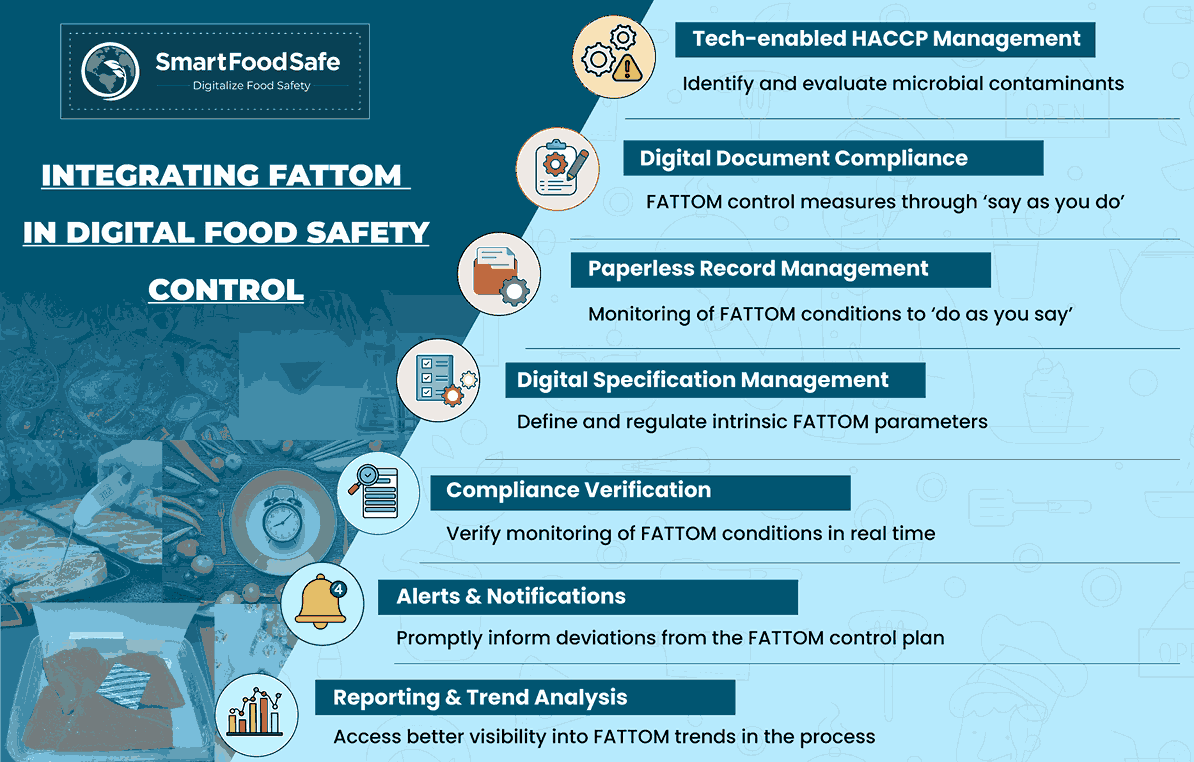
As the integration of advanced technologies has led to the evolution of innovative approaches in food safety management, Smart Food Safe continuously aspires to stay at the forefront by leveraging digital modules capable of keeping FATTOM components in check.
Understanding and controlling FATTOM factors can help prevent the growth of harmful bacteria in food. Practicing proper hygiene, using safe storage methods, cooking food to appropriate temperatures, and minimizing time in the danger zone are all strategies derived from the FATTOM concept.

 French
 Spanish
 Portuguese