


 English
▾
English
▾
English
▾
English
▾
“The future starts today, not tomorrow.” — Pope John Paul II. This is a concept that holds immense power in the realm of the future of food safety, especially with the global population set to reach9.7 billion by 2050. It brings heightened pressure on ensuring safer, sustainably produced, more affordable, and healthier diets for all, accompanied by the equitable improvement of economic outcomes and livelihoods.
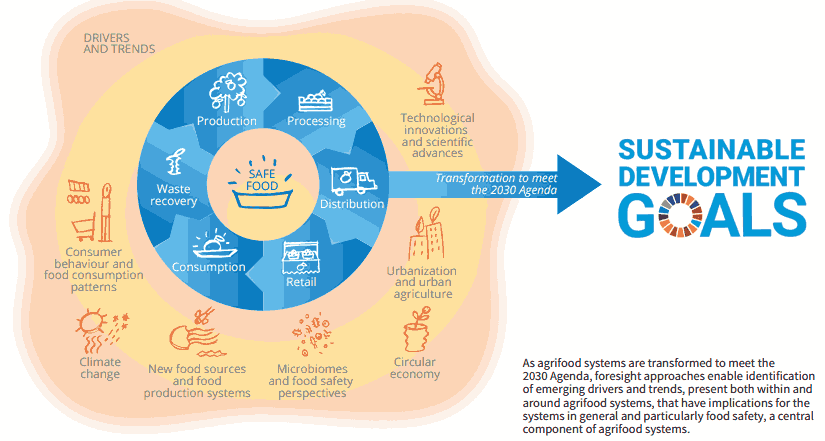
The UN 2030 Agenda for Sustainable Development emphasizes the ongoing transformation to build a strong agrifood system encompassing the different dynamic and interlinked stages of agricultural production, processing, distribution, up to the consumption of food, which further involves value chains, multiple stakeholders, and their interactions. Food safety evidently takes center stage in this system and plays an important role in preparing to navigate the potential threats, disruptions, and challenges that may arise.
Reference: https://www.qassurance.com/the-future-of-food-safety-a-foresight-report-fao/
The Food and Agriculture Organization of the United Nations released the publication ‘Thinking about the future of food safety: A foresight report’ delving into the FAO food safety foresight program. It provides an overview of the major relevant global drivers and trends, their food safety implications, and how to look forward amidst them. Let us have a brief look at what the report talks about and introspect what it would mean for the food supply chain partners.
Foresight can be defined as the “act of inventing, examining, evaluating, and proposing possible, probable, and preferable futures.” It also provides a means of looking at concerns holistically, from a multisectoral point of view, which is inherent in a food system’s way of thinking.
The concept of foresight involves recognizing that early signs of probable future changes exist in the present. Monitoring these signs helps prepare for upcoming variabilities by influencing them in the current times and shaping them to evade undesirable consequences. Factors within and outside agrifood systems can affect food safety, so early identification through foresight is critical to shift from reacting to anticipating issues.
To construct agrifood systems that remain robust, sustainable, and equitable in the face of economic, social, and environmental challenges while meeting the needs of the rising world population, tools such as foresight should be undertaken. These would comprise forward-looking approaches required to identify, evaluate, and steer the major global drivers, related patterns, and other problems impacting agrifood systems.
Foresight is not a specific, singular technique but a comprehensive set of different approaches that generally focus on two mainstream thematic outcomes: understanding trends and uncertainties and guiding decision-making toward desired goals. These methods can be broadly categorized as qualitative, quantitative, and semi-quantitative.
The program aims to help policymakers and private-sector operators address issues regarding the food sector that will, or could, emerge in the medium-to-long term. It simply readies the food industry for the opportunities and bottlenecks on the horizon, beginning with gathering information through horizon scanning and scenario building, analyzing it, using the results for proactive decision-making, and setting up appropriate strategies.
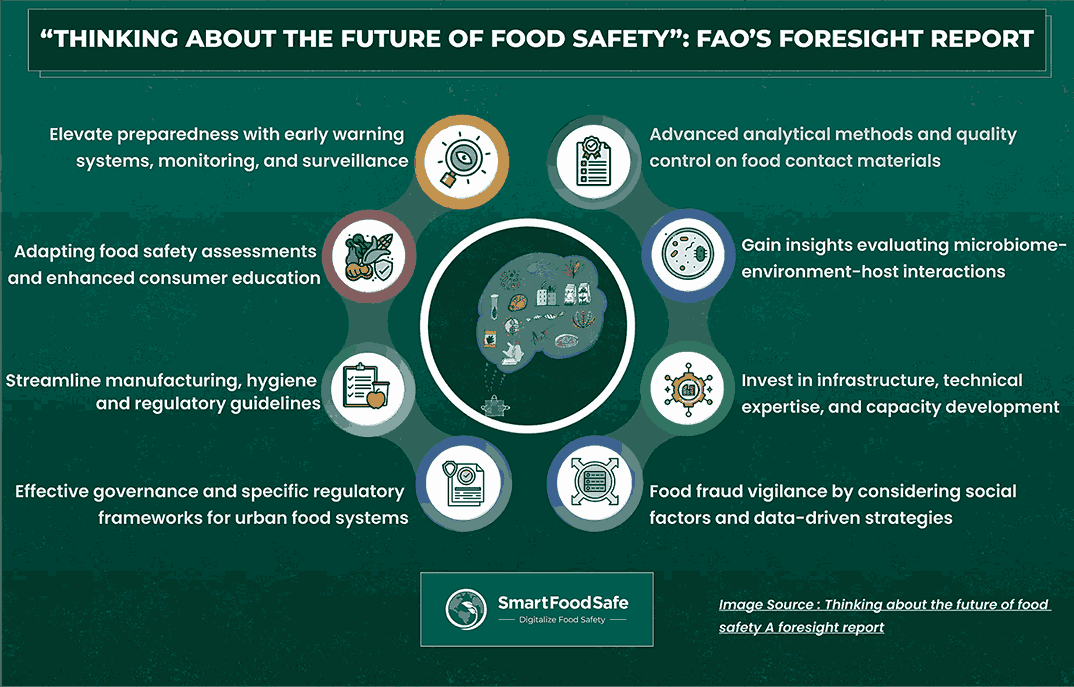
The effects of climate change, such as rising temperatures, shifting precipitation patterns, and more frequent extreme events, disrupt our ability to produce sufficient nutritious food for the growing global population. The diverse consequences of climate change on different food safety hazards, including both biological and chemical aspects, were explored. It can further worsen the situation by creating conditions that make foodborne hazards more likely to emerge and spread.
Hence, it is of utmost importance that food supply chains and regulatory bodies elevate their readiness to respond effectively to the climate change influences on food safety. Vital elements for preventing and managing foodborne outbreaks, particularly in climate-sensitive regions, include the establishment of early warning systems and the implementation of monitoring and surveillance techniques. Enhancing preparedness to tackle the influence of climate change on food safety not only supports food security but also contributes to the resilience of agricultural and food systems.
In today’s context, changes in consumer behavior are being affected by a wide range of factors, including climate change, an augmented focus on health, especially post-pandemic, the environmental impact of food production, increasing incomes, and various other considerations. These drive transformations in how people purchase and consume food, which may also introduce associated food safety concerns that require adequate assessment.
Food safety risk assessments must be adapted to evolving consumer preferences and demands to guarantee consumer protection. Online resources can serve as valuable instruments for engaging and educating consumers about food safety. In contrast, technological advancements are invaluable to staying in the loop with the latest developments in the food industry, such as new allergens and contaminants in novel food sources, setting suitable standards, and establishing risk management systems.
To achieve better health of the environment and the nutritional value of food, new food sources and ways to produce food are being brought forth, which accompanies certain food safety implications that need to be kept in check.
The global interest in farming edible insects, seaweed, and jellyfish is growing. As these new food sources are entering new markets, it is paramount to conduct thorough food safety assessments to establish proper hygiene, manufacturing procedures, and regulatory guidelines to ensure safety. As consumer diets are slowly shifting to include fewer animal-based food products, plant-based alternatives are gaining popularity, which have their unique food safety attributes. Cell-based food production is growing and has begun to be commercialized in some regions, necessitating proper assessment of food safety risks.
In the context of escalating urbanization and concerns about global food security, urban agriculture is gaining attention. These are agricultural activities carried out within urban areas (intra-urban agriculture), ranging from backyard gardens and community farms to innovative indoor vertical farming methods.
The report highlights essential food safety considerations related to urban agriculture and focuses on the necessity for effective governance and specific regulatory frameworks for urban food systems to ensure food safety. Some food safety challenges that need to be considered are soils, chemical hazards, water sources, air pollution, and animal husbandry.
Unlike a linear approach, the circular economy adopts a systems-based perspective that involves activities and processes aimed at sustainably managing materials within a closed-loop system. It seeks to disconnect plastics from fossil fuel sources, promote sustainable plastic production, repurpose plastic waste, and manage plastic pollution. Such policies have far-reaching impacts on food, health, food safety, the environment, food security, and the economy. Implementing a circular economy for plastics faces multiple barriers, including financial, logistical, lack of technical knowledge and skills, and technological gaps.
International harmonization of methods to assess the fate and physiological effects of chemicals from plastic packaging in contact with food is necessary. Advancements in analytical methods and quality control can help ensure the safety of recycled plastics for their intended use. To boost the safety of food contact materials within the context of a circular economy, collaboration among relevant experts and stakeholders along the supply chain is pivotal.
Microbiomes are a complex and dynamic network of microorganisms (bacteria, viruses, fungi, archaea) that adapt and live in a functional relationship with their specific habitats. Microbiomes within agrifood systems and throughout the food supply chain are interconnected and can influence each other.
The human gut microbiome is regularly exposed to microorganisms and substances found in the diet. Food additives, residues from veterinary drugs, and environmental contaminants that can alter the gut microbiome and affect the host’s health are now increasingly considered in food safety risk assessments. Additionally, there are specific concerns related to the transmission of antimicrobial resistance (AMR) from food-related organisms to the gut microbiome and the potential rise in AMR due to exposure to antimicrobials or low-level veterinary residues.
The all-around understanding of how microbiome-environment-host interactions affect human exposure to different types of biotic or abiotic factors is required, creating a new avenue to grasp health risks and hazards better, paving the way for more in-depth microbiological and chemical assessments. The insights gained from the evaluation of microbiomes will guide decisions on whether and how to modify chemical risk assessment and regulatory science processes.
Technological advancements have significantly advanced the capacity to identify contaminants in food, aid in outbreak investigations, enhance predictive analytics for risk identification and improve food supply traceability. The food industry is rapidly evolving, incorporating innovations in food packaging, emerging technologies like nanotechnology, and novel food production methods like 3D printing. This would mean carefully evaluating their benefits and potential threats to food safety.
The application of automation, Artificial Intelligence (AI), big data, and Blockchain technology holds promise for bolstering food safety management within the changing landscape of agrifood systems. However, it also raises concerns related to equitable access, adoption, and data privacy. Moreover, scientific progress is set to revolutionize food safety risk assessments, making it imperative for the global community to stay attuned to these advancements, as they have substantial implications for food safety and international trade.
Though technological inventions offer faster, more cost-effective international trade with improved food safety and reduced fraud risks, they also present challenges, and therefore, standardization, best practices, reliable reference databases, and transparent data sharing are indispensable for the successful implementation of emerging technologies.
The rapid advancement of technology often surpasses regulatory development, raising concerns about data governance, privacy, and transparency. To address problems in data governance, transparency, and uneven distribution of cutting-edge technologies, the international community must invest in infrastructure, technical expertise, and capacity development.
Food fraud is a multifaceted hurdle that often triggers strong consumer reactions and may pose risks to food safety. The growing incidents of food fraud by those exploiting the complexity of agrifood systems usher the foresight brief to refocus the conversation on the importance of amplified awareness and the establishment of trust within food control systems.
It is pertinent for food supply chain stakeholders to acknowledge that adverse situations due to food fraud can occur and, hence, must keep their food systems alert and vigilant to combat them. Relying solely on data and data-based techniques may not provide a complete solution to food fraud, and therefore, it is recommended to consider social factors as well. Rather than reacting hastily to every food fraud scandal, it is suggested that we analyze how national and regional approaches can be developed by combining appropriate regulatory strategies.
Smart Food Safe comes forward as a smart investment in technology for safer food through a well-designed suite of digital modules for Food Safety, Quality, Regulatory, and Traceability management with farm-to-fork applications. These tech-enabled solutions contribute to facilitating a better future for food safety by equipping food enterprises to overcome challenges in global food safety drivers and trends, as recognized in FAO’s foresight report.
We enable food industries to exercise end-to-end traceability and optimized control throughout the food supply chain by leveraging capabilities for real-time monitoring of food production, processing, and distribution, ensuring that food safety standards are consistently met at every stage. These further aid in detecting and mitigating food safety risks, preventing foodborne outbreaks, reducing product recalls, and reinforcing consumer trust in the safety and quality of the food they consume, thus fostering a more resilient and transparent food safety ecosystem.

 French
 Spanish
 Portuguese