


 English
▾
English
▾
English
▾
English
▾
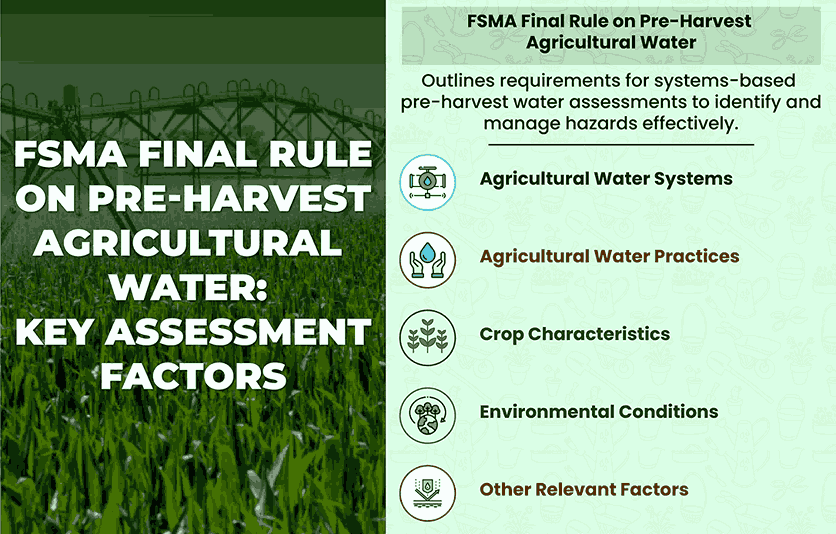
On May 6, 2024, the FDA published a final rule that revises the pre-harvest agricultural water provisions for covered produce (other than sprouts) under Subpart E of the FSMA Produce Safety Rule, as part of the Food Safety Modernization Act (FSMA), representing a landmark reform of food safety laws, aiming to ensure the U.S. food supply is safe by shifting the focus from responding to contamination to preventing it.
The FSMA Final Rule on Pre-Harvest Agricultural Water rule replaces the previous microbial quality criteria and testing requirements with a systems-based approach for pre-harvest agricultural water assessments, designed to identify hazards and manage risks effectively. Let us have a look at the key aspects of this rule, including the assessment factors, corrective and mitigation measures, reassessment requirements, exemptions, and compliance dates.

The final rule sets three compliance dates based on the size of the farm:
The cornerstone of the final rule is the requirement for covered farms to conduct pre-harvest agricultural water assessments. These assessments are intended to identify conditions that are reasonably likely to introduce known or foreseeable hazards into or onto produce or food contact surfaces. Based on the outcomes of these assessments, farms must make informed decisions about implementing corrective or mitigation measures to minimize risks.
The rule outlines several factors that must be evaluated during the assessments:
Upon completing the assessments, covered farms must document their findings and determine the necessity of corrective or mitigation measures. If the agricultural water is deemed unsafe or of inadequate sanitary quality, its use must be discontinued immediately, and corrective actions taken before resuming use. If hazards related to animal activity, BSAAOs, or human waste are identified, mitigation measures must be implemented promptly, within the same growing season. For other hazards, measures must be implemented as soon as practicable, but no later than the following year.
The rule specifies various corrective and mitigation measures that farms can adopt based on assessment outcomes:
Corrective Measures: These include re-inspecting the affected water system, making necessary changes, or treating the water according to Produce Safety Rule standards.
Mitigation Measures: These can involve repairing water systems, increasing the interval between water application and harvest, changing water application methods, and treating water according to PSR standards.
Farms must conduct annual pre-harvest agricultural water assessments. Reassessments are required if there are significant changes in water systems, practices, crop characteristics, environmental conditions, or other relevant factors that may introduce hazards. Written records of assessments, including evaluated factors and outcomes, must be maintained.
Certain farms are exempt from conducting assessments if they meet specific conditions, such as using water that meets harvest and post-harvest requirements, receiving water from a compliant public system, or treating water according to Produce Safety Rule standards.
The revised rule reflects recent scientific advancements, findings from outbreak investigations, and stakeholder feedback, aiming to enhance public health protections while being feasible for diverse agricultural water systems and practices. By focusing on hazard identification and risk management, the rule encourages proactive measures to prevent contamination, reducing the incidence of foodborne illnesses.
Science-Based Approach – The transition from prescriptive microbial quality criteria to a systems-based assessment approach aligns with contemporary scientific understanding. It acknowledges the complexity and variability of agricultural water systems and the need for tailored, farm-specific risk management strategies. This flexibility allows for continuous improvement and adaptation to new scientific findings and technological advancements.
Practical Implementation – The rule is designed to be practical and feasible for farms of varying sizes and practices. By allowing for different corrective and mitigation measures and providing exemptions under certain conditions, the FDA ensures that compliance is achievable without imposing undue burdens on producers. The staggered compliance dates further support this goal, giving smaller farms additional time to adapt to the new requirements.
Enhancing Traceability and Accountability – The requirement for written records of assessments and outcomes enhances traceability and accountability. These records provide a documented history of risk management decisions, facilitating audits and inspections. They also serve as a valuable resource for continuous improvement, allowing farms to track the effectiveness of implemented measures and make data-driven adjustments.
Addressing Diverse Agricultural Environments – The rule’s consideration of various factors, including environmental conditions and crop characteristics, ensures that the assessments are comprehensive and relevant to diverse agricultural environments. This holistic approach recognizes that different crops and regions face unique challenges and risks, requiring tailored solutions.
While the final rule represents a significant advancement in agricultural water safety, its implementation may present challenges for some farms. These challenges include the need for technical expertise to conduct assessments, the costs associated with corrective and mitigation measures, and the administrative burden of maintaining detailed records.
However, the rule also presents opportunities for farms to enhance their operations and reputation. By proactively managing risks and demonstrating compliance with rigorous safety standards, farms can build consumer trust and gain a competitive advantage in the marketplace. Additionally, the emphasis on science-based decision-making and continuous improvement aligns with broader industry trends towards sustainability and innovation.
The FSMA final rule on pre-harvest agricultural water marks a pivotal step in advancing food safety and public health protections. By requiring systems-based assessments and tailored risk management strategies, the rule addresses the complexities of agricultural water systems and the diverse conditions under which produce is grown. While implementation may pose challenges, the rule’s flexibility and practicality ensure that farms can achieve compliance without compromising their operations. Ultimately, the rule fosters a proactive, science-based approach to food safety, benefiting consumers, producers, and the agricultural industry as a whole.
Tech-assisted farm management solutions can play a critical role in helping farms comply with the new FSMA pre-harvest agricultural water requirements. Tools like Smart Food Safe’s Smart Farm are instrumental in this endeavor, offering specialized digital solutions that streamline and enhance agricultural practices.
Smart Farm digitalizes crop production activities, ensuring real-time traceability and compliance with Good Agricultural Practices (GAP) requirements. This farm management tool facilitates real-time visualization of farm activities such as agricultural water management procedures, customized crop schedules, and flexible data capture, thereby enhancing transparency across the supply chain. The platform provides a portal for agronomists and growers to improve communication and task management, making it easier to meet regulatory requirements while optimizing farm operations.

 French
 Spanish
 Portuguese