


 English
▾
English
▾
English
▾
English
▾
Embarking on a journey of document management requirements, it’s paramount to adhere to the timeless principle: ‘Do What You Say & Say What You Do,’ ensuring seamless alignment between intention and execution.
In the world of food safety management, written down proof of procedures is a critical element in demonstrating compliance as ensuring adherence to food safety regulations hinges greatly on maintaining meticulous and accurate food safety documentation. This is where the importance of a document management system becomes evident.
A document management system is like a digital filing cabinet for organizing, storing, and managing documents. Imagine a computer’s file system, but more sophisticated and tailored for handling a large number of documents. It helps businesses and individuals keep track of all their digital files in a systematic and accessible manner.
With a document management system, you can store various types of documents, such as text files, spreadsheets, presentations, images, and more, all in one central location. It often comes with features like version control, access control, and workflow automation, which make it easier to collaborate with others and ensure that everyone is working with the most up-to-date information.
Instead of rummaging through piles of papers or folders on your computer, a document management system lets you simplify document handling, improve productivity, reduce the risk of losing important information, and quickly search for and retrieve the necessary documents. Here’s what you can expect from a typical document management system:
Enhanced Organization: Document management systems provide centralized and intuitive organization, simplifying document categorization, location, and retrieval.
Improved Productivity: These systems enhance productivity by streamlining access to documents, reducing time spent searching, and minimizing frustration.
Expedited Search & Retrieval: Powerful search capabilities enable quick retrieval of documents based on keywords, tags, or metadata, saving time and effort.
Collaborative Actions: Centralized access facilitates seamless collaboration among multiple users regardless of physical location, overcoming challenges of scattered documents in manual systems.
Compliance and Records Management: These systems assist in adhering to industry regulations, offering features like records retention schedules and compliance reporting.
Security Measures: Robust security features such as access controls and encryption ensure compliance and protect sensitive information from unauthorized access or tampering.
Integrating a document management system into a food safety management system ensures efficient handling of critical documents such as Standard Operating Procedures (SOPs), Hazard Analysis and Critical Control Points (HACCP) plans, and regulatory compliance records. By centralizing document storage, retrieval, and version control, organizations can streamline compliance audits, reduce errors, and enhance traceability, ultimately contributing to maintaining and improving food safety standards.
This is a multifaceted process that requires careful consideration of system requirements, system compatibility, workflow alignment, data synchronization, employee training, and continuous improvement efforts.
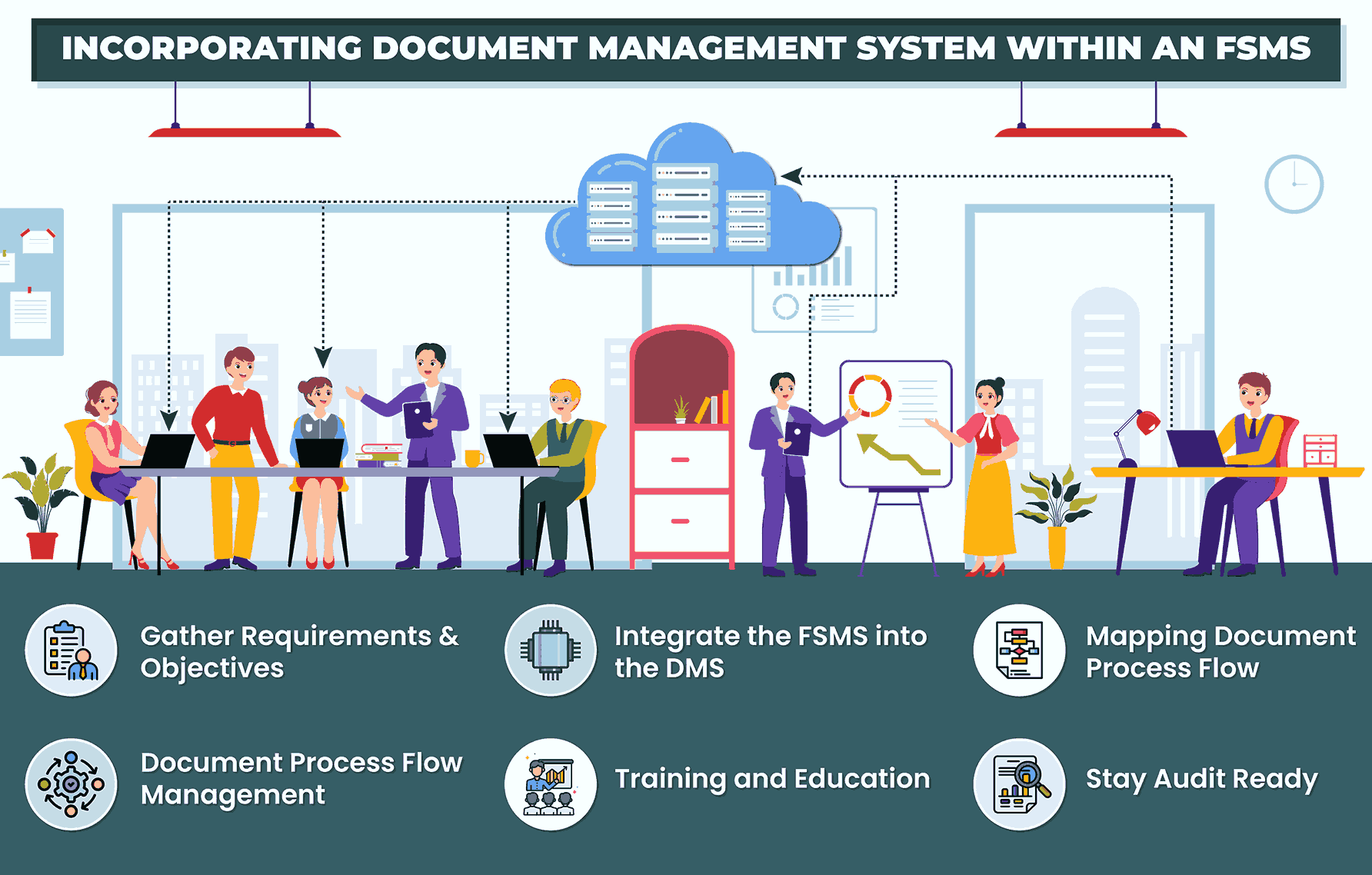
1. Gather Requirements and Objectives: Understand the specific needs and goals of FSMS and the stakeholders through comprehensive stakeholder consultations and needs assessments, to define how they can be integrated into the DMS and establish alignment between the two systems.
2. Integrate the FSMS into the DMS: Develop an integration strategy that enables bidirectional data flow between the FSMS and DMS platforms, ensuring that critical food safety documents are easily accessible within the document repository while maintaining data integrity and security protocols.
3. Mapping Document Process Flow: Analyze the current document workflow within the FSMS and DMS to identify redundancies, gaps, and areas for improvement. Create a detailed map outlining the lifecycle of food safety documents from creation to archival, highlighting key touchpoints where integration between the systems is crucial.
4. Document Process Flow Management: Implement standardized procedures and workflows within the DMS to streamline the management of food safety documents, including document creation, review, approval, distribution, and revision control.
5. Training and Education: Provide thorough training programs and cultivate a culture of continuous learning and improvement to ensure that all stakeholders are proficient in utilizing the integrated systems effectively.
6. Stay Audit Ready: Implement robust audit trails and reporting mechanisms within the integrated FSMS-DMS framework to facilitate efficient audit processes and ensure compliance with food safety regulations. Regularly conduct internal audits and reviews to identify and address any discrepancies or non-conformities, maintaining readiness for external audits and inspections.
By seamlessly linking these systems, organizations can enhance their ability to manage food safety documentation, mitigate risks, ensure regulatory compliance, and ultimately protect consumer health and safety.
An integrated food safety document management system presents certain anticipated outcomes and hurdles associated with implementing the same. Let’s delve into them.
Expected Outcome
One of the primary outcomes of an integrated food safety document management system is the clarity and comprehension of relevant standards and codes. This clarity is required to enable organizations to coordinate their processes and procedures accordingly.
Bottleneck Faced
However, a notable bottleneck in this aspect may arise from the complexity of deciphering and interpreting the standards. Navigating through intricate regulatory language and ensuring all aspects are adequately addressed within the food safety document management system can be challenging.
Solution
Adopting an advanced document management mechanism to centralize complex food safety documentation requirements and employ appropriate categorization functionalities can streamline the organization of standards, ensuring that all pertinent aspects are properly addressed within the food safety document management system. It also highlights the importance of employing skilled personnel or utilizing specialized software solutions to streamline the interpretation and implementation process.
Expected Outcome
Another significant expectation of an integrated food safety document management system is the ability to meet compliance requirements competently. This proactive approach not only minimizes the risk of non-compliance but also enhances food safety management efficacy and consumer trust.
Bottleneck Faced
Staying abreast of constantly evolving regulations and adjusting the food safety document management system consequently poses a continuous challenge for organizations, requiring dedicated monitoring and updating processes.
Solution
By fusing regulatory tracking and updating into the document management process, organizations can receive real-time alerts and notifications regarding changes in regulations relevant to their procedures. This brings about keen monitoring of operations, ensuring that the food safety document management system remains compliant with the latest standards, thus minimizing the risk of non-compliance.
Expected Outcome
The dynamic nature of food safety regulations necessitates continuous adaptation within an integrated food safety document management system. One of the key outcomes in this regard is the agility to respond promptly to changes in codes, standards, and regulatory requirements.
Bottleneck Faced
The challenge lies in managing these changes efficiently without disrupting day-to-day operations. Implementing revisions to documentation, training staff on updated protocols, and validating compliance with new standards can strain resources and cause temporary disruptions.
Solution
Organizations must strike a balance between agility and stability within their food safety document management system to mitigate bottlenecks associated with change management. Incorporate version control systems into document management solutions to track revisions, automatically update documentation, and facilitate seamless collaboration among stakeholders, equipping organizations to ascertain compliance with evolving regulations while minimizing interruptions to daily operations.
Expected Outcome
By establishing clear protocols for document creation, review, approval, storage, and retrieval, , organizations can enhance transparency, accessibility, and traceability of information, improving operational efficiency and risk management.
Bottleneck Faced
However, developing and maintaining such a process requires careful planning and ongoing commitment. Bottlenecks may arise from inadequate training, inconsistent procedures, or technological limitations.
Solution
Investing in employee training, leveraging automation tools, and conducting regular audits are essential strategies to overcome these challenges and ensure the effectiveness of the documentation management process. Training should focus on educating personnel on standardized procedures for food safety document creation, review, approval, and retrieval. Investing in modern document management software equipped with intuitive interfaces, and search features can augment food safety documentation processes, thereby overcoming technological limitations and promoting consistency across the organization.
In an era of tightening regulatory scrutiny and consumer awareness, the adoption of document management software is not merely a matter of convenience but a strategic imperative for food businesses. By streamlining document handling processes, enhancing collaboration, automating workflows, and bolstering security, it serves as a linchpin in ensuring compliance with food safety regulations.
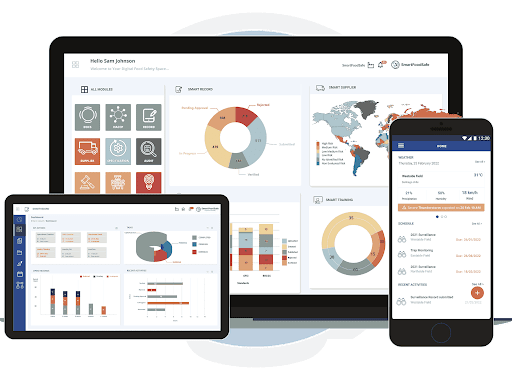
Enhance your organization’s document compliance management efficiency with Smart Food Safe’s Smart Docs, designed to expedite the entire document lifecycle while ensuring adherence to global quality and food safety standards such as SQF, BRCGS, IFS, and many more.
We make it possible by presenting an integrated food safety document management system, incorporating global regulatory standards to enable easy access to standard templates and migration to the latest versions, facilitating smooth compliance with 21 CFR Part 11 Document Compliance while staying audit-ready.
Smart Docs revolutionized document management processes with several key features. Firstly, it offers streamlined document control through an intuitive interface and seamless integration with cloud storage, simplifying document creation, editing, and organization. Thirdly, Smart Docs enables centralized document management by consolidating documents into a secure repository, customizable folder structures, and search filters for easy retrieval. Moreover, it includes task scheduling to manage compliance deadlines effectively, automated workflow processes for increased productivity, traceable audit trails for accountability, and smart linking capabilities to connect relevant policies and records across modules for regulatory compliance and due diligence.
 French
 Spanish
 Portuguese