


 English
▾
English
▾
English
▾
English
▾

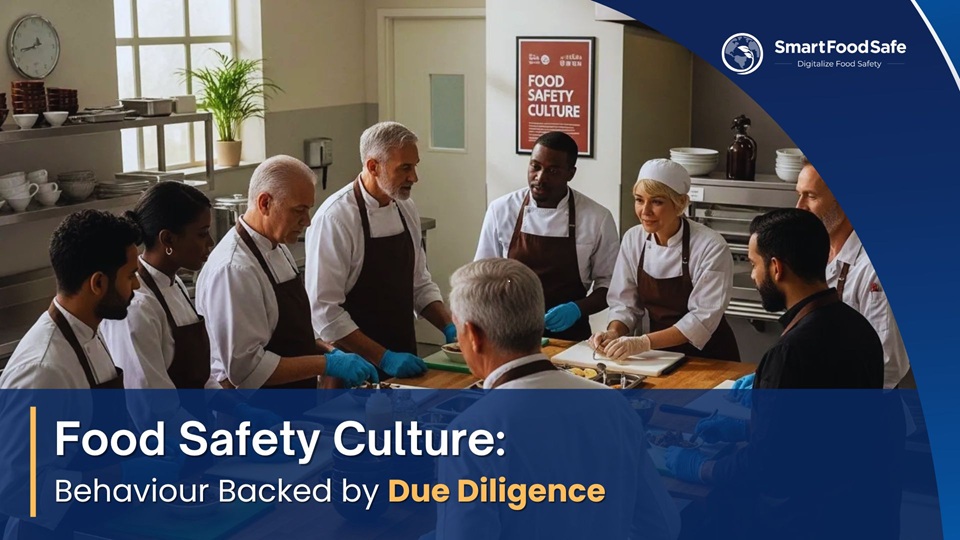
No food safety system is stronger than the people who bring it to life. Even the most advanced hazard controls and carefully written procedures cannot prevent every failure. Outbreaks rarely begin with missing policies; they begin in everyday moments of pressure, distraction, assumption, or routine shortcuts.
Building on that perspective, emerging research no longer treats food safety culture as a soft add-on to management systems. Instead, it is increasingly understood as a behavioural phenomenon — one that actively interacts with how procedures are interpreted, how strictly critical limits are respected, and how quickly teams respond when something feels off. Management systems may define what should happen, but culture determines what actually happens on the floor.
This article explores why food safety culture must be understood as human behaviour in action, how due diligence brings accountability and proof of safe behaviour, and why integrating both into daily processes is essential for food safety excellence and organisational resilience.
Culture is shaped by human psychology, and food safety culture is a deeply ingrained organisational construct made up of shared mindset, routine behaviours, assumptions, and consistent actions that influence how employees think and act about food safety every day.
When we describe food safety culture as a behavioural phenomenon, we mean something very practical: it is visible in what people do, not in what they claim to value.
It appears in small, ordinary decisions:
These moments may seem minor, but they are where food safety culture truly exists.
If food safety culture is about everyday behaviour, due diligence is the evidence that those behaviours are consistent and controlled. More than documentation for audits, it is the structured proof that risks were identified, preventive controls were implemented, performance was monitored, and corrective actions were taken before harm reached consumers.
In practical terms, due diligence shows that an organization acted responsibly and reasonably under real-world conditions. It connects intention with verification and transforms daily actions into defensible records.
Why does due diligence matter?
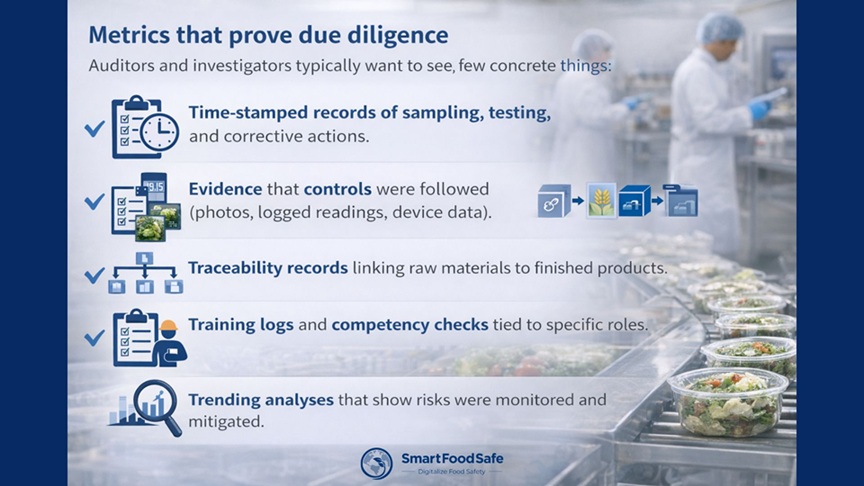
Food safety culture and due diligence cannot operate in isolation. Policies may define expectations, and records may prove compliance, but it is human behaviour that connects the two. If safe actions are difficult, unclear, or invisible, even the best-designed systems will struggle to hold.
Behavioral science consistently shows that people respond to clarity and structure. When the right actions are simple, supported, and reinforced in real time, compliance stops feeling forced and begins to feel routine. That is where culture and due diligence become integrated as one continuous practice.
To meaningfully connect behaviour with due diligence, organizations should focus on:
These steps align with behavioural research showing that evolving food safety culture requires multi-layered interventions over time and not one-time checklist enforcement.
Pinpoint the handful of daily actions that most directly influence food safety outcomes such as swabbing high-risk areas, maintaining hand hygiene after breaks, or correctly labelling quarantined products.
Break complex activities into 1–3 step actions. Frontline staff should be able to do them without referring to long manuals.
Move from paper-based records to structured digital forms that capture timestamps, required fields, and traceable data automatically.
Ensure that deviations trigger timely alerts and escalation pathways so corrective actions are taken before issues compound.
Monitor process-based KPIs such as completion rates of critical checks, response time to corrective actions, frequency of deviations, and overall audit readiness.
Treat deviations as opportunities to strengthen systems and understanding, rather than as isolated failures.
Communicate when issues are resolved and highlight how specific actions prevented larger risks.
When these practices are embedded consistently, due diligence becomes the natural byproduct of structured behaviour. Over time, this steady reinforcement transforms food safety from a compliance requirement into a disciplined, dependable way of operating.
As organizations strengthen structure, clarity, and accountability within their daily operations, technology naturally becomes a catalyst for progress. When thoughtfully implemented, it does not create additional pressure or oversight; instead, it reinforces good practices, providing quiet support that makes consistency easier and more sustainable.
When digitisation is practical and purposeful:
Smart Food Safe’s food safety management software supports this shift by bringing consistency and visibility into everyday operations. By organizing workflows, capturing real-time data, and maintaining audit-ready documentation in the background, routine actions become reliable proof of control.
When performance is visible and documentation is seamless, teams no longer prepare separately to demonstrate due diligence, it is already embedded in how they operate. Over time, this steady alignment transforms food safety from a monitored obligation into a dependable standard of work. Structured compliance gradually matures into a resilient food safety culture built on daily, verifiable practice.

 French
 Spanish
 Portuguese