


 English
▾
English
▾
English
▾
English
▾
Food safety is a dynamic and adaptable concept rather than a static notion, which is why food businesses need to continually assess and improve their processes, detect potential risks, and implement preventive measures through approaches such as early warning and response systems (EWarSs).
The Food and Agriculture Orgainization of the United Nations (FAO) disseminates the concept that ‘the prevention, mitigation, and management of food safety incidents globally can be enhanced through more effective early warning systems for food safety.’
The rising globalization of the food supply, coupled with the implementation of new technologies and other dynamic changes in agrifood systems, along with factors like climate change and shifts in dietary patterns calls for heightened attention to food safety hazards that can infiltrate the food chain at any stage. In response, FAO published a technical background report, ‘Early warning tools and sytems for emerging issues in food safety,’ which discusses the crucial role of early warning systems in identifying early signals and emerging food safety risks and providing timely warnings for taking appropriate measures to mitigate potential risks from hazards.
Raising awareness about the utilization of evidence-based innovative digital tools in food safety early warning and creating a food safety management system with an integrated early warning and response system has become the need of the hour for the food sector to stay ahead of food safety risks. Let’s have a brief look at the critical aspects of early warning systems discussed in the report and comprehend what it means for global food industries.
The report talks about recent advancements in early warning systems, signifying a departure from reactive approaches towards more proactive systems. The latter primarily focuses on predicting food safety risks that may arise in the (near) future, in contrast to the former which concentrates solely on existing food safety incidents.
It further explores modern warning systems, fueled by abundant real-time and diverse data, and leveraging advancements in artificial intelligence (AI) and machine learning (ML) techniques, exhibit the capability for food safety early warning and analysis. The report addresses gaps and barriers hindering the adoption of tools for food safety early warning and risk identification. These gaps are identified through literature reviews, surveys, and workshops, covering technical and socioeconomic challenges in the development and utilization of these tools and feasible solutions to overcome them.
The core four objectives of the report are as follows:
a. Enhance awareness and understanding of early warning tools and systems for emerging issues in food safety.
b. Promote exploration of the application of Big Data and AI in food safety early warning systems and emerging risk identification processes.
c. Provide an overview of available food safety early warning tools and consider prospects and innovative solutions for addressing gaps in their implementation in low- and middle-income countries (LMICs).
d. Offer practical examples of open-access tools to support food safety early warning and identification of emerging issues.
In the context of food safety, early warning systems include various tools, technologies, processes, and resources used to monitor, detect, and verify early warning signals, analyze data and information arising from such signals, and disseminate and communicate alerts to stakeholders at appropriate levels to inform risk management actions and decision-making.
Various methods and systems are vital in predicting and detecting potential hazards in food that pose risks to human health. These include Early Warning and Response Systems (EWARS) and foresight, which operate on different time horizons—present, near, or far future. The focus of these methods may be on specific hazards, such as disease-causing bacteria, or health effects following exposure, such as acute or chronic foodborne diseases. Another key approach is retrospective “root cause analysis” (RCA), also known as “environmental assessment,” which traces the causes of a historic incident to identify lessons that can help prevent the incident from reoccurring.
It emphasizes the importance of time in early warning systems, noting that for some food safety risks, the warning time may be very short. To be practical and effective, proactive early warning systems in food safety must consider the need for sufficient advance warning time and the time required to implement preventive actions. The effectiveness of preventive action depends on the type of hazard, associated health risks, and the coordinated efforts of food business operators, competent food safety authorities, and consumers.
It specifically focuses on foresight in the context of food safety. Foresight goes beyond simple risk forecasting; it involves gathering data, exploring future scenarios, and vision-building to provide governments with options for informed decision-making. Foresight supports decision-making by enhancing preparedness, implementing mitigating policies, allocating resources, and developing strategies to address future challenges.
Different methods are employed in foresight, including:
i) Qualitative Methods: Based on subjectivity and creativity, involving the interpretation of data and events through techniques like horizon scanning, expert panels, workshops, conferences, and surveys.
ii) Semi-Quantitative Methods: Apply mathematical principles (e.g., weighing) to expert opinions, allowing for the quantification of subjectivity.
iii) Quantitative Methods: Rely on the measurement and processing of reliable statistical data as inputs for future projections, using techniques like trend extrapolation and benchmarking.
Emerging Data Sources and Infrastructure for Big Data in Food Safety
While conventional data sources include information collected by food inspectors and companies, recent advancements in technology, such as the Internet of Things (IoT) and radiofrequency identification (RFID), offer diverse data streams. These technologies enable the real-time collection of food safety and quality data from the field. Emerging technologies like blockchain enhance data transparency by ensuring immutable storage, enabling efficient tracking and tracing of products to enhance overall food safety.
Diverse sources of data for food safety comprise structured information from traditional monitoring programs, inspection, and control systems, as well as notification systems. With the advent of digitalization, unstructured data such as images, sensors, and text data from sources like satellite images, IoT, and social media are becoming increasingly available.
Moreover, the utilization of additional data beyond traditional food safety sources, incorporating information on climate trends, trade statistics, and demographic statistics, and the integration of these diverse data sets enhances the accuracy of predicting food safety issues by adopting a comprehensive food system approach that considers social, economic, and environmental factors. For instance, a study initiated the development of an early warning system for future food safety risks by detecting anomalies in selected drivers of change and indicators.
Key barriers include a lack of coordination between agencies, inadequate financial, human, and material resources, and issues related to data accessibility, quality, and integration. Technical challenges involve a shortage of applied technologies, limited internet access, and insufficient monitoring of foodborne hazards. Socioeconomic obstacles include a lack of coordination between agencies, limited awareness of available tools, and a need for financial support. Collaboration among researchers, authorities, and policymakers is emphasized as important for effective national and international management of food safety risks.
The report discusses the challenges hindering the widespread adoption of modern tools and technologies for food safety early warning, addressing both technical and socioeconomic aspects. From a technical perspective, the importance of sufficient infrastructure, reliable internet access, and computational capabilities for processing large datasets, especially Big Data, is highlighted. On the socioeconomic front, coordination of food safety activities, partnerships among stakeholders, and capacity development through training are emphasized.
The implementation of AI in various fields has raised ethical and policy challenges, including concerns related to privacy, bias, and human judgment. Explainable AI is suggested to enhance transparency and explicability, while decentralized AI applications using technologies like Blockchain aim to accelerate response time. While not all tools may be applicable to Low- and Middle-Income Countries (LMICs), digitalizing the management of food safety risks in the future is mainstreamed.
Various tools and methods for monitoring the evolution of hazards and strengthening controls, particularly under favorable conditions like open source and open access. The report focuses on three open-access tools – MedISys, MedISys-FF, and SGS DIGICOMPLY, with detailed practical information about these tools, their usage, and functionalities for professionals provided.
Food safety management software can be the one-stop solution for establishing an early warning system by integrating various aspects that contribute to monitoring, identifying, and addressing potential issues in the food safety process. Below are the key features of food safety management software that can equip food enterprises to have in place an efficient early warning system to ensure food safety.
By combining these elements, food safety management software creates a comprehensive early warning system that empowers food manufacturers to pinpoint and handle potential issues swiftly, minimizing the risk of contaminated products reaching consumers and ensuring compliance with regulatory standards.
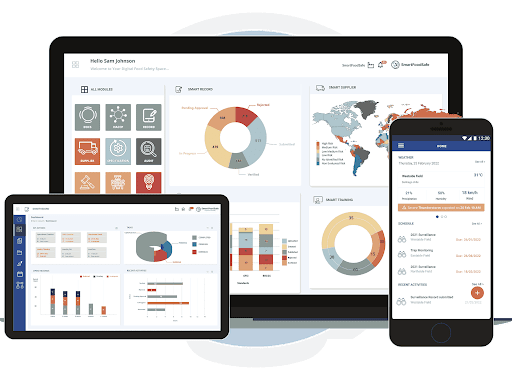
“The timely availability of and accessibility to updated diverse sources and various types of food safety information is critical both for food safety early warning, for getting insights into emerging risks and for supporting the informed and faster risk management decision-making,” stated Eleonora Dupouy, FAO Food Safety Officer in the FAO workshop held on 16th December 2022 about early warning tools and systems. Smart Food Safe strives to enable food industries to be equipped with these capabilities by presenting a consolidated platform featuring a multitude of functionalities to set up an efficient and proactive early warning system as part of their food safety management system, facilitated through the following digital modules:
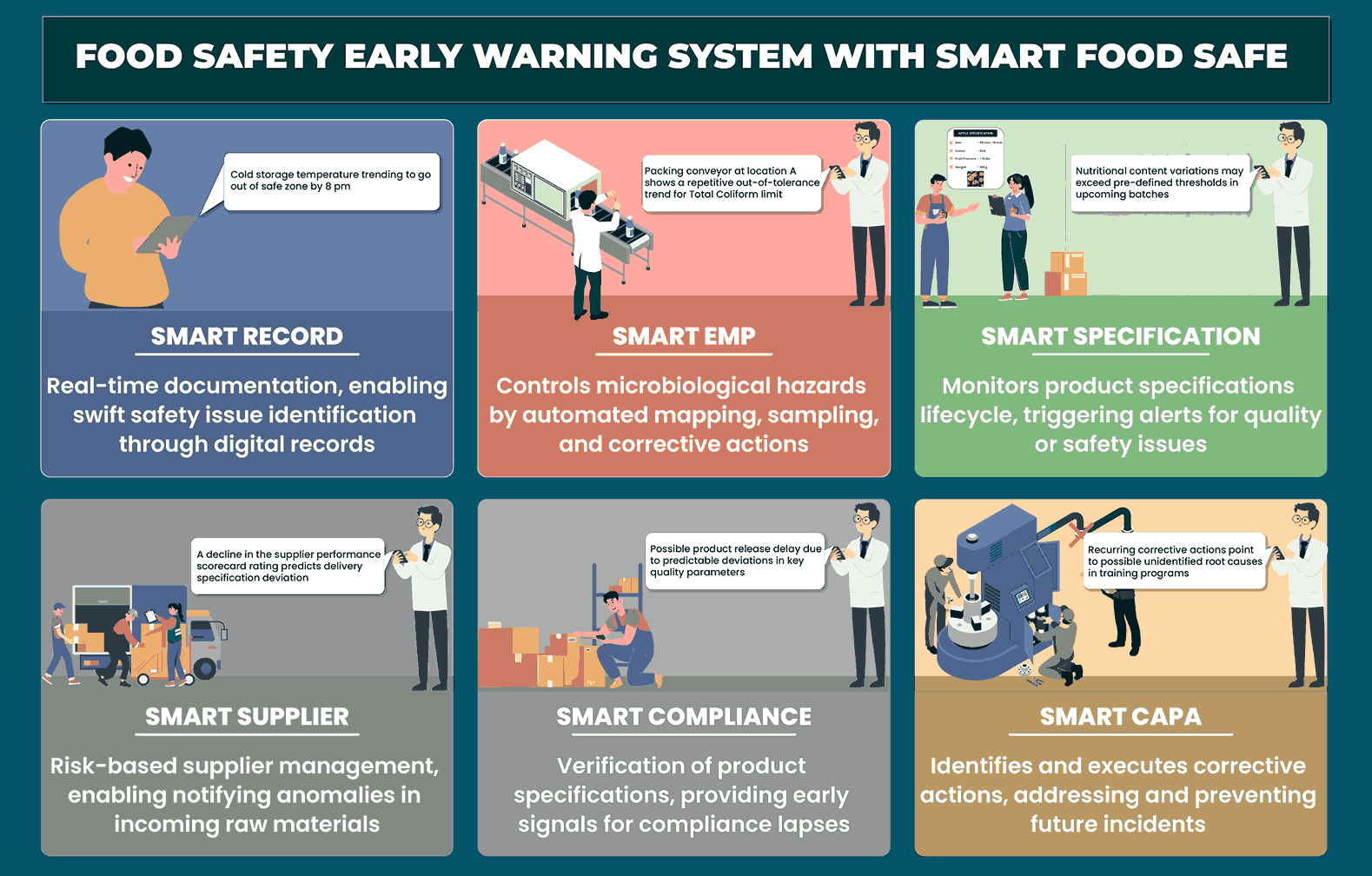
Our records management software streamlines data recording processes, ensuring real-time documentation of critical information, and enabling swift identification of potential safety issues and early intervention with the power of digital records.
Our Environmental Monitoring Program software acts as an early warning system for microbiological hazards by thoroughly monitoring and maintaining the hygienic environment in the food manufacturing facility through automated mapping, scheduling, and pre-defined corrective actions.
Our specification management software can assist in tracking a batch throughout its lifecycle, from raw material sourcing to finished products, triggering alerts for any discrepancies or changes in the defined parameters as an early warning mechanism for potential quality or safety issues.
Our supplier management software enhances supply chain transparency by monitoring and evaluating supplier performance and issuing alerts for any anomalies, thereby establishing an early warning system for potential risks in the incoming raw materials.
Our product compliance management software ensures adherence to regulatory standards and compliance requirements through automated verification of specifications in real-time, offering an early warning mechanism for any potential lapses in compliance that may arise.
Our CAPA management software enables the identification and execution of corrective and preventive actions in response to identified issues, addressing and preventing future incidents, thus forming an integral part of the early warning system.
 French
 Spanish
 Portuguese