


 English
▾
English
▾
English
▾
English
▾
Competent authorities (CAs) in the European Union (EU) countries participated in a revolutionary study exploring the level of application of digital technologies in official food safety control inspections, revealing a remarkable 62.5% of the surveyed respondents reporting that they have already incorporated digital environments to some extent during their food safety inspections.
The assessment involved administering a questionnaire to CAs from 15 EU countries, with a total of 88 national, regional, or local CAs participating in the survey. It brought to light that further possibilities exist for the EU food sector to employ digital technologies as support tools for boosting inspection efficiency and identifying the main barriers that stand in the way of achieving an advanced inspection system.
Digital systems present unprecedented opportunities to modernize official food safety control by offering the advantage of recording and reporting data directly in digital format and enabling process automation through rule-based instructions to simplify the analysis and disclosure of inspection data. Let us have an elaborate look into the study to understand the contemporary approaches for optimized inspection outcomes and how transitioning from paper-based to digital systems positively impacts the consistency of official control measures.
The purpose of the research project funded by the Barcelona Public Health Agency was to investigate the benefits and barriers, and bridge the knowledge gaps associated with adopting digital environments in retail food safety inspections, leveraging vital insights for EU stakeholders.
Following the experience of developing and implementing a digital environment for inspections in Barcelona, Spain, the Barcelona Public Health Agency distributed an initial questionnaire to CAs to gather information. The survey took place online between April and May 2022 and was dispensed to CAs in all 27 EU Member States through the Heads of Food Safety Agencies group. It consisted of 30 questions covering seven topics:
The significant shift of 62.5% towards integrating digital inspection strategies is driven by key internal and external motivations, which include:
Internal Reasons:
External Reasons:
Of the 37.5% of CAs who reported not using a digital environment during inspections, 39.4% equally and totally agreed that the lack of budget and technological constraints were the reasons. Additionally, 33.3% cited a shortage of information technology personnel. Some authorities provided open-ended comments, expressing concerns about the coexistence of different and non-interoperable digital systems in public administration and the lack of Internet connection at food premises.
A digital environment in food safety inspection is seen as the context where digital tools (e.g., apps or programs) and devices (e.g., smartphones or tablets) are used to record, analyze, transmit data or enable communication and collaboration between food business owners and other stakeholders (food safety consultants, consumers, etc.) along the food chain.
It serves to enhance and streamline the process of inspecting and monitoring food safety practices in various food establishments for improved efficiency, accuracy, and transparency, ultimately leading to better food safety standards and the protection of public health. Following are some of the components of a digital environment for food safety inspection:
Inspection data and reports are stored securely in the cloud, making it easily accessible from any authorized device with an internet connection. This centralization of data ensures that all relevant parties have access to the information and can collaborate effectively.
Tech-enabled monitoring devices can be deployed in food processing facilities to monitor various parameters such as temperature, humidity, and cleanliness. These devices can automatically send alerts if any parameter goes out of the acceptable range, enabling proactive action before a safety issue arises.
Automated systems can send notifications and alerts to food establishments about upcoming inspections or reminders for necessary corrective actions. This helps establishments stay compliant and proactively address safety concerns.
Food inspectors can use mobile applications on smartphones or tablets to record inspection data in real-time. These apps can offer pre-defined checklists, digital forms, and the ability to capture photos or videos as evidence during inspections.
The digital environment can utilize data analytics to identify trends, patterns, and potential problem areas. By analyzing large datasets, authorities can make data-driven decisions, allocate resources more effectively, and target inspections where they are needed most.
The digital environment can be integrated with existing regulatory systems, such as health departments and food safety agencies. This integration streamlines communication and ensures that inspection data is seamlessly shared with relevant authorities.
By harnessing the capabilities of digital solutions, food safety authorities and businesses can transform the traditional food inspection paradigm and significantly improve the safety and quality of food products in the global food sector.
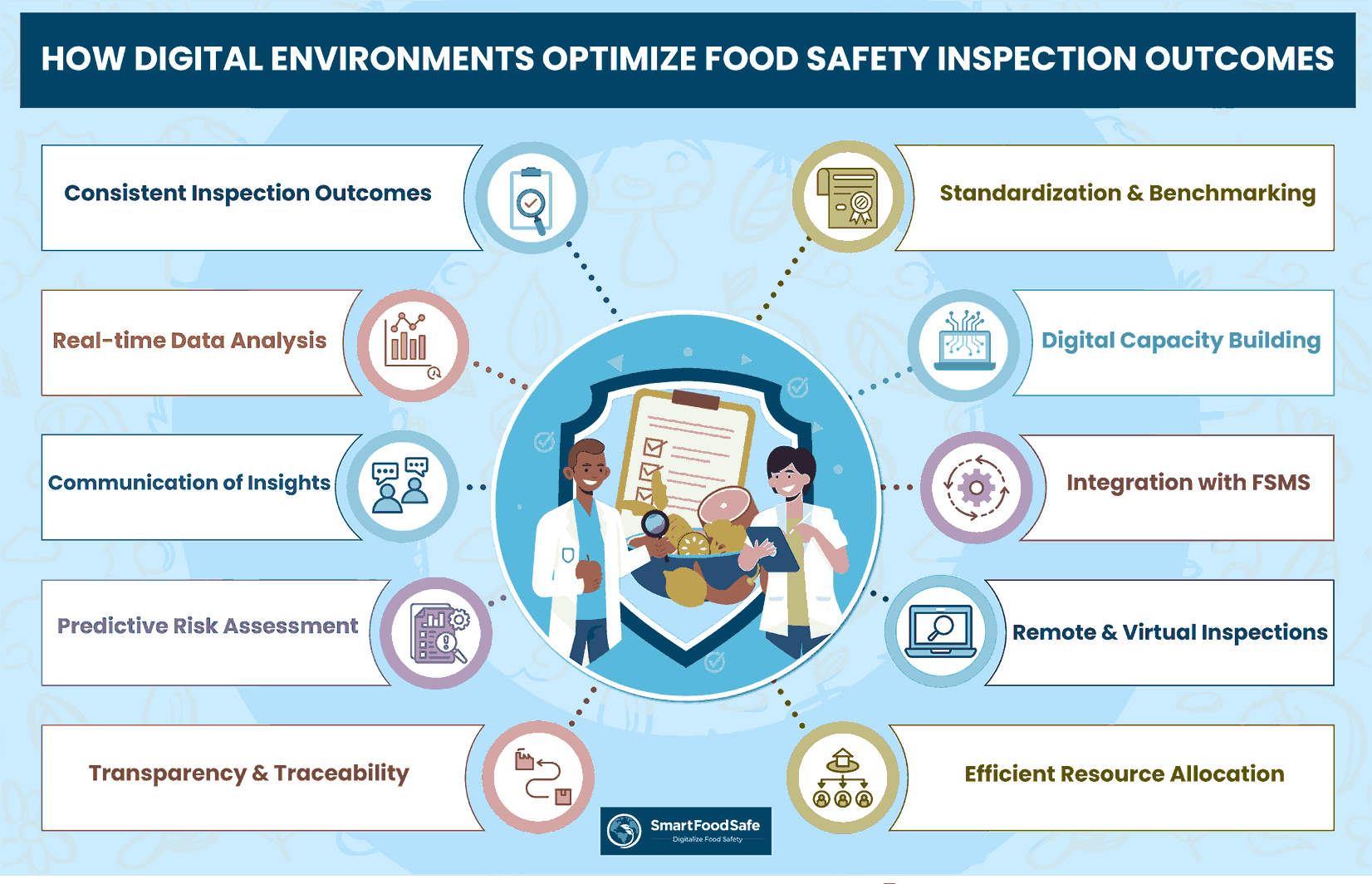
Real-time data collection and analysis are the primary merits of digital tools during inspections. Inspectors can collect data in real time, enabling instant analysis to identify probable food safety risks. This immediate access to data allows for faster decision-making and swift responses to critical issues, reducing the time gap between inspection and action. By serving as repositories of valuable information, best practices, and training materials for food safety inspectors, they can also cultivate continuous learning and capacity building within the food safety workforce.
Traditional paper-based inspection processes can be error-prone and inconsistent due to manual recording and interpretation. However, digitization helps eliminate human errors, ensuring precise and standardized data collection and leading to more reliable and stable inspection results. Remote and virtual inspections are made possible with digital tools, such as remote sensors and cameras. This reduces the need for physical visits in certain cases, saving time and resources while allowing inspections to be conducted in challenging or dangerous situations.
The use of digital platforms also enables predictive analytics for risk assessment. By making use of tech-driven analytics with historical data retention, authorities and food companies can proactively address prevalent food safety risks before they become widespread problems. Efficient resource allocation is achieved through digital systems, where food safety authorities can optimize their resources by focusing inspections on high-risk areas or facilities. This targeted approach ensures that inspections are prioritized where they are most needed, maximizing the impact of limited resources.
Digital environments can be integrated with other food safety management systems, such as Hazard Analysis and Critical Control Points (HACCP) or food traceability systems. This integration streamlines data sharing and establishes a more holistic approach to food safety management. It also brings about the implementation of standardized inspection protocols and benchmarking of food safety practices across different regions and countries, promoting international cooperation in food safety.
In a digital environment, process transparency and traceability are achievable. Inspection results can be transparently shared between authorities, businesses, and consumers, fostering trust and accountability in the food supply chain. Stakeholders can track the history of food products from farm to fork, enhancing overall food safety. The transparency offered by digital systems authorizes consumers to access information about food safety inspections and compliance status. This heightened public awareness can encourage businesses to mainstream food safety and maintain a positive reputation.
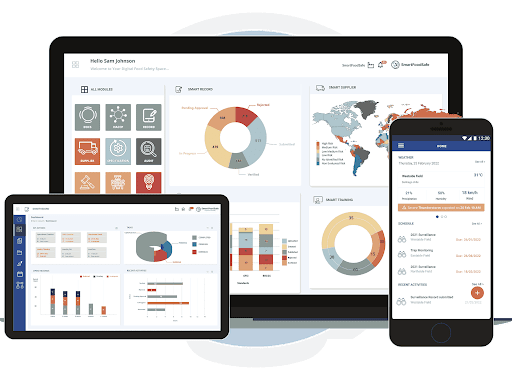
Smart Food Safe is committed to leading the way in guiding food industries toward creating a robust digital environment that enhances the efficiency of food safety inspections. Our tech-enabled and cost-effective software modules are thoughtfully designed to ensure quality, food safety, and regulatory compliance in the food industry. By digitizing risk-based hazard analysis, preventive control planning, root cause analysis, CAPA, audit and recall management, and environmental monitoring, we enable businesses to oversee their inspection activities skillfully.
Our innovative functionalities aid in data analysis, identifying high-risk areas, and pinpointing sources of contamination, empowering inspectors and authorities to allocate resources with competence. With the shift from traditional paper-based methodologies to digital systems on smartphones, tablets, or other mobile devices, Smart Food Safe encourages embracing the digital age of food safety inspections, advocating a safer and more productive food supply chain.
 French
 Spanish
 Portuguese