


 English
▾
English
▾
English
▾
English
▾


We must have heard the name Listeria many times—what comes to mind when we hear Listeria: Deadly, Pathogenic? Indeed, Listeria monocytogenes is a formidable foodborne pathogen, responsible for listeriosis, an illness with a mortality rate of 20-30% in vulnerable populations like pregnant women, newborns, the elderly, and immunocompromised individuals. Often lurking in ready-to-eat (RTE) foods, dairy, and produce, it thrives in cold, moist environments and forms resilient biofilms on processing equipment. While best practices such as Good Manufacturing Practices (GMP), Hazard Analysis and Critical Control Points (HACCP), and routine sanitation have long been the frontline defense, they sometimes fall short against persistent strains. This article delves into innovations, technologies, and advances in scientific research that push beyond these fundamentals, offering strategic, proactive approaches to control Listeria in the food industry.
Listeria monocytogenes is a Gram-positive bacterium notorious for its environmental resilience.The challenge with Listeria lies in its unique survival mechanisms. Unlike many pathogens, it thrives in cold environments, forms resilient biofilms, and can colonize niches within food processing facilities that are difficult to sanitize.
Hence, the problem lies in the gap between theoretical protocols and real-world execution, where detection delays and biofilm persistence create opportunities for Listeria to survive and spread.
Modern Listeria control strategies move beyond the basics by blending science, technology, and culture into a unified approach. One critical advancement lies in early detection. Detection alone, however, isn’t enough. The next step is predictive control. AI-driven environmental monitoring programs can analyze past sampling data, sanitation records, and facility layouts to highlight zones at highest risk.
At the same time, new research is unlocking better biofilm interventions. Standard sanitation often struggles to remove Listeria once it embeds in multispecies biofilms. Innovative solutions from enzymatic cleaners to bacteriophage sprays and dry steam sanitation are showing promise in breaking down these stubborn microbial communities.
Infrastructure design also plays a role. Smarter zoning and hygienic equipment design reduce harborage points in drains, cracks, and floor junctions. Facilities that invest in controlled traffic flows and audit-ready cleaning accessibility significantly strengthen their EMP effectiveness.
Finally, digital transformation ensures consistency. Cloud-based EMP automation tools integrate sampling schedules, corrective actions, and compliance dashboards, removing the chance of human oversight and creating a transparent, traceable food safety record. Paired with a strong culture of accountability, where every employee understands and owns their role in contamination prevention, these modern strategies offer a sustainable path to controlling Listeria.
Therefore, the question every QA/QC leader should be asking is simple: Are we just meeting compliance, or are we truly controlling Listeria at its source? Because in today’s fast-paced food industry, the difference between “good enough” and “advanced” can be the difference between a safe product and a devastating recall.
Moving beyond traditional sanitation and routine monitoring, the food industry is increasingly turning to innovative tools and scientific advances to control Listeria more effectively. These strategies not only detect the pathogen faster but also prevent its persistence in food environments.
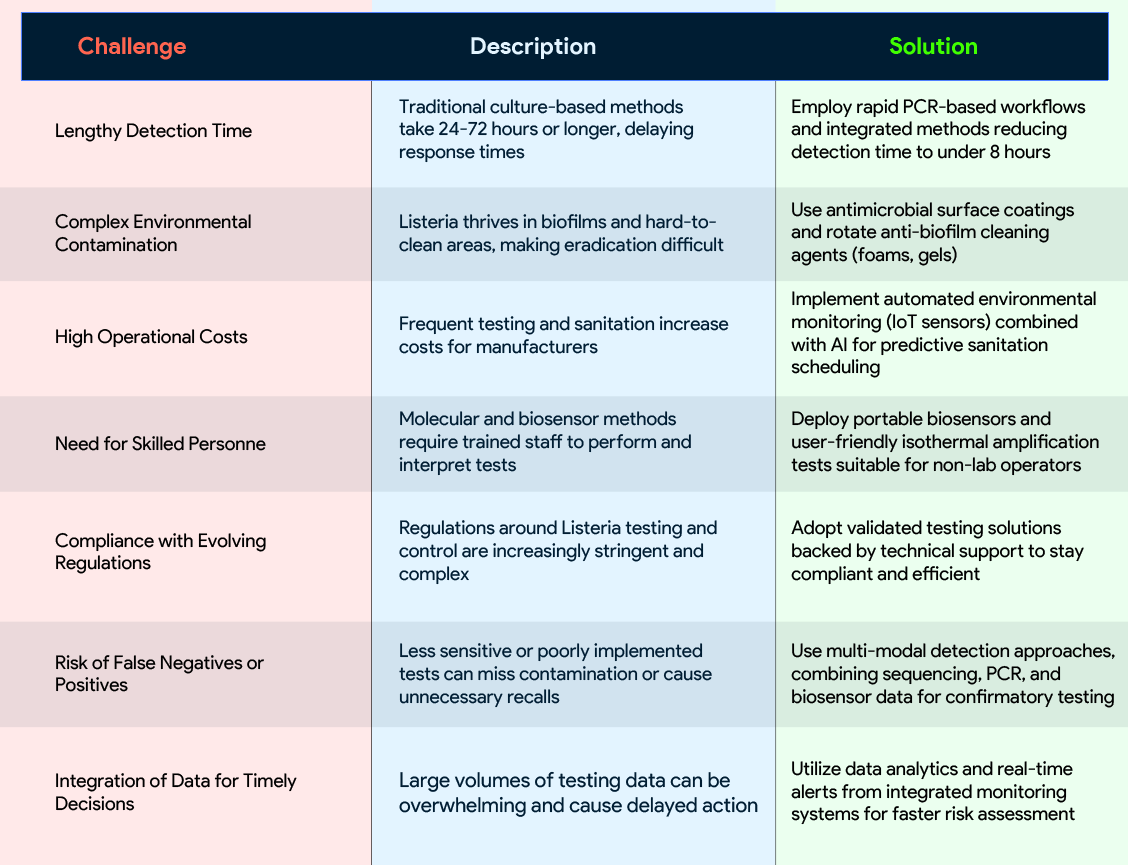
Here is a table categorizing common challenges faced during Listeria detection and control implementation along with corresponding solutions:
A large dairy processor faced recurring Listeria monocytogenes positives despite rigorous sanitation under HACCP protocols. The root cause was traced to persistent biofilms in floor drains and junction cracks, the classic harborage zones.
To resolve this, the facility adopted rapid Listeria detection kits, cutting confirmation time from 3–5 days to under 8 hours.They implemented a dry-floor sanitation program and applied natural antimicrobial treatments such as peracetic acid and bacteriophage-based rinses to target biofilm persistence. Integration with EMP software further strengthened the system by automating high-risk drain swab scheduling and tracking contamination trends. Within six months, contamination incidents dropped by 70%, and audit compliance scores improved significantly.
A ready-to-eat meat processor struggled with intermittent Listeria positives on slicing equipment. Standard GMP and sanitation knocked contamination down, but it kept resurfacing. Swab mapping later revealed the pathogen colonized pre-existing multispecies biofilms within hard-to-reach machine crevices.
The facility resolved the issue by using enzymatic biofilm disruptors followed by targeted sanitizers to break down microbial matrices, introducing IoT-enabled sensors on slicers to monitor humidity and temperature, and leveraging EMP software with advanced analytics to visualize contamination hot zones and guide preventive maintenance. As a result, they achieved 12 consecutive months of Listeria-free production, restored customer confidence, and passed third-party audits without corrective actions.
As these case studies show, listeria outbreaks have long challenged the food industry, exposing critical gaps in safety systems. But what if we could stay several steps ahead catching threats before they materialize? With rapid detection technologies and smarter control methods, this shift is already happening. Leading this transformation, Smart Food Safe’s Smart EMP platform plays a pivotal role by digitizing and automating environmental monitoring from mapping swabbing zones and scheduling random sampling to managing corrective actions helping food businesses stay ahead of contamination risks. By integrating data, regulatory guidelines, and Risk based insights, Smart EMP empowers proactive decision-making that transforms food safety from a reactive task into a strategic advantage. The future demands vigilance, innovation, and courage to embrace new tools. Will food safety rise to meet that challenge? With Smart Food Safe, the answer is already taking shape.

 French
 Spanish
 Portuguese