


Leafy green vegetables rank among the most commonly eaten vegetables and are undeniably vital components of a healthy diet, offering an array of essential nutrients and dietary fiber. Despite their widespread intake with millions of servings consumed safely daily, leafy greens have been recurrently associated with outbreaks of foodborne illnesses stemming from Shiga toxin-producing E. coli (STEC), with the most prevalent strain being E. coli O157:H7.
Gaining a comprehensive grasp of E. coli contamination in leafy green vegetables, the criteria that contribute to it, and the pertinent food safety measures necessary for its control is paramount for their safe consumption. Aligning with this agenda, the U.S. FDA released the Leafy Greens STEC Action Plan (LGAP), first published in 2020 and last updated on November 17th, 2023, in response to several repeated instances of outbreaks associated with leafy greens due to STEC.
Understanding E. Coli Contamination in Different Leafy Greens
Among various leafy greens, lettuce stands out as a frequent culprit in related outbreaks. A recent study conducted by researchers at the University of Illinois Urbana-Champaign sheds light on the factors influencing E. coli contamination in five different leafy greens: romaine lettuce, green-leaf lettuce, spinach, kale, and collards.
Lead author Mengyi Dong and fellow researchers sought to delve deeper into the susceptibility of different leafy greens to E. coli contamination. The susceptibility of leafy greens to E. coli contamination is influenced by several factors, including leaf surface roughness and the presence of a natural wax coating. While lettuce tends to harbor E. coli more readily due to its smoother surface and lack of protective coatings, kale and collard greens exhibit greater resilience, partly owing to their waxier texture. Cutting leafy greens releases vegetable juice, which contains nutrients that can stimulate bacterial growth. However, spinach, kale, and collard juice exhibited antimicrobial properties that hindered E. coli growth, offering a potential protective mechanism against contamination.
They explored the impact of temperature and leaf surface properties on the growth and survival of E. coli O157:H7. Their findings underscored a crucial interplay between temperature and leaf surface characteristics. At room temperature or higher, E. coli exhibited rapid growth on lettuce, whereas refrigeration at 4°C (39°F) led to a significant reduction in bacterial populations. Conversely, waxy greens like kale and collards displayed slower E. coli growth under warmer temperatures but prolonged survival under refrigeration.
Transmission Pathways of E. coli to Leafy Greens
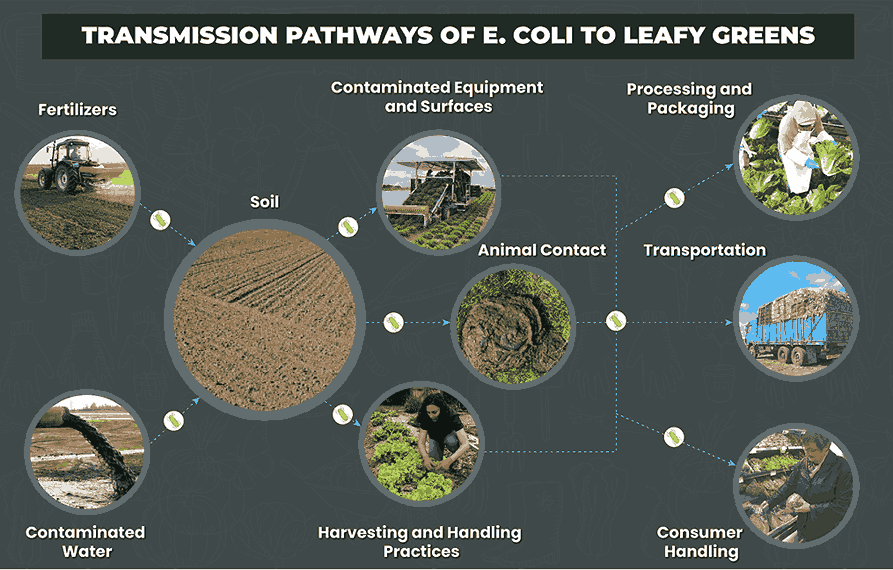
E.coli can reach leafy greens through a multitude of routes, within which contamination from the agricultural fields is prominent. Here are the common transmission pathways:
Contaminated Water: E. coli can contaminate irrigation water used in agriculture, especially if it comes into contact with fecal matter from animals or humans. Runoff from nearby farms, sewage leaks, or contaminated water sources can introduce E. coli to the fields where leafy greens are grown.
Animal Contact: Wild animals, livestock, and birds can carry E. coli in their feces. When the animal feces come into contact with leafy greens or the soil they’re grown in, they can transmit the bacteria directly.
Fertilizers: Organic fertilizers, such as manure, may contain E. coli if not properly composted or treated. When these fertilizers are applied to fields, they can introduce bacteria to the soil, which can then contaminate leafy greens during growth.
Contaminated Equipment and Surfaces: Farm equipment, tools, and surfaces in contact with leafy greens can harbor E. coli if not cleaned and sanitized properly. Cross-contamination can occur if these surfaces come into contact with contaminated water, soil, or animals.
Harvesting and Handling Practices: Improper hygiene practices during harvesting, such as handling leafy greens with unwashed hands or using contaminated containers, can introduce E. coli. Additionally, workers who are carriers of E. coli can inadvertently contaminate the produce during harvesting.
Processing and Packaging: Processing facilities may become contaminated with E. coli due to inadequate sanitation practices. If contaminated leafy greens are processed alongside other produce items, cross-contamination can occur. Improper packaging materials or storage conditions can also contribute to the spread of E. coli.
Transportation: During transportation from farms to distribution centers or retail outlets, leafy greens can be exposed to conditions that promote E. coli growth if not handled properly. Contaminated vehicles or improper temperature control can exacerbate the risk of contamination.
Consumer Handling: If consumers do not handle leafy greens properly, they can introduce E. coli during washing, cutting, or storage. Cross-contamination can also occur if contaminated leafy greens come into contact with other foods or surfaces in the kitchen.
Moreover, breaking down how E. coli contaminates lettuce and other leafy green fields involves consideration of two primary theories. The first theory posits that bacteria from cattle manure may infiltrate irrigation canals that intersect feedlots. This contamination can occur either through direct washing of manure into the canals or via airborne dust particles carrying bacteria from the feedlots into the water. The risk is exacerbated by the uncertainty surrounding the water’s contamination status. Alternatively, another theory suggests that E. coli-laden dust originating from feedlots may drift onto adjacent fields, settling onto the surfaces of leafy vegetables. Although federal health agencies lean towards the irrigation canal hypothesis, the notion of contaminated cattle feedlot dust settling on agricultural lands raises significant concerns.
Ultimately, to mitigate the risk of E. coli contamination in leafy greens, all stakeholders, including farmers, processors, distributors, and consumers, need to implement proper hygiene practices, adhere to food safety regulations, and ensure comprehensive monitoring and testing procedures are in place throughout the supply chain.
FDA’s Leafy Greens STEC Action Plan (LGAP): Guidelines for Food Sector Stakeholders to Safeguard Leafy Greens Against E.Coli
Over the last few years, the FDA and partners in the public and private sectors have worked to enhance the safety of leafy greens through the development and implementation of the LGAP. This work includes prioritized inspections, focused sampling, stakeholder engagement and collaboration, data sharing, root cause investigations, and advancements in the science of detection and prevention. Collectively, this work has expanded their body of knowledge about how and why outbreaks linked to leafy greens have occurred, which has guided and informed the evolution of the action plan over the years. Given below is a very precise version of the key points involved in the LGAP:
Prevention
⇒ Advance agricultural water safety used in the production process of leafy greens as it can be a major conduit of pathogens
⇒ Enhance inspections, audits, and certification programs to prepare growers to comply with the Produce Safety Rule, offer regulators insights into compliance trends, and aid in preventing future food safety issues on farms
⇒ Technical assistance to meet buyer specifications that produce growers need to adhere for retailers to buy and sell their products
⇒ Leafy greens data trust to facilitate sharing data on related outbreaks and mitigation strategies that can be used to prevent future incidents
⇒ Microbiological surveys for STEC detection and enhanced sampling protocols to identify potential contamination events and prevent contaminated leafy greens from entering commerce
⇒ Increase awareness and address concerns around adjacent and nearby land as the conditions and practices on those lands can play a critical role in contributing to produce contamination
⇒ Establish and strengthen regular outreach and communication programs for stakeholders in growing regions to better understand and respond to contamination events in those areas
Response
⇒ Continue to release investigation reports following STEC outbreaks providing insights into potential contamination routes for stakeholders and identifying contamination trends over time
⇒ Conduct follow-up surveillance inspections and sampling of farms that may have been linked to previous outbreaks to help prevent future contamination events
⇒ Promote tech-enabled traceability to rapidly find the source of the product and where a contamination may have occurred to facilitate it’s faster removal from the marketplace
⇒ Improve utilization of shopper card data that can provide critical information about purchase history during an outbreak and recall events
⇒ Accelerate whole genome sequencing (WGS) data submissions by states to help rule out or rule in specific strains during outbreak events as WGS can provide definitive evidence to detect and characterize pathogens
⇒ Advance root cause analysis to help industries modify practices to avoid identified risks and provide more robust data for predictive analytics
⇒ Enhance outbreak and recall communications to provide transparency around emerging food safety issues to ensure that industry, consumers, and other stakeholders are on the lookout for issues
Addressing Knowledge Gaps
⇒ Multi-year longitudinal studies to levy new knowledge on how various environmental factors may influence bacterial persistence and distribution and how it may impact the risk of produce becoming contaminated
⇒ Data mining and analytics on previous outbreaks provide insights that can help inform the development of strategies to help prevent further outbreaks.
⇒ Adjacent and nearby land use’s role in contributing to produce contamination and what mitigation strategies might be employed to address the issue.
⇒ Compost sampling assignment to understand the effectiveness of intervention strategies designed to reduce or eliminate the presence of pathogens in compost
From harnessing natural antimicrobial agents to advocating for stringent food safety practices, collaborative efforts across the food industry and research community are key to protecting the integrity of leafy greens and ensuring public health, paving the way for a safer and healthier food future.
Ensure Leafy Green Safety By Incorporating Smart Food Safe’s Digital Solutions
Smart Food Safe remains a front-runner in tech-enabled food safety management tools, designed to tackle the complexities of modern supply chains head-on. Our digital solution Smart Farm empower growers, processors, and distributors to proactively monitor, track, and manage every aspect of their leafy greens’ journey from farm to table.
Smart Farm leverages real-time data analytics to monitor crop health, environmental conditions, and harvesting practices, ensuring that leafy greens are cultivated under optimal conditions. This proactive approach allows stakeholders to preemptively identify and address potential contamination risks, thereby safeguarding the integrity and safety of the produce.
In addition to Smart Farm, our integrated platform includes Smart Audit and Smart Training. Smart Audit streamlines the process of conducting thorough quality checks and compliance assessments across the supply chain. By automating these critical evaluations, businesses can maintain consistent standards and promptly detect any deviations that may compromise food safety. Complementing this, Smart Training offers targeted educational resources and interactive modules to equip personnel with the knowledge and skills needed to adhere to best practices in food safety.
By integrating the innovative functionalities that we bring forward, food enterprises can strengthen their food safety protocols for leafy green vegetables, build consumer trust, and contribute to a safer and more sustainable food system for all.