


Did you know that an estimated 600 million people annually experience illness from consuming contaminated food, with children under five accounting for 40% of these foodborne diseases, resulting in 420,000 deaths yearly?
Safe food is of utmost importance, impacting every nation by significantly contributing to improved health, food security, livelihoods, economic development, trade, and the international reputation of each country. The observance of World Food Safety Day, organized collaboratively by the World Health Organization (WHO) and the Food and Agriculture Organization of the United Nations (FAO), serves as a significant occasion to enhance global efforts in guaranteeing the safety of our food, elevating food safety awareness as a public agenda, and mitigating the global burden of foodborne illnesses.
FAO plays a critical role in strengthening food safety systems worldwide to ensure safe and nutritious food for all by setting international standards, providing technical assistance, and advancing sustainable agriculture practices through capacity building, knowledge sharing, and crisis management. In the wake of the fifth World Food Safety Day commemorated on 7th June 2023 with the theme “Food Standards Save Lives,” let us look at what FAO stands for, the challenges they aspire to conquer, and some transformative food safety actions they have undertaken.
FAO: A Quick Overview
Established in 1945, FAO is a specialized agency of the United Nations that focuses on addressing global food and agricultural bottlenecks and leads international efforts to bring strategic solutions and initiatives to prevent, detect, and respond to food safety issues. The primary goal of FAO is to attain global food security by achieving the United Nations’ Sustainable Development Goals, ascertaining that everyone has consistent access to safe, high-quality food. With 195 members, including 194 countries and the European Union, FAO works in over 130 countries across the world.
Through its International Food Safety Authorities Network (INFOSAN), FAO facilitates information exchange and collaboration among food safety authorities globally. INFOSAN enables rapid sharing of relevant food safety alerts and supports coordinating emergency responses during food safety incidents or outbreaks. This cooperative approach empowers the ability of countries to hinder the spread of contaminated food and protect public health.
Furthermore, FAO actively promotes adopting science-based food safety standards and practices. It works closely with international bodies such as the Codex Alimentarius (CAC) to develop harmonized guidelines, definitions, and standards for food production, processing, distribution, and handling. These standards serve as a reference for countries to ensure the safety and quality of their food supply chains, promoting fair trade and consumer protection.
Another area FAO concentrates on is skill development and training programs, uplifting the abilities of food safety professionals, farmers, and food handlers with the knowledge and skills necessary to implement and maintain effective food safety management programs, along with improving infrastructure, laboratory capabilities, and regulatory frameworks.
What Does FAO Stand For And How Does It Define Food Safety?
FAO stands for the Food and Agriculture Organization of the United Nations, headquartered in Rome, Italy. Its founding date, October 16, 1945 is commemorated annually as World Food Day, a global observance highlighting the ongoing fight against hunger.
On food safety specifically, FAO’s official definition is precise: food safety is the assurance that food will not cause harm to the consumer when it is prepared and/or eaten according to its intended use. This covers biological hazards (bacteria, viruses, parasites), chemical hazards (pesticide residues, heavy metals, mycotoxins), and physical hazards, across every stage of the food chain from farm to fork. The economic stakes are significant: unsafe food costs low- and middle-income economies an estimated US$95 billion in lost productivity every year.
The Four Pillars of Food Security
Pillar 1: Availability — Food availability refers to the physical presence of sufficient quantities of food, through domestic production, imports, food reserves, or food aid.
Pillar 2: Access — Even where food is available, individuals and households may be unable to obtain it due to economic barriers (poverty, unemployment) or physical barriers (remote location, poor infrastructure, market inaccessibility).
Pillar 3: Utilization — Utilization refers to the body’s ability to effectively use and benefit from the food consumed.
Pillar 4: Stability — Stability is the cross-cutting dimension; it ensures that the other three pillars hold over time.
Key Functions and Objectives of FAO
Understanding what FAO does requires looking beyond its name. FAO’s work spans five broad functions and five strategic objectives, all deeply interlinked and aligned with the United Nations’ Sustainable Development Goals (SDGs).
The 5 Core Functions of FAO
1. Setting International Food Safety Standards: FAO’s most globally recognized function is co-developing and maintaining international food safety standards through the Codex Alimentarius Commission (CAC), in partnership with WHO. These science-based standards serve as the benchmark for food safety regulation worldwide and as the reference point for resolving food safety trade disputes under the WTO’s Sanitary and Phytosanitary (SPS) Agreement, directly incentivizing global harmonization of national food safety laws.
2. Providing Technical Assistance and Capacity Building: FAO delivers technical expertise and on-the-ground assistance to help member states strengthen their food safety systems. This includes supporting the development of national food safety policies, upgrading laboratory infrastructure, training government officials and food inspectors, and advising on regulatory reform, with particular focus on countries with limited institutional capacity.
3. Collecting, Analyzing, and Disseminating Agricultural Data: FAO maintains the world’s most comprehensive agricultural database, FAOSTAT, tracking global food production, trade, food security indicators, and nutritional data across 245 countries and territories. The Global Information and Early Warning System on Food and Agriculture (GIEWS) continuously monitors food supply-and-demand situations and triggers alerts for emerging food crises, enabling evidence-based policymaking and early intervention.
4. Facilitating International Policy Dialogue and Governance: FAO acts as a neutral convening platform where governments, international organizations, civil society, and the private sector build consensus on food and agriculture policy. It facilitates intergovernmental negotiations, sets global norms, and helps countries align national legislation with internationally agreed frameworks, including legal reform, regulatory development, and institutional strengthening.
5. Coordinating Emergency Response and Crisis Management: When food crises strike, whether from conflict, climate disasters, pest outbreaks, or disease, FAO coordinates emergency agricultural interventions to restore food production, prevent hunger, and protect livelihoods. FAO’s emergency response architecture is backed by GIEWS monitoring and inter-agency coordination with WFP, UNICEF, and other UN partners.
The “Why” Behind FAO’s Core Notion
The numbers always speak for themselves, so let us go through some facts and figures to understand FAO’s mission and vision truly. As we discussed in the beginning, 600 million individuals, that is, one in ten people worldwide, fall victim to food contamination each year. Even more shockingly, children under the age of five bear a disproportionate burden, accounting for 40 percent of foodborne disease cases despite comprising only 9 percent of the population. This alarming statistic highlights the essential need to resolve this issue on a global scale.
The dangerous repercussions of the consumption of contaminated food cannot be understated, as it can lead to over 200 different diseases caused by bacteria, viruses, parasites, or chemical substances like heavy metals. A concerning matter closely related to food safety is the transmission of antimicrobial-resistant microbes through the food chain. Every year, approximately 5 million lives are lost due to infections caused by antimicrobial-resistant microbes.
Emphasizing the safety and nutritional value of food holds immense importance in augmenting children’s growth, development, and overall well-being. These factors have far-reaching effects on their intellectual and physical potential, ultimately leading to enhanced academic performance and increased productivity in adulthood. This depicts why investing in food safety measures is imperative to secure a promising future for upcoming generations.
Food safety goes beyond the confines of the dining table. It is intricately intertwined with the health of animals, plants, and the environment in which food is cultivated. For establishing a comprehensive and efficient food safety system, it is pivotal to adopt a holistic One Health approach, defined as a “collaborative, multisectoral, and transdisciplinary approach – working at the local, regional, national, and global levels – with the goal of achieving optimal health outcomes recognizing the interconnection between people, animals, plants, and their shared environment.”
Therefore, the core notion of the FAO is rooted in its underlying “why” or purpose, which originated from the recognition of the pressing need to prioritize food safety worldwide as the significance of food safety transcends human health. By tackling concerns related to food safety, FAO works towards nurturing sustainable agriculture, encouraging responsible consumption and production patterns, combating hunger and malnutrition, and stimulating economic growth and general well-being in society.
Big Challenges Ahead for FAO
With the world population projected to hit a staggering 9.7 billion by 2050, ensuring safe food for nearly 10 billion people by then has become the greatest unprecedented challenge faced by the Food and Agriculture Organization (FAO). Following are the major existing and up-and-coming challenges faced by FAO that are closely tied to its global goals:
1. Climate Change and Natural Hazards
In collaboration with other agencies, one of the key hurdles to be overcome is drastically reducing greenhouse gas (GHG) emissions from global agri-food systems and the economy as a whole while simultaneously enhancing the resilience of agri-food systems to shocks and climate-related hazards.
2. Sustainable Use of Natural Resources
Ensuring the sensible and sustainable utilization and management of natural resources and restoring the natural resource base is a paramount challenge.
3. Eradicating Extreme Poverty
FAO has to make sure that all development processes contribute to the definitive eradication of extreme and persistent poverty.
4. Hunger and Malnutrition
Ensuring that all courses of action and policies effectively contribute to the ending of world hunger, the elimination of all forms of malnutrition, and the sustenance of long-term outcomes should be monitored by FAO.
5. Institutional Weaknesses and Governance
They should be able to confront the shortcomings of institutions, lack of cross-sectoral coordination, governance processes, and legal frameworks at all levels. It also involves overcoming difficulties related to enforceability and their implications for agri-food systems.
6. Evolving Consumption Choices
FAO must make indispensable efforts to assist countries and the global development community increase consumer awareness regarding healthy consumption choices.
7. Income and Wealth Distribution
Income and wealth disparities within and between countries, including their implications for agri-food systems, have to be supervised and dealt with by FAO.
8. Managing Innovative Technologies
FAO has to commence state-of-the-art technologies and systemic approaches while alleviating potential risks to improve food and agricultural productivity in a sustainable manner.
FAO’s work’s complex and multifaceted nature underscores the need for concerted efforts to manage these challenges and address food safety gaps. They make it possible by bringing forth initiatives that are capable of creating a positive impact in the realm of food safety.
FAO’s Role in Reducing Child Mortality and Protecting Children
As established above, children under five carry 40% of the global foodborne disease burden despite being only 9% of the population, a disparity that drives FAO’s dedicated child-focused programming. FAO’s child protection and food safety work operates through several intersecting programs and partnerships:
School Feeding and Nutrition Programs
FAO collaborates with the World Food Programme (WFP) and UNICEF on school feeding programs that provide nutritious, safe meals to children in food-insecure regions. These programs improve attendance, learning outcomes, and nutritional status simultaneously.
REACH Initiative
FAO co-leads REACH (Renewed Efforts Against Child Hunger and Undernutrition), a UN partnership bringing together FAO, UNICEF, WFP, and WHO to accelerate country-level action against child malnutrition. REACH supports governments in developing multi-sector nutrition plans and food safety frameworks that specifically protect children.
Infant and Young Child Feeding (IYCF) Guidelines
FAO and WHO jointly develop and promote guidelines for safe complementary feeding practices for infants and young children, including standards for the safety and nutritional adequacy of commercially produced infant foods.
Safe Food Handling Education
FAO develops community-level training materials and campaigns, particularly targeting mothers, caregivers, and food handlers, on safe food storage, preparation, and hygiene practices that directly reduce the risk of foodborne illness in young children.
Codex Standards for Vulnerable Populations
Through the Codex Alimentarius, FAO has established specific standards for foods targeting infants and young children, including maximum limits for contaminants, pesticide residues, and food additives in products intended for this vulnerable group.
FAO’s child protection work in the context of food safety is not a standalone program, it is embedded across every dimension of FAO’s food safety mandate, from standard-setting to emergency response to community education.
How FAO Promotes Food Safety to Make a Difference
There is no one way to ensure that food safety is well-integrated into every stage of the food value chain, and hence a multitude of measures have to be undertaken to yield the best food safety outcomes. Recognizing this, FAO has long acknowledged the significance of adopting diverse measures to achieve optimal food safety outcomes, which led them to take the lead for the following food safety initiatives aimed at making a substantial difference.
Codex Alimentarius Commission
FAO, in collaboration with the World Health Organization (WHO), established the Codex Alimentarius Commission (CAC) to develop unified international food standards, principles, and texts such as codes of practice under the Joint FAO/WHO Food Standards Programme to safeguard food safety, preserve consumer health, and set up fair practices in food trade. Codex standards are developed based on sound science provided by independent international risk assessment bodies or ad-hoc consultations organized by FAO and WHO.
Competency Enhancement
FAO goes hand-in-hand with countries to strengthen their capacity to vitalize food safety systems. It provides technical assistance, training programs, and expertise to upgrade the knowledge and skills of government officials, food producers, and processors, assisting countries to implement and enforce effective food safety programs.
Risk Assessment and Management
FAO conducts risk assessments to identify and evaluate the presence and potential health risks of food safety hazards such as contaminants and pathogens in the food supply chain. It works closely with governments, scientific institutions, and international partners to help countries build risk management schemes and make informed decisions on food safety regulations and policies by offering scientific evidence and guidance.
Foodborne Disease Surveillance
FAO actively encourages the establishment of robust systems for monitoring and tracking foodborne diseases. It aids countries in intensifying their surveillance capacities, including data collection, analysis, and reporting mechanisms. FAO’s foodborne disease surveillance efforts equip countries to detect food safety risks and carry out appropriate control measures with timely and precise oversight information.
Emergency Response and Preparedness
FAO strongly enables countries to devise and execute emergency response plans to be utilized in events of foodborne outbreaks and food safety incidents. They implemented projects in over 25 countries, conducted inter-agency missions in nearly 60, and scaled up their monitoring through the Global Information and Early Warning System on Food and Agriculture, which continuously monitors food supply and demand and other key indicators for assessing the overall food security situation in all countries of the world. By assembling proper preparedness protocols such as risk communication, traceability mechanisms, and corrective and preventive action (CAPA) systems, FAO contributes to minimizing the severity and impact of food safety crises on public health and businesses.
Safe Production and Handling
FAO advocates for the adoption of Good Agricultural Practices (GAPs) and Good Manufacturing Practices (GMPs) to guarantee the safety of food production and handling. These practices highlight the implementation of sustainable and eco-conscious routines that minimize the use of harmful substances in farming. FAO also plays a critical role in establishing food safety management systems based on Hazard Analysis Critical Control Point (HACCP) for risk-based control of food safety hazards from farm to fork.
Food Safety Education and Awareness
FAO raises awareness about food safety issues among consumers, producers, and other stakeholders. It develops educational materials, campaigns, and training programs to promote safe food handling practices, hygiene, and nutrition. By empowering individuals with knowledge, FAO fosters a culture of food safety at all levels.
Latest FAO Global Venture: Strategic Framework 2022-31
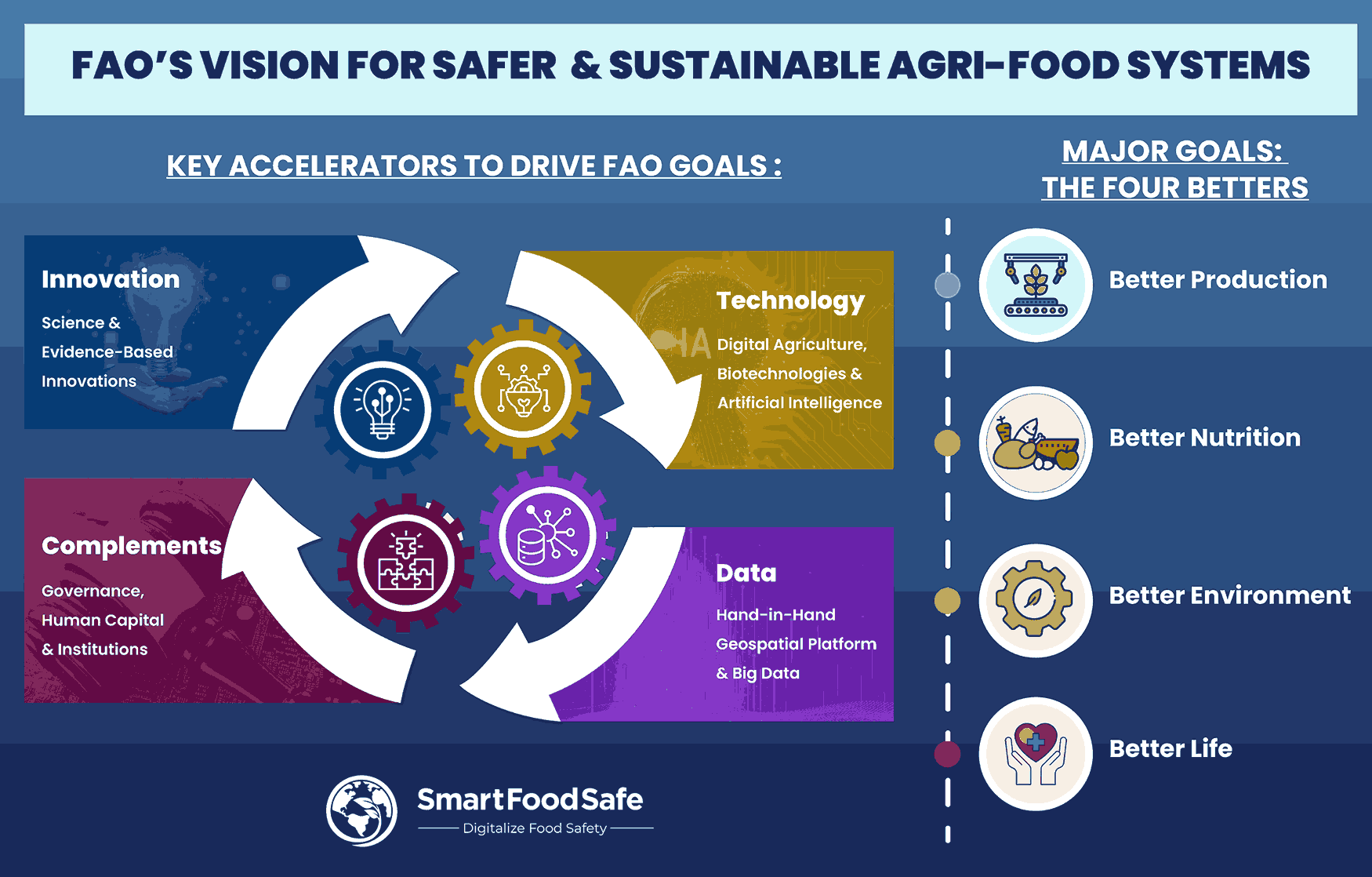
The FAO Strategic Framework 2022-31 aims to help achieve the goals of the 2030 Agenda by progressing agricultural and food systems in four important ways: efficiency, inclusiveness, resilience, and sustainability, with particular attention to creating better production, better nutrition, a better environment, and a better life for everyone, without leaving anyone behind.
A Closer Look at FAO’s “Four Betters”
Better Production
The focus of better production is on propagating sustainable ways of producing and consuming food, ushering in efficient and inclusive supply chains at local, regional, and global levels. This includes making agri-food systems resilient and sustainable in the face of climate change and environmental challenges.
Better Nutrition
This objective involves putting an end to world hunger and accomplishing food security, as well as boosting nutrition for all, which includes affirming safe food for everyone, reducing food loss and waste, transparent markets and trade, expanding nutritious food, and making healthy diets more accessible, especially for the most vulnerable.
Better Environment
The protection, restoration, and sustainable use of land and marine ecosystems, as well as heeding to climate change, is strategized with emphasis on climate change mitigation and adaptation, sustainable use of biodiversity and ecosystem services, and the development of sustainable urban food systems.
Better Life
Inclusive economic growth and reducing inequalities between different groups and regions are considered the main pathways to a better life globally. This includes empowering rural women, promoting inclusive rural transformation, addressing agriculture and food emergencies, building resilient agri-food systems, and amplifying investment opportunities, to finally reduce disparities between urban and rural areas, as well as between rich and poor countries, and embrace the overall vision of the FAO.
FAO disseminates four cross-cutting approaches that will be integrated into all programmatic interventions as key accelerators for propelling their four major goals, that is, the four betters:
- Innovation – Science and Evidence-based Innovations
- Technology – Digital Agriculture, Biotechnologies, and Artificial Agriculture
- Data – Hand-in-Hand Geospatial Platform and Big Data
- Complements – Governance, Human Capital, and Institutions
The FAO will also contemplate the cross-cutting themes of gender, youth, and inclusion to ensure that no one is left behind, aligning with the UN programming principle. Industry leaders, food safety authorities, and other relevant stakeholders can be a part of FAO’s journey to an optimized agri-food system by incorporating these key elements into their foundational operations and food safety and quality management maneuvers.
SmartFoodSafe Stands By FAO’s Global Initiatives to Transform Food Safety
SmartFoodSafe’s comprehensive suite of digital solutions delivers 18+ software modules designed to combine food supply chain functional expertise with innovation, technology, and data integrations to produce streamlined end-to-end applications. They can aid food industries more efficiently by incorporating FAO’s global initiatives, which remain instrumental for a future of safer, smarter, and more sustainable food systems.
As Frank Yiannas rightly stated, “Making Every Day a World Food Safety Day” is essential for thinking, talking, and practicing food safety every day. Transform your enterprise’s food safety paradigm with SmartFoodSafe by mainstreaming food safety virtues into everything you do.
What is the difference between food security and food safety?
Food security focuses on ensuring people have consistent access to enough food, while food safety ensures that the food consumed is free from biological, chemical, and physical hazards. A country can have food availability but still face major public health risks if food safety systems are weak.
How does FAO support developing countries in improving food safety systems?
FAO helps developing countries through technical training, laboratory strengthening, regulatory guidance, risk assessment support, and food safety capacity-building programs. It also assists governments in aligning national food regulations with international standards like Codex Alimentarius.
Why are international food safety standards important for global trade?
International food safety standards create consistency between countries, helping food products move safely across borders. They reduce trade disputes, improve consumer trust, and ensure imported and exported foods meet scientifically recognized safety requirements.
How can digital technologies improve global food safety management?
Digital technologies improve food safety through real-time monitoring, traceability, automated compliance tracking, supplier management, predictive analytics, and faster recall management. They help food businesses reduce manual errors and improve audit readiness.
What role does traceability play in preventing foodborne outbreaks?
Traceability helps identify the origin and movement of contaminated food products across the supply chain. Faster traceability enables companies and regulators to isolate affected products quickly, reducing the spread of foodborne illnesses and minimizing recall impact.
How do climate change and environmental factors affect food safety?
Climate change can increase food safety risks by affecting water quality, crop contamination, pest activity, and the spread of foodborne pathogens. Extreme weather events and rising temperatures can also disrupt food storage, transportation, and agricultural production systems.