


Do you remember the salmonella outbreak that occurred back in 2010 due to numerous food safety lapses attributed to inadequate training protocols, which sickened hundreds of people and led to the recall of 380 million eggs?
Many aspects of the food safety system are at stake when employees working in a food enterprise are not appropriately trained. The most prominent one would be the probability of the employee doing a wrong action resulting in a severe consequence that affects millions of people, typically via the route of the employee violating food safety regulations leading to food-borne illnesses, legal action, and recalls. Moreover, employees lacking the necessary knowledge and skills tend to cause slowed-down operations, equipment malfunctioning, increased downtime, and additional costs, ultimately affecting the overall efficiency of the company processes. This is why implementing effective training for employees is of utmost importance and will always provide businesses an upper hand.
Governments worldwide are taking up training as a vital element to enhance the effectiveness of food safety protocols. For instance, the Food Safety Department of Dubai Municipality released the ‘Requirements for integrated Training Management System for food Establishments,’ requiring all food handling staff, supervisors, and managers in a food business to be formally trained on food safety, corresponding with their work activity. The new, stricter Australian food standard, Standard 3.2.2A Food Safety Management Tools, is announced to come into effect on 8th December 2023 by Food Standards Australia New (FSANZ) with the agenda to strengthen food safety training in food enterprises. It mandates all Australian businesses that prepare and serve food to have trained Food Safety Supervisors available on their premises at all times. For Australian manufacturers to comply with national food safety regulations, they should be capable of conducting adequate food safety training by overcoming the current challenges in the training landscape.
As food businesses around the globe incorporate modern and optimized employee training systems to improve employee knowledge and expand relevant skill sets, it can bring forth a safer and more secure food system.
Key Points to Remember for Employing a Successful Training System
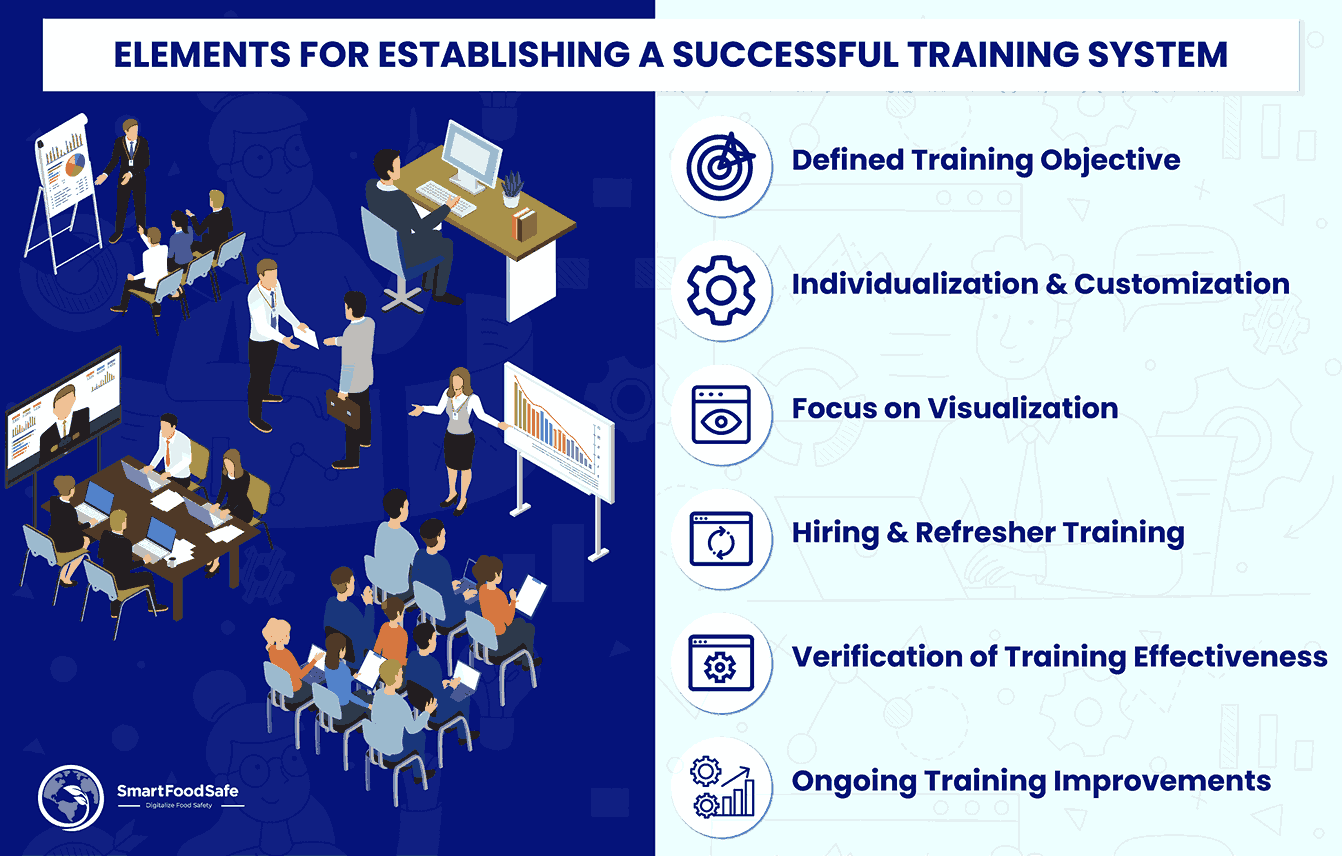
There will always be a learning curve as each job responsibility evolves over time with changing food safety requirements and employee turnover. Effective training of employees takes place when the system in place can attend to each employee’s learning curve. The following are some core elements to consider for the success of a training system:
- Well-defined Training Objectives: A training program should be designed based on an enterprise’s training requirements and how well the defined goals cater to enhancing employee efficiency and benefiting the organization as a whole.
- Individualization: Employee training programs should be versatile to align with each employee’s needs and skill set rather than a one-size-fits-all approach. The effectiveness of training can vary among employees of different age groups due to differences in learning styles, motivation, and prior experience. The linguistic barrier is another factor that can have a significant impact on training efficacy, particularly in situations where employees speak different languages or have different levels of proficiency in the language of instruction. The customizability of the training program to suit employees of all ages and linguistic backgrounds is essential to establish successful training.
- Focus on Visualization: Visualization of learning content can amplify training practices as it helps individuals to better understand complex concepts and retain information. By presenting information in a visual format, such as through videos, infographics, or interactive simulations, employees can see and experience concepts firsthand, which can enhance their comprehension and engagement.
- Communication & Interaction: It is crucial to establish proper communication among trainers and employees to understand the efficacy of training programs for them to stay involved in the training. Interactive training strategies tend to drive employee engagement and capture their interests.
- Facilitate Ongoing Learning: Training is not a one-step process. Employees having access to consistent learning and training opportunities can constantly progress and contribute to the enterprise’s growth.
- Continuous Improvement: Offering updated and continued learning prospects to new hires, existing employees, and training leaders alike can aid in ascertaining a training system that can yield the best results. This factor is of great significance, especially for employees working in a complex supply chain system, such as the food industry, to stay knowledgeable of the latest trends in food safety and quality paradigms.
- Accessibility: The training mechanism should be devised in such a way that it is accessible for all employees to undergo training in a timely and convenient manner.
- Fostering a Culture of Learning & Development: Gathering employee feedback to improve training principles promotes an encouraging environment for the employees to elevate their learning and development.
- Verification of Training Effectiveness: Enterprises should be able to verify whether the training has achieved its intended objectives and has resulted in measurable improvements in employee productivity. Verification of training processes can be done through administering training assessments and evaluations, maintaining employee performance metrics, and obtaining feedback surveys.
Challenges to Establishing Training Programs Having a Transformative Impact on Work Culture
The findings of the 2022 Global Food Safety Training Survey, which involved data analysis from over 2000 food industry professionals, demonstrated several Challenges plaguing the food industry in building a productive training process that can positively impact employee behavior and workplace culture. Let us have a look at these challenges:
-
Upskilling and Retraining for a Digital Workplace
As modern times are propelling companies to go through digital transformation, workplaces are shifting to digital modes. This would mean that training practices should also be able to cope with the changing work settings and be capable of developing employee skills to meet their job requirements digitally. Often, companies find it challenging to make this transition and struggle to set up training programs with the relevant resources for a large workforce.
-
User-Hostile Training Methods
Training methods used for the onboarding and constant development of employees drive the innovation and output of any enterprise. Hence, chosen training approaches might become counterintuitive if it is complicated for the employees to understand and navigate through.
-
Transitioning from Outdated to Contemporary Training Models
Gone are the days when training employees involved gathering staff into a conference room and conducting lectures for hours at length. This is deemed one of the least effective ways of training employees, according to Edgar Dale’s Learning Pyramid. Without timely adoption of effective training systems by companies, the training provided may fail to meet the learning needs of employees, rendering the entire exercise a wasteful expenditure of their time, effort, and resources.
-
Adapting to Virtual Training
It is usually tedious for employees to find time to take training while tackling their normal workload. This is where the provision of virtual training can empower employees with a contextual yet interesting training process that suits their convenience and availability of time. Revising training programs to adapt to remote learning modes is of great significance, especially when employees prefer to work from home.
-
Quantifying Training Efficacy
By measuring the Return-on-investment (ROI) of the training systems, businesses can interpret the effectiveness to bring the desired outcome and define how the training process should be modified to increase employee performance. Even the most well-designed training programs will not deliver the expected results unless specific performance metrics are in place to track progress in employee learning.
-
Personalizing Training & Development
One-on-one training programs or self-paced learning usually work the best, but it is very difficult for enterprises to roll out training systems designed to engage a large number of employees in this manner.
Digital Learning Management Solutions to the Rescue
With online learning becoming a universal presence in education at all levels, companies have begun integrating this technology into their training and professional development systems to bring out the best results. A learning management system (LMS) is a software tool for onsite, remote, and on-demand cloud-based training that helps users create, deliver, and report training courses and programs.
Digital learning management solutions provide a comprehensive platform to establish effective training systems that meet the needs of modern workplaces. An LMS can leverage solutions to conquer the challenges in establishing a training program that can bring about a difference through the following ways:
- A centralized medium for managing all aspects of training to streamline the training procedures, including scheduling, tracking, and reporting.
- Easy access to training materials, regardless of the participants’ location or time zone, is particularly useful for remote or distributed employee teams as they can attend training programs from anywhere.
- Hassle-free customization of training content to fit the employees’ job roles, skill sets, and learning styles.
- Allowing collaboration among employees, trainers, and managers for increased engagement and improved learning outcomes.
- Real-time tracking and reporting capabilities to monitor training progress and identify where additional training is needed to ensure that the employees receive the training required to perform their jobs effectively.
Smart Training as an Intelligent Tool to Achieve Competent Training Process
Smart Training is a software specialized in providing businesses with the necessary training infrastructure to digitally organize, track, and manage training employees, customers, and other external partners. It is a learning management tool that can help enterprises automate and establish a successful training process through the following features:
Course Creation & Management
Create courses from the ground up using our drag-and-drop course builder, layout templates, or upload using the Doc Integration feature. Manage the created courses by configuring the course settings as per learning requirements.
Training Library
Users can develop courses by selecting pre-defined training courses or cloning learning content from our industry-specific, pre-existing training library.
Training Program
Provide learners with a clear path for learning through course bundles, created by grouping multiple courses together to form comprehensive training programs.
Self Learning
Self-Learning feature enable trainees to have the flexibility to finish their assigned training at a pace and in an environment that suits them best.
Group Learning
A group of trainees can simultaneously undergo and complete training under a trainer using the Group Learning feature.
Refresher Training Scheduling
For retraining purposes, refresher training sessions can be planned and organized as future training events using the scheduling option, which is automatically notified to assigned trainees.
Integrated Knowledge Assessment (Q/A)
High-quality and impactful training assessments can be included with support for multiple question types such as In course Q/A, Mandatory or Optional Q/A, and Graded & Non-Graded Assessments.
Certification
According to the configured criteria, the course completion is initiated, and the certificate is generated, which can be exported by the trainee.
Skill Matrix
The training skill matrix facilitates the review and management of training completion and employee skills in a visualized format for analyzing learner performance.
If your organization is looking for a solution to enforce an effective learning management system capable of systematizing your training process while catering to unique business needs, Smart Training can help you. Reach out to us today, and our team of experts will help you get started with Smart Training to achieve your enterprise’s training objectives.