


Are you aware that the FDA data shows the average count for identifying a product source without a lot code is about 35 days compared to 6 days when there is a lot code? During the 2018 E.Coli outbreak in Romaine Lettuce, possible identification of the source took more than 7 days costing five lives, 96 hospitalizations and a total of 210 infected people. In addition, it is estimated that an average recall costs more than $10 million. Due to the severe consequences to the consumer’s health and safety from a recalled product, timely tracing and withdrawal from the supply chain is critical for any food safety management system. The most recent traceability policy rolled out by FDA is the much needed tool to reduce the recall risk and impact.
As the global food system continues to grow, evolve, and diversify in the blink of an eye, reducing the number of recalls and employing proper steps to rapidly mitigate the effects of food safety incidents to prevent further consequences is more important than ever today. U.S. Food and Drug Administration (FDA) recognized the necessity for an enhanced traceability system in the food supply chain and published the breakthrough rule, Food Traceability Final Rule, on 15th November 2022 with a compliance date 20th January 2023 for food industries. This rule was released to aid the FDA in notifying the public about recalls more quickly, pinpointing the root cause of the problem, and withdrawing the potentially contaminated food from the market as fast as possible.
Food Traceability Final Rule is a vital component of the FDA’s New Era of Smarter Food Safety Blueprint as this initiative encompasses tech-enabled traceability. Also referred to as FSMA 204 or FSMA Rule 204, it represents one of the most significant food traceability regulations the U.S. food industry has seen. The rule also mandates Section 204(d) of the FDA Food Safety Modernization Act (FSMA).
How Food Traceability Final Rule Came Into Existence?
To comprehend what the Food Traceability Final Rule talks about, one should be familiar with the concept of food traceability. The biggest issue faced by many food manufacturers nowadays in the event of an outbreak or recall is going back to the source of contamination and the related ingredients, as well as identifying and reaching all pathways the food had gone to and ended up in. That’s where food traceability can bring about a significant difference.
FDA defines food traceability as the ability to follow the movement of a food product and its ingredients through all steps in the supply chain, both backward and forward. Traceability involves documenting and linking the production, processing, and distribution chain of food products and safe ingredients. With improved traceability systems, it would be possible to conduct root-cause analysis for a food safety incident more efficiently, determine why outbreaks occur in the first place and prevent them from recurring.
Factors such as public health importance, consumer expectations, and the insistence by United States Congress to propagate food traceability regulations influenced FDA to establish the Food Traceability Final Rule. Powerful traceability strategies depict the food supply chain’s capability to readily investigate food safety and quality issues, which the FDA can utilize to create risk-based planning for inspections.
Fundamentals of Food Traceability Final Rule
The Food Traceability Final Rule published the additional record-keeping requirements for individuals who manufacture, process or pack/hold certain foods that come under the Food Traceability List (FTL), ranging across the entire food supply chain. The rule applies mainly to foods present in the FTL and foods that contain the listed items as ingredients, provided that they remain in the same form as they appear on the list. FTL comprises fresh leafy greens, melons, peppers, sprouts, herbs, tomatoes, cucumbers, tropical tree fruits, shell eggs, nut butter, fresh-cut fruits and vegetables, ready-to-eat deli salads, cheeses (other than hard cheese), finfish and crustaceans.
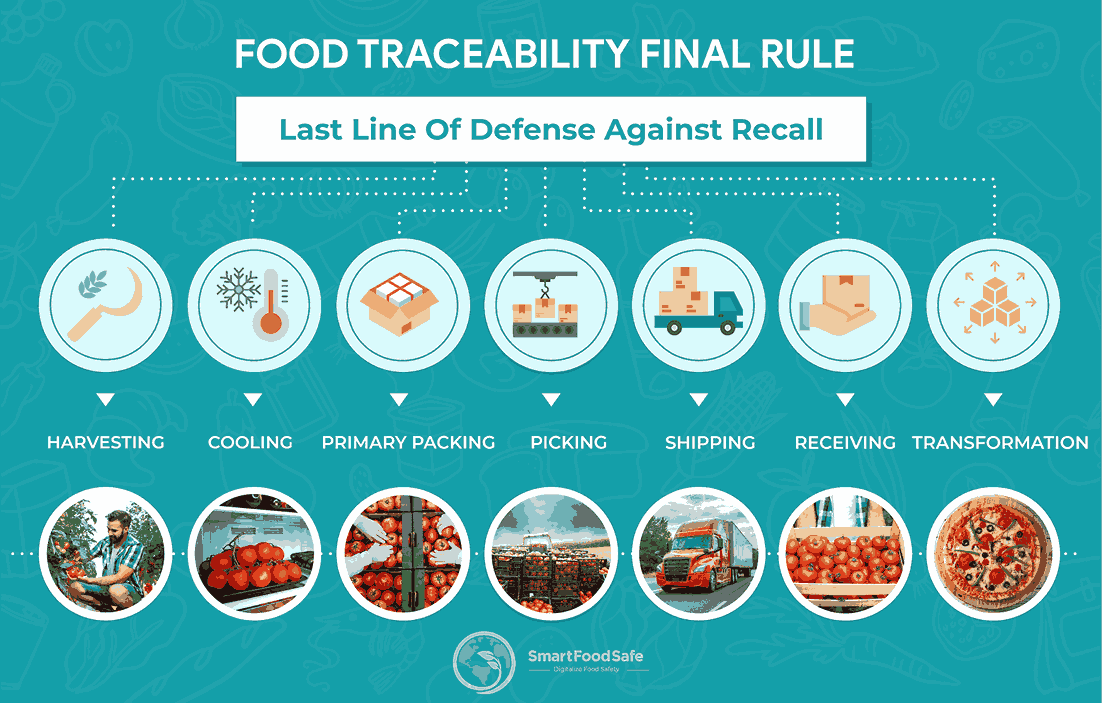
The rule talks about collecting appropriate records of the required Key Data Elements (KDE), which depends on the Critical Tracking Events (CTE) being executed by the food enterprise. KDE refers to the standardized data with key information the food company must possess and may share with their supply chain partners, which can help quickly link a food safety incident to the causal food product. CTE refers to certain crucial activities in the supply chain, such as:
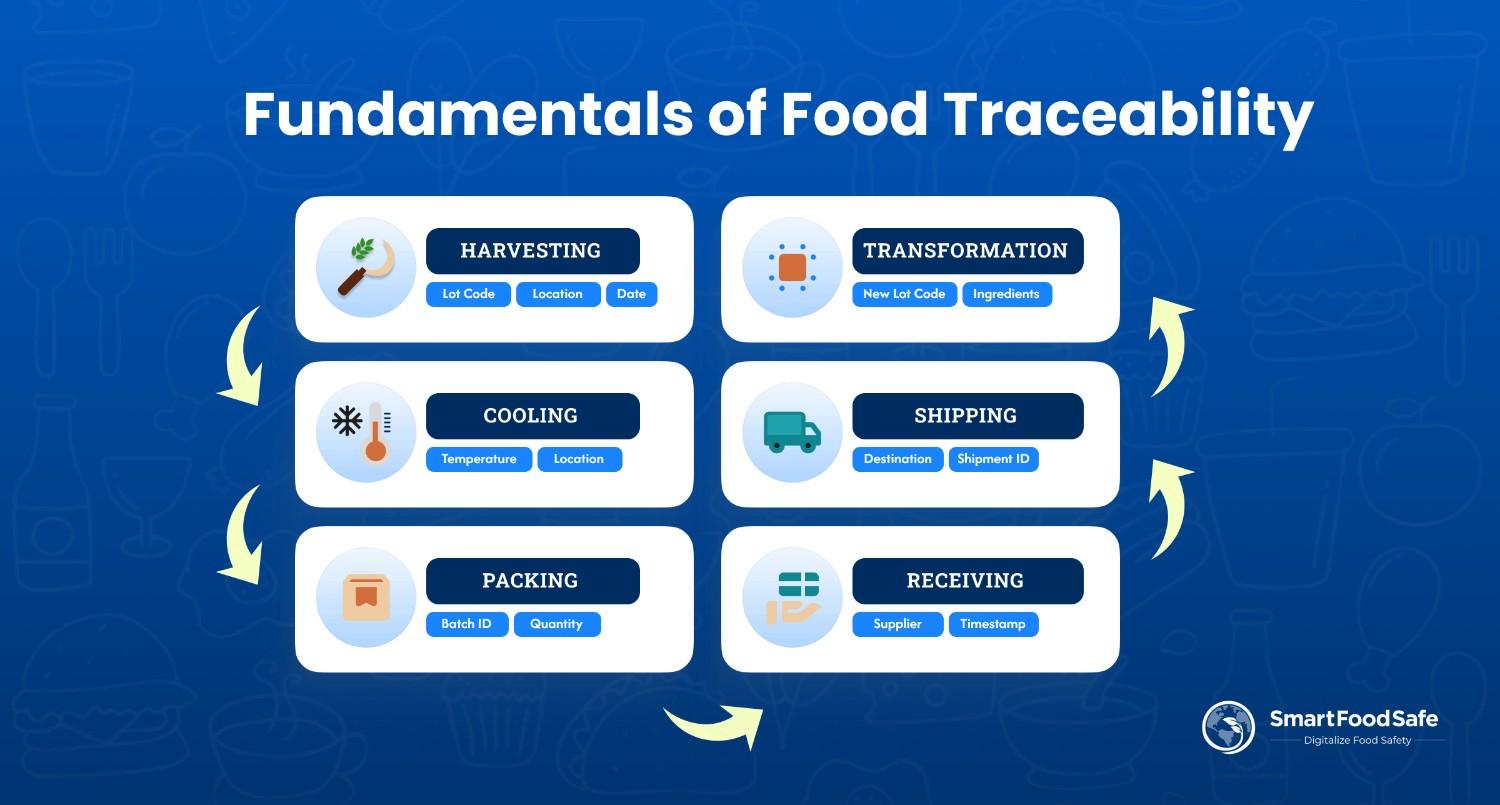
- Harvesting
- Cooling
- Initial packing
- First land-based receiving
- Shipping
- Receiving
- Transformation
An essential feature of the Food Traceability Final Rule is the Traceability Lot Code (TLC), which facilitates the FDA to track the movement of food through the food production system to eliminate disastrous recalls. This aspect of the rule dramatically improves food safety traceability as the traceability lot code of a product determines the rate at which the item can be traced. The TLC also enables one-up one-back tracking; every entity in the supply chain must link the TLC to who they received the food from and who they shipped it to, creating an unbroken chain of traceability lot code source records across the entire supply chain.
Those subjected to the requirements are supposed to maintain records in the form of the original paper, electronic data, or true copies and deliver them to the FDA within 24 hours or any reasonable time period as agreed by the FDA, on request for an official review of the establishment. Following these guidelines, food manufacturers and suppliers can comply with the new rule and change their overall approach to food safety oversight activity.
What Are FDA High-Risk Foods on the Food Traceability List?
The Food Traceability List identifies foods designated by the FDA as high-risk based on a scientific risk-ranking model that evaluates outbreak history, illness severity, and economic impact of recalls. Understanding what qualifies as an FDA high-risk food product is essential for any business determining whether the rule applies to its operations.
The FTL currently includes leafy greens such as romaine and spinach, fresh-cut fruits and vegetables, herbs including cilantro and basil, shell eggs, nut butters, certain soft cheeses, finfish, crustaceans, mollusks, and ready-to-eat deli salads. The FDA reviews the list periodically and can update it based on new public health evidence, with any additions becoming effective two years after the relevant Federal Register notice.
If your business manufactures, processes, packs, or holds any FTL food or a product containing an FTL ingredient in the same form it appears on the list, the enhanced recordkeeping requirements of the Food Traceability Final Rule apply to you.
Food Traceability 2026: What Changed with the FSMA 204 Compliance Deadline
A critical update for businesses tracking the food traceability rule compliance timeline: in March 2025, the FDA announced its intention to extend the FSMA 204 compliance date by 30 months. The original deadline of January 20, 2026 has been pushed to approximately July 2028 to give food businesses more time to implement traceability systems and coordinate with supply chain partners.
Despite the extension, businesses that have not started building their food traceability infrastructure are already behind. The written traceability plan, TLC assignment processes, KDE documentation, and partner coordination required under the rule take significant time to put in place. The compliance date changed, the requirement did not.
Who Is the Last Line of Defense for Food Safety?
This is one of the most searched questions in food safety, and the answer directly explains why food traceability matters.
Food safety is a layered system of shared responsibility across the supply chain, from farmers and processors to distributors and retailers. But when every upstream layer fails, the consumer becomes the last line of defense, with no meaningful protection. This is exactly the gap the Food Traceability Final Rule is designed to close.
By requiring end-to-end traceability of food products and ensuring the FDA can access records within 24 hours, the rule empowers every layer upstream to act faster than the food can reach consumers. Strong food recall and traceability capability means the supply chain itself becomes the defense, not the person at the end of it.
Benefits of Implementing Food Traceability Final Rule
Food Traceability Final Rule can lead food firms to take up, systematize and leverage more digital traceable action plans by setting up the foundation of a universal language of food traceability. The benefits of food traceability do not revolve around food safety alone but also have a pronounced impact on other major areas in the food supply chain.
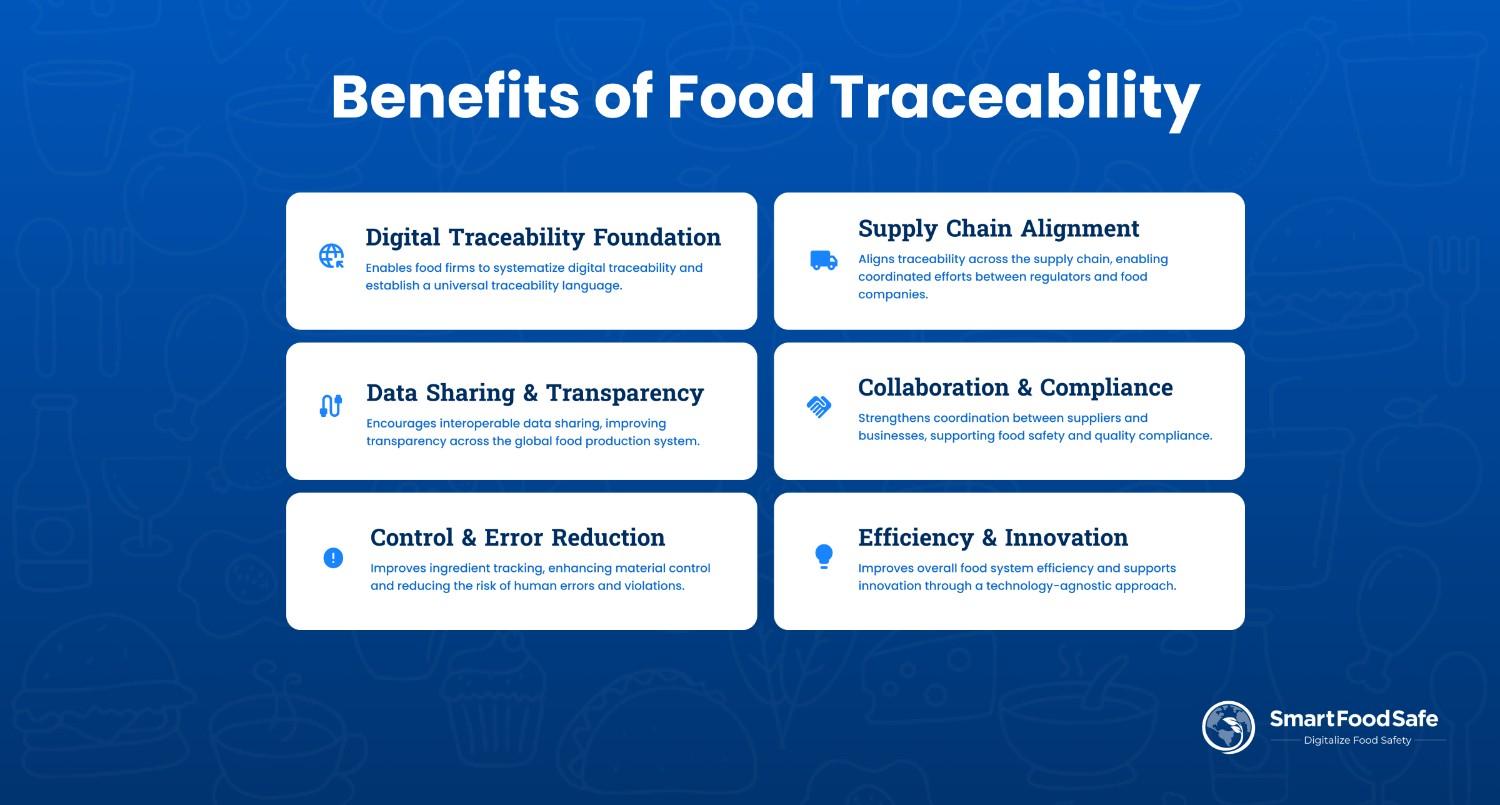
- By food industries complying with the new rule, an alignment of food traceability occurs within the food supply chain that helps regulatory agencies and food companies to work collectively to bring progress in global food traceability.
- This rule encourages interoperable data sharing among the different food supply chain partners, boosting commodity-based traceability initiatives that pave the way for maximum transparency in the global food production system.
- Collaboration and adequate communication between global suppliers and food business partners help to guarantee food safety and quality compliance through streamlined data collection and reporting initiated by Food Traceability Final Rule.
- By quickly keeping track of the different ingredients that go into the food items, food manufacturers will have improved control over material consumption and thus have chances to lessen the risk of human errors resulting in violations.
- Implementation of the traceability rule will have a domino effect on the global food system, creating better food system efficiency. Furthermore, as the rule is technology agnostic, it enables food industries to transcend innovations quite easily.
How SmartFoodSafe Can Assist Food Enterprises to Comply With the Rule?
The beauty of the Food Traceability Final Rule is that it does not authorize any particular technology to be put into use and hence, has the provision to accommodate flexibility for future technological advancements. In fact, this rule is considered to be a stepping stone for the FDA’s ‘New Era of Smarter Food Safety.’ Through digital applications, end-to-end traceability requirements can be achieved across food safety systems which can significantly act as a line of defense against recalls for food enterprises.
As Katherine Vierk, Director of Public Health Informatics and Analytics Division at FDA, stated, the rule outlines ‘what’ information firms need to have in their records, and the industry needs to work with their supply chain partners on the ‘how’ – how best to communicate that information with each other. SmartFoodSafe provides 16+ interconnected modules that can facilitate establishing this communication.
Our smart software solutions range across farm-to-fork activities, integrating functional expertise with technologies, and can serve to recognize the CTE and KDE for conforming to the Food Traceability Final Rule. They can also help food companies to attain traceability goals in real-time, affordably, and conveniently by assisting in organizing and maintaining record-keeping and documentation procedures for complying with the new rule.