


 English
▾
English
▾
English
▾
English
▾

"The greatest food-safety risk may not be the hazard we can see, but the vulnerability we have stopped looking for."
By the time a contamination issue reaches the production floor, its origins may be much further upstream. It could begin with a crop affected by extreme weather, a supplier changing its source, an ingredient moving through several intermediaries, a shipment exposed to poor temperature control, or a regulatory requirement that was not properly understood across borders.
That is what makes today's food supply chain increasingly difficult to manage. Food moves farther, sourcing networks are more interconnected, and a disruption in one region can have consequences far beyond it. Research on global food systems has similarly highlighted contamination, regulatory differences, traceability gaps, climate change, food fraud, and supply disruptions as interconnected food-safety challenges.
For manufacturers, the priority is no longer simply to control known hazards. It is to recognize what is changing across the network and which changes could create a food-safety, quality, compliance, or business risk.
Emerging risk does not always mean a completely new hazard. It can also mean a familiar hazard becoming more significant because the conditions around it have changed.
Several forces are reshaping the risk landscape:
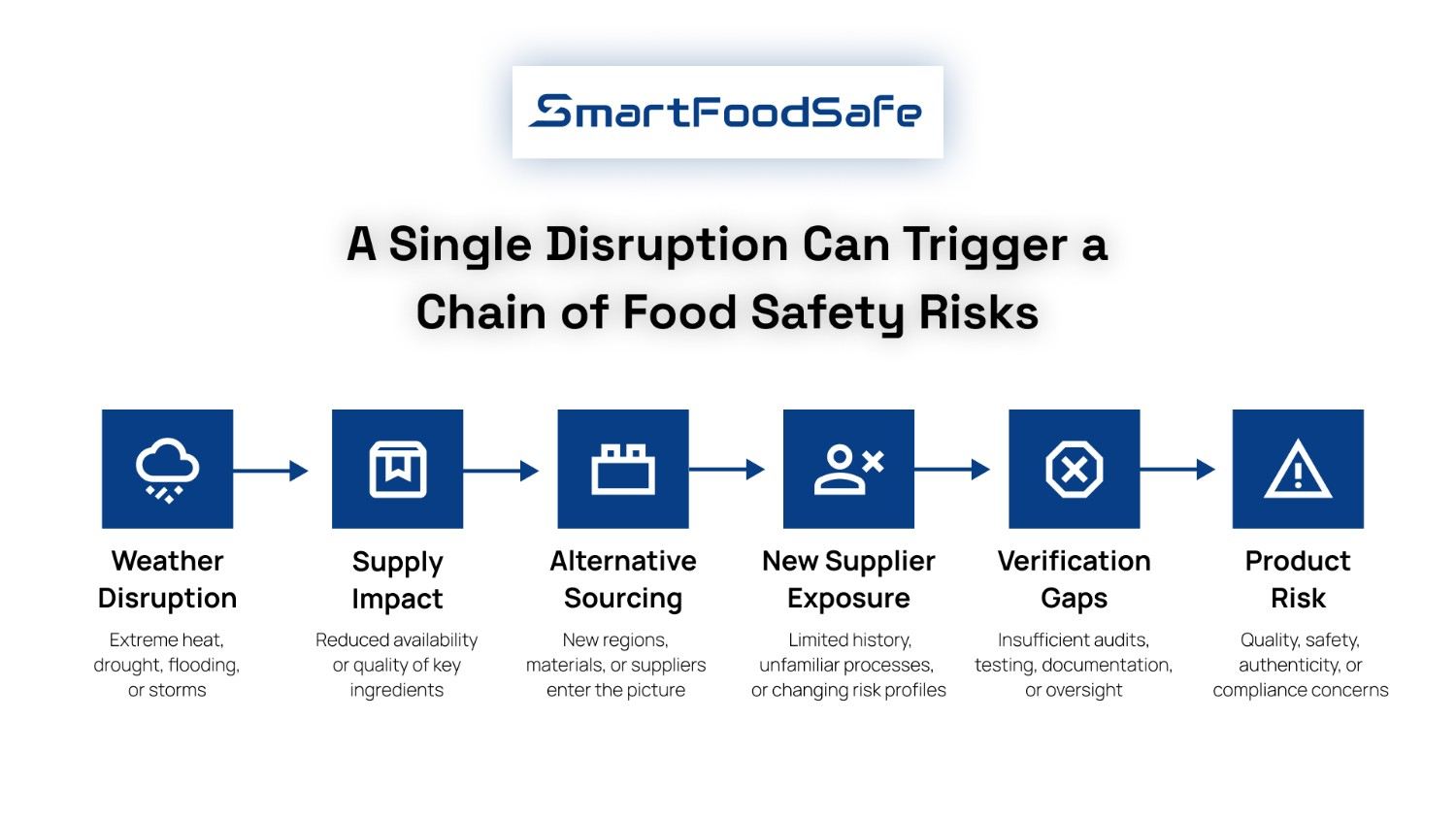
That is why emerging threats need to be considered across the entire journey of an ingredient or product.
Climate change is increasingly becoming a food safety consideration as well as an agricultural challenge. Extreme heat, drought, flooding, changing rainfall, and water scarcity can affect crop quality, ingredient availability, contamination patterns, and storage conditions. They can also disrupt roads, ports, warehouses, and refrigeration infrastructure.
Some hazards may become more significant under these changing conditions, including concerns around mycotoxins and other contaminants.
Areas that may require closer attention include:
For food manufacturers, changes in the environment can ultimately become changes in food safety, raw-material quality, supply continuity, and supplier risk.
An approved supplier can become a very different risk six months later. Sources change, facilities are added, processes are modified, subcontractors enter the chain, and capacity constraints can affect consistency. Documentation can also become outdated.
This is why supplier qualification should be treated as an ongoing process rather than a one-time decision.
A resilient supplier program should connect:
Qualification → Performance → Audit → Change → Reassessment
When an ingredient becomes scarce or significantly more expensive, authenticity can become harder to take for granted.
Substitution, dilution, adulteration, mislabeling, and misrepresentation can exploit weaknesses in complex sourcing networks. The risk can be greater when fraudulent materials are difficult to distinguish through routine quality checks.
Key controls include:
The goal is not to test everything equally. It is to understand where fraud is plausible, what could be gained from it, and where existing controls could fail.
 Also Read
Food Integrity in Food Safety
Also Read
Food Integrity in Food Safety
Pathogens remain a critical food safety concern, but they are only part of the evolving hazard landscape. Manufacturers are also monitoring mycotoxins, chemical residues, environmental contaminants, marine biotoxins, antimicrobial resistance, and other emerging risks.
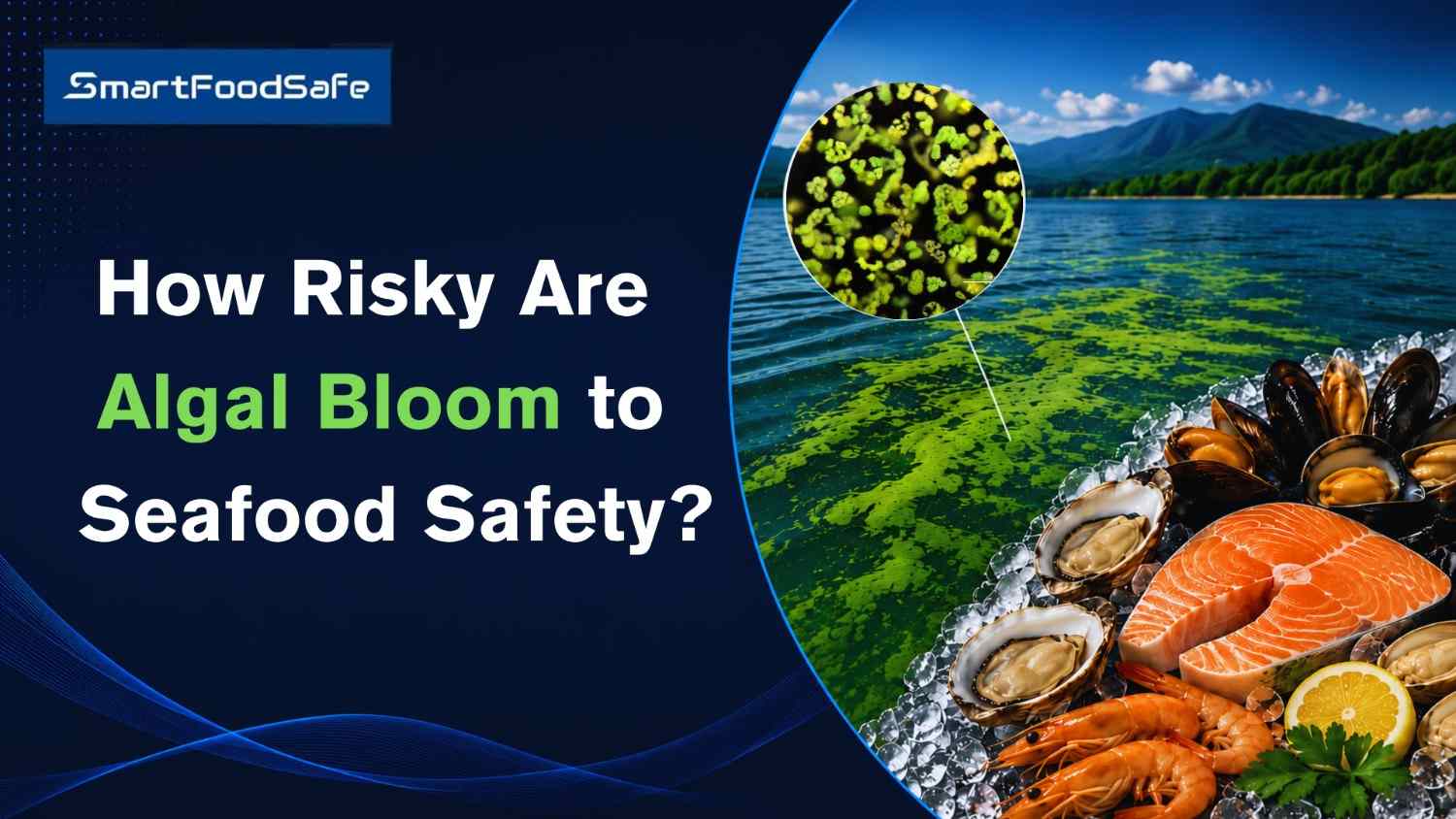 Also Read
How Harmful Algal Blooms Impact Seafood Safety and Aquaculture
Also Read
How Harmful Algal Blooms Impact Seafood Safety and Aquaculture
This does not mean every manufacturer needs an ever-growing testing program. Instead, hazard assessments should evolve when scientific evidence, sourcing conditions, or regulatory expectations change.
Useful signals can come from:
As supply networks become longer and more geographically dispersed, maintaining consistent oversight becomes more difficult. Different countries can have different regulatory requirements, enforcement approaches, labeling expectations, and food safety standards, creating potential compliance gaps for businesses operating across markets.
For multinational manufacturers and suppliers, the challenge is balancing global consistency with local requirements.
This makes the following increasingly important:
Traceability can seem routine when operations are running normally. Its real value becomes clear during an incident, when teams need to quickly determine where a material came from, which lot received it, where it was used, and which finished products could be affected.
When this information is spread across spreadsheets, emails, certificates, and separate systems, containment becomes slower and less precise.
A strong traceability model creates a clear information trail:
Supplier → Ingredient → Lot → Production → Finished Product → Distribution
This helps teams narrow the scope of an incident and take targeted action instead of treating every related product as potentially affected.
A supply chain vulnerability becomes a food safety incident when a weakness or change upstream begins to affect the safety, quality, or compliance of the material entering production. The warning signs are often subtle and may appear across different stages of the supply chain rather than in one place.
For example, a supplier may change a raw-material source, experience a process deviation, or introduce a new subcontractor. On its own, each change may seem manageable. But when these changes coincide with unusual test results, recurring quality issues, or shifts in supplier performance, they can signal a much larger risk.
The warning signs may include:
Most established food manufacturers already have controls for suppliers, specifications, audits, testing, traceability, environmental monitoring, and CAPA.
| Disconnected controls | Connected controls |
|---|---|
| Supplier changes remain buried in emails | Changes are linked to supplier risk |
| Specifications sit in separate records | Requirements stay linked to materials |
| Audit findings remain isolated | Findings connect to corrective actions |
| Monitoring data is reviewed separately | Trends are viewed across related data |
| CAPAs sit on their own | Actions stay linked to the root issue |
| Traceability requires multiple searches | Records can be traced across the process |
Digitalization is therefore most valuable when it connects decisions, evidence, and action, rather than simply replacing paper forms.
Resilience starts with knowing where the greatest exposure lies and making sure controls evolve as conditions change. The goal is not to add more checks everywhere, but to focus effort where it can have the greatest impact.
Start with the factors most likely to affect food safety, including:
Match verification activities to the level of exposure. Depending on the risk, this may include supplier documentation, audits, testing, authenticity checks, specifications, and incoming-material controls.
Changes in supplier performance, environmental monitoring, laboratory results, deviations, or audit findings can reveal emerging problems before they escalate.
When an issue is identified, connect it to investigation, root-cause analysis, corrective action, effectiveness checks, and reassessment where needed.
Supply chain resilience is not a one-time exercise. Each finding should inform the next decision, creating a cycle of:
Assess → Verify → Monitor → Respond → Improve
Managing emerging food safety and supply chain risks becomes more difficult when supplier records, specifications, audits, monitoring data, and corrective actions are scattered across spreadsheets, emails, and disconnected systems.
Smart Food Safe brings these processes together in a connected food safety management system, helping food manufacturers improve supplier risk management, strengthen food safety compliance, and maintain better visibility across the supply chain.
Food safety risk management starts before raw materials enter the facility. Smart Supplier helps teams manage the supplier lifecycle while keeping qualification, risk, performance, and compliance information organized.
Key capabilities include:
Smart Specification keeps material and product requirements structured and accessible, while Smart Compliance and Smart Audit support verification, audits, findings, and follow-up.
Supplier controls cannot identify every risk once production begins. Ongoing environmental monitoring helps manufacturers detect changing conditions within the facility.
Smart EMP supports digital environmental monitoring through:
This helps food safety teams identify patterns and respond before an isolated finding develops into a larger issue.
When a food safety deviation or nonconformance occurs, the response needs to go beyond immediate correction. Smart CAPA provides a structured workflow for investigation, root-cause analysis, corrective and preventive action, and effectiveness verification.
This creates a clearer path from finding → investigation → action → verification, helping teams address underlying causes and reduce recurrence.
 Also Read
How CAPA Strengthens Every Part of a Food Safety Management System
Also Read
How CAPA Strengthens Every Part of a Food Safety Management System
The real value comes from connecting these processes rather than managing each one separately:
Supplier → Specification → Verification → Audit → Monitoring → CAPA → Continuous Improvement
A connected approach gives food manufacturers greater visibility into supplier risk, food safety performance, emerging issues, and the actions required to address them.
Build a More Connected Food Safety Management System
Emerging food safety risks cannot always be predicted, but manufacturers can strengthen how they identify, monitor, and respond to them. Smart Food Safe connects supplier management, specifications, compliance, audits, environmental monitoring, and CAPA in one digital ecosystem. → Request a Demo
It may not arrive as an obvious contamination event.
It could begin with a crop failure, a sourcing decision, a supplier change, a new contaminant, a regulatory shift, or an unusual result hidden among thousands of routine records.
That is why resilience is becoming less about predicting every possible disruption and more about seeing change early enough to do something about it.
The strongest food businesses will not be those that assume their existing controls are enough.
They will be those willing to keep asking what has changed, connect the signals, and strengthen the controls before a vulnerability becomes an incident.
Key areas include climate-related disruption, supplier vulnerability, food fraud, emerging contaminants, antimicrobial resistance, regulatory differences, traceability gaps, logistics disruption, and digital information risks.
Changing temperatures, rainfall, water availability, and extreme weather can influence raw-material quality, contamination patterns, agricultural production, storage, and transportation.
Supplier risk can change when sourcing, facilities, processes, subcontractors, or business conditions change. Periodic reassessment helps identify those changes before they affect production.
A combination of commodity vulnerability assessment, supplier verification, authenticity testing, specification management, targeted audits, and traceability can strengthen prevention.
Traceability helps identify the source, movement, and use of affected materials, allowing organizations to narrow the scope of containment and make recall decisions more precisely.
Connected systems can link supplier information, specifications, audits, monitoring data, compliance activities, and corrective actions, helping teams identify relationships and respond more efficiently.

 French
 Spanish
 Portuguese