


 English
▾
English
▾
English
▾
English
▾
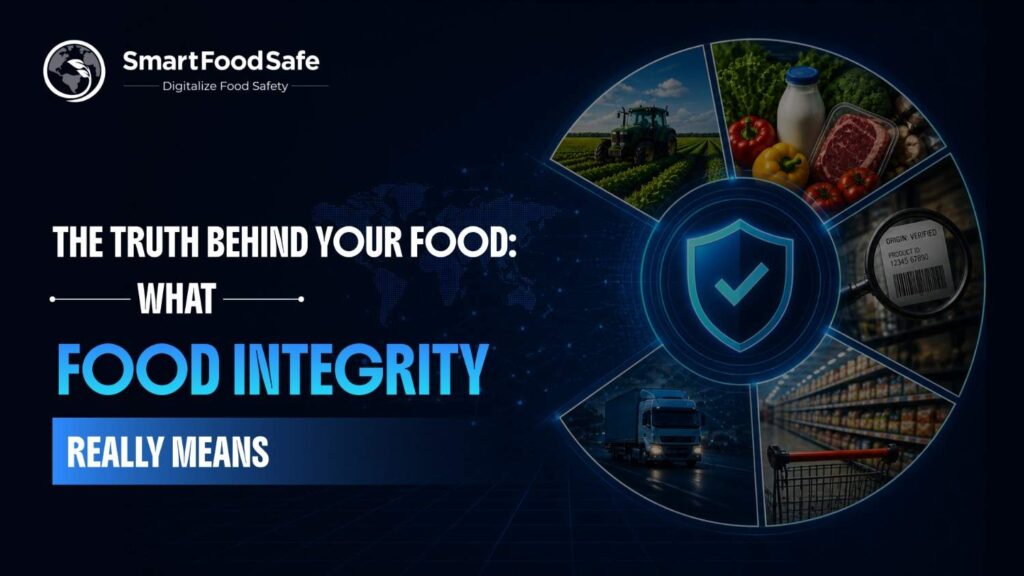
When a product says "organic," "pure," or "authentic," how do you know it truly is?
It's a simple question but it carries a complex reality.
Today, food integrity is no longer just a technical concept, it's a promise. A promise that what's written on the label matches what's inside the product. A promise that what consumers trust is, in fact, true.
With rising concerns around food fraud, mislabeling, and increasingly complex supply chains, that promise is under pressure.
This blog breaks down what food integrity really means, why it matters more than ever, and how businesses can actively protect it.

Food integrity means ensuring that a food product is authentic, traceable, transparent, safe, and compliant from source to shelf.
It asks important questions: Is this product genuine? Can its origin be verified? Are the ingredients and claims accurate? Has it been handled responsibly across the supply chain?
In simple terms, food integrity means delivering exactly what was promised - nothing less, nothing different.
Food safety and food integrity are related, but they are not the same.
Food safety protects consumers from harm such as pathogens, contamination, and unsafe handling. Food integrity, however, goes beyond that. It includes:
A product can be safe to eat and still lack integrity if it is diluted, mislabeled, or falsely marketed. That is why food integrity is broader: all food with integrity must be safe, but not all safe food has integrity.
Food quality focuses on taste, freshness, texture, appearance, and consistency.
Food integrity includes quality but also asks deeper questions:
A product may taste excellent and still fail the integrity test if it is misrepresented. That difference matters more than many brands realize.
Consumers place enormous trust in labels, certifications, and brand promises. They expect honesty. They expect transparency. And they are increasingly looking for clean label products, ethical sourcing, and verified claims.
When food integrity is compromised, trust can disappear in an instant. And once lost, trust is difficult to rebuild.
A single issue involving food fraud, mislabeling, or a recall can spread fast, especially in today's digital world. News travels quickly. So do screenshots, comments, and public criticism.
That means one integrity failure can damage a reputation that took years to build.
Food integrity also supports compliance with regulations around traceability, labeling accuracy, and supplier verification. When these systems are weak, the risks are serious: penalties, recalls, market restrictions, and lost business.
Food fraud includes practices such as adulteration, substitution, and counterfeiting. Sometimes it is driven by profit. Sometimes by pressure. But the result is the same: consumers get something different from what they were promised.
Strong food integrity systems act as preventive controls against that risk.
At its core, food integrity depends on five things: authenticity, traceability, transparency, quality consistency, and safety compliance.
Authenticity confirms the product is genuine. Traceability allows ingredients and materials to be tracked across the supply chain. Transparency ensures accurate communication with consumers and regulators. Quality consistency keeps standards uniform from batch to batch. And safety compliance ensures the product is handled responsibly at every step.
Together, these elements create confidence.
Food integrity is often broken not by one major event, but by many small failures.
Food fraud can involve diluted milk, fake organic claims, or substituted oils and spices. Cross-contamination may introduce allergens, pathogens, or foreign materials. Supply chain weaknesses can hide issues when suppliers are not verified or transport conditions are poorly controlled.

Then there are labeling inaccuracies and poor documentation, which may sound administrative but can have real consequences. Incorrect records break traceability. Incorrect labels break trust.
For manufacturers, strong food integrity means better compliance, fewer recalls, and more efficient operations.
For suppliers, it builds credibility and long-term partnerships.
For retailers and distributors, it reduces the risk of stocking non-compliant or fraudulent products.
And for consumers, it means confidence, safety, and value for money.
Food integrity does not just protect products. It protects relationships.
Protecting food integrity begins with stronger systems.
Start with supplier verification. Audit, approve, and continuously monitor suppliers based on risk. Strengthen traceability with digital tools that provide real-time visibility. Standardize quality and safety checks through inspections, testing, and environmental monitoring programs.
Improve labeling and documentation controls so claims are validated before release and records stay accurate. And use digital tools and automation to reduce manual errors, improve consistency, and support preventive action.
The more visible your process becomes, the harder it is for risk to hide.
Systems matter. But culture decides whether those systems work.
A strong food integrity program depends on people who take responsibility seriously. Employees must be trained to recognize risks, report issues, and understand why honesty in food production is non-negotiable. Leadership must set the tone by making integrity a priority, not a slogan.
When integrity becomes part of daily behavior, it becomes part of the brand.
Food integrity is not optional. It is foundational.
It connects food safety, food quality, trust, transparency, and compliance into one essential standard: honesty. In the end, the question is not only whether your food is safe. It is whether it is true to what it claims to be.
The real question is this: are your systems strong enough to protect that truth?

 French
 Spanish
 Portuguese