


 English
▾
English
▾
English
▾
English
▾
Did you know that a staggering 94% of employees expressed a willingness to remain with a company if it prioritized continuous learning? This revelation comes from LinkedIn’s 2018 Workplace Learning Report, underlining the significance of ongoing learning opportunities.
The rise of digital technology is reshaping the landscape of talent development. Traditional learning methods are undergoing a transformation, with online platforms, virtual classrooms, and interactive tools providing personalized and flexible learning experiences. E-learning modules, virtual simulations, and AI-driven assessments are enhancing skill acquisition and performance evaluation. This digital shift allows learners to access knowledge anywhere, anytime, promoting constant growth and adaptability in an ever-changing professional environment. This is where a robust learning management system (LMS) comes into play.
An LMS serves as a software application that streamlines the creation, delivery, and automation of learning and training materials. These systems contribute to the digitalization of the learning process by integrating crucial components like learning content, content creation, collaboration tools, tracking, and reporting into a unified platform.
The significance of LMS lies in its ability to seamlessly incorporate learning into the work routine, catering to the 68% of employees who prefer learning at their workplace (2018 Workplace Learning Report). Moreover, 58% of employees opt for self-paced learning, a preference easily accommodated by LMS. Organizations implementing LMS establish a contemporary and efficient learning environment aligned with the demands of today’s hybrid work setups.
The journey begins with content creation. Educators, trainers, or administrators design digital learning materials that are organized and uploaded to the LMS. Courses are made engaging through the inclusion of audio, video, presentations, interactive quizzes, and even virtual reality experiences.
LMS platforms allow administrators to manage user accounts. This involves creating new accounts, enrolling users in specific courses, assigning roles (such as student, instructor, or administrator), and setting access permissions.
Instructors or content creators utilize the LMS to design courses. A course typically comprises a sequence of modules or lessons. Within these modules, content is uploaded, objectives are set, and learning outcomes are defined. Assessments like quizzes or assignments can be incorporated to gauge learners’ progress.
Learners are enrolled in courses by administrators or instructors. Upon enrollment, they gain access to the course materials and resources within the LMS. Some systems even allow self-enrollment, granting learners the freedom to choose and join courses independently.
Admins can share lessons with employees online and monitor their progress. Learners access course materials, which encompass videos, presentations, reading materials, interactive simulations, and more, via the LMS. They can study at their own pace, following the course structure set by the instructor. Assessments are completed, with the system automatically grading and recording performance.
Features for tracking progress enable oversight of learners’ advancement through the course. Advanced reporting systems provide managers with dashboards to monitor individual progress, simplifying compliance demonstration and audit preparedness.
LMS platforms often include communication tools such as discussion forums, chat, and messaging systems. These tools facilitate interaction between learners and instructors, allowing for discussions, questions, and clarifications.
Instructors can provide feedback on assignments and assessments through the LMS. Administrators and instructors can access detailed reports and analytics regarding learner progress, engagement, and performance. This data aids in refining courses and instructional strategies.
Completion of a training course results in a certificate and proof of competencies, enhancing one’s resume and professional profile. Notifications are sent to managers when learners complete courses.
A study covering 32 Asian countries from 2010 to 2021 explored the impact of labor quality and digitalization on upgrading the industrial structure of Asian economies.
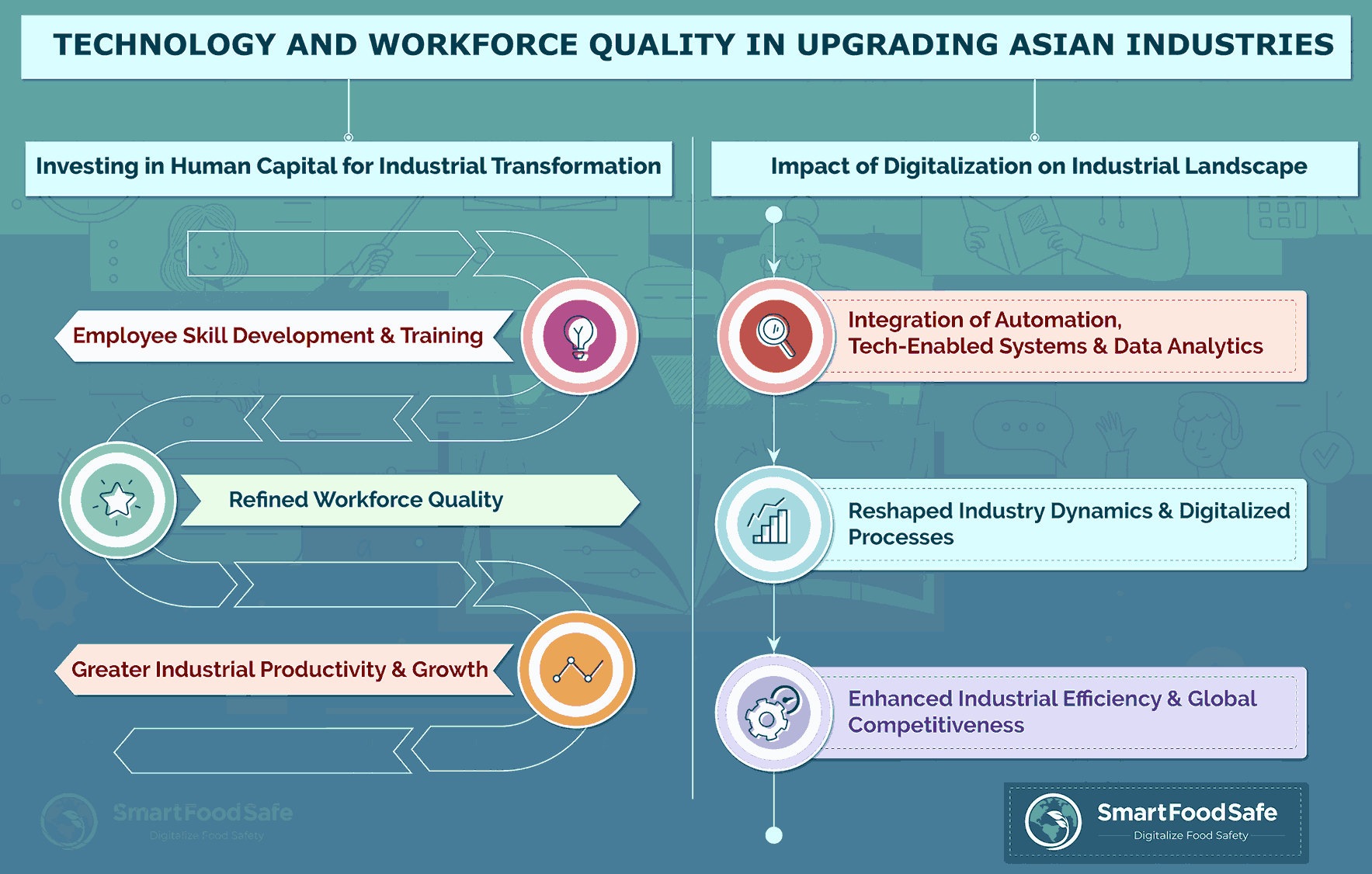
The findings underscored the positive influence of a high-quality workforce on industrial structure enhancement. Digitalization played a crucial role in fostering collaboration, connectivity, and increased productivity. The study emphasized the importance for Asian nations to invest in education and skill development to improve human capital quality while also prioritizing digitalization through investments in digital infrastructure, skill development, and favorable regulatory environments. These measures can accelerate industrial advancement, resulting in sustainable economic growth, enhanced competitiveness, and improved living standards.
Industrial upgradation refers to the process of strengthening and advancing existing industrial infrastructure within a specific sector or region. This involves modernizing and improving various aspects of industrial operations, including technology, processes, equipment, and overall efficiency, with the aim of fostering economic expansion and competency. Industrial transformation encompasses dimensions like technological advancement, infrastructure development, skill enrichment, and research and development efforts. Developing economies, predominantly in Asia, face significant challenges in upscaling their industrial structures, making this a critical concern. A skilled workforce proficient in new technologies drives progress by effectively operating machinery, maintaining quality standards, and contributing to research and development. The synergy between technology and workforce quality sustains a thriving industrial landscape.
Over the past four decades, numerous Asian economies have undergone significant structural changes in output and employment systems. East Asian economies, including Japan and Southeast Asian countries, have experienced remarkable economic and industrial advancements. Meanwhile, India has aimed to boost manufacturing’s contribution to GDP and job creation, while the Philippines has sought to reverse a period of deindustrialization. The pivotal role of the industrial sector in Asian economies’ rapid growth highlights the importance of understanding the interplay between labor quality, digitalization, and industrial enhancement, all crucial for sustained economic development.
The study “Unleashing the Potential of Labor Quality and Digitalization in Upgrading Asian Industrial Structures” sheds light on the intricate relationship between labor quality, digitalization, and industrial structure enhancement across diverse Asian countries. Despite rapid economic growth and industrialization, these dimensions have received limited attention in previous research, making this study a significant contribution.
The study utilized panel data from 32 Asian countries spanning 2010 to 2021. Acknowledging the diversity within labor markets, encompassing varying education levels, skills, and expertise, the research provides insights into the potential impact of labor quality on industrial progress.
The augmentation of human capital quality emerges as a pivotal factor in shaping the industrial structure, as revealed by the study. A strong positive correlation between labor quality and industrial framework advancement across different Asian nations was observed. Given the diverse labor markets in these countries, strategic investments in human capital through education, skill development, and workforce training emerged as catalysts for enhancing industrial productivity and efficiency. Prioritizing the refinement of labor quality significantly contributes to overall industrial enhancement, supporting economic growth, investment attractiveness, and a conducive environment for advancement.
The study also emphasizes the favorable influence of digitalization on the evolution of the industrial landscape in Asian countries. This digital transformation stimulates industrial structure advancement, supported by robust institutional frameworks, comprehensive employment strategies, and robust research and development initiatives. The integration of digital technologies such as automation, artificial intelligence, and data analytics has fundamentally reshaped industry dynamics in Asian economies. This integration translates to increased productivity, operational efficiency, and innovative capabilities, bolstering these industries’ competitive positions globally.
The implications of these findings extend profoundly to policy formulation. Asian governments are encouraged to recognize the pivotal roles of labor quality and digitalization in driving industrial transformation. Policy frameworks should prioritize investments in education, skill enrichment, and digital infrastructure to nurture a skilled workforce and foster technological innovation. Such measures can catalyze industrial expansion, enhance global competitiveness, and support sustainable development trajectories. Facilitating knowledge exchange and collaboration among nations can further facilitate the transfer of skills, technological expertise, and insights, fostering mutual learning and paving the way for cohesive regional industrial integration.
In pursuit of effective developmental strategies, each Asian country should evaluate its unique strengths and weaknesses in the context of digitalization. Addressing the digital divide in certain Central and South Asian nations requires concerted efforts to strengthen regional infrastructure. A strategic focus on cultivating specialized talent, reinforcing digital technology-focused research and development funding, and creating an innovation-friendly ecosystem is essential for these countries.
Strategic investments in human capital development and embracing digitalization and technological progress yield tangible benefits in the form of heightened productivity, efficiency, innovation, and global competitiveness. These insights provide invaluable guidance for policymakers, industry stakeholders, and researchers in their endeavors to drive sustainable industrial development and economic prosperity within the region.
Drawing from the study’s insights, an effective approach for Asian industries involves combining digitalization and skill development through the adoption of an efficient Learning Management System (LMS). This integration promises to revolutionize workforce training strategies by seamlessly incorporating digital features.
In today’s rapidly evolving business landscape, maintaining a competitive edge demands more than just keeping up with trends – it requires an agile, well-equipped workforce that can drive growth. This is where Smart Training, a state-of-the-art learning management system, comes into play. By harnessing the power of digitalization, Advanced Training offers a transformative approach to workforce development, ensuring that your company remains a trailblazer in its industry’s evolution.
In a world shaped by digitalization, Smart Training stands as a beacon of innovation, leveraging its capabilities to empower the workforce, drive industry transformation, and secure a prosperous future. Embrace the digital era and elevate your business with Smart Training – where learning meets digital empowerment.

 French
 Spanish
 Portuguese