


 English
▾
English
▾
English
▾
English
▾
Can you recollect the last instance when you experienced food poisoning? While it may seem commonplace for many of us to encounter food safety issues, understanding the principles of safe food preparation can significantly reduce such incidents, especially when unsafe food can create a vicious cycle of disease and malnutrition, particularly affecting infants, young children, the elderly, and the sick.
The World Health Organization (WHO) accurately states that a safe food supply contributes to food and nutrition security and hence, supports national economies, trade, and tourism, stimulating sustainable development.
WHO has identified several common errors related to food handling that are responsible for a significant proportion of foodborne disease episodes worldwide. To address these issues, WHO has developed the ”Golden Rules” for Safe Food Preparation, a set of guidelines aimed at reducing the risk of foodborne pathogens contaminating, surviving, or multiplying in our food.
According to WHO data, there are a few key factors related to food handling that contribute to the large number of foodborne disease episodes. These include:
⇒ Improper Food Preparation and Storage: This involves preparing food several hours before consumption and storing it at temperatures that promote the growth of pathogenic bacteria or the formation of toxins.
⇒ Inadequate Cooking or Reheating: Insufficient cooking or reheating of food can fail to eliminate or reduce pathogens, making the food unsafe to consume.
⇒ Cross-contamination: This occurs when harmful bacteria from raw foods are transferred to cooked or ready-to-eat foods, leading to contamination.
⇒ Poor Personal Hygiene: People with inadequate personal hygiene handling food can introduce harmful bacteria and pathogens into the food.
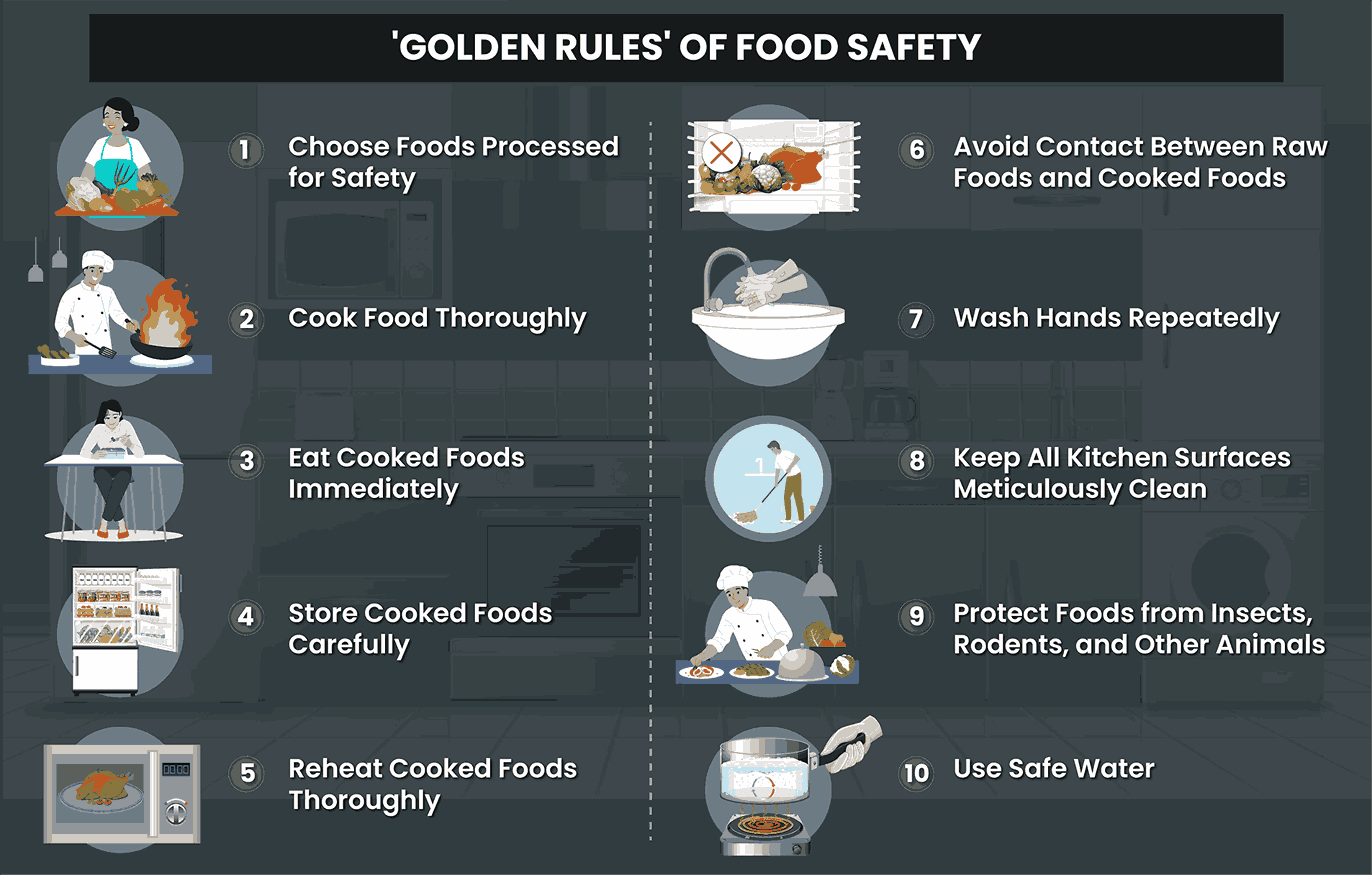
To combat the above-mentioned common errors and reduce the risk of foodborne diseases, WHO has formulated the following “Golden Rules” for safe food preparation:
While many foods, such as fruits and vegetables, are best in their natural state, others simply are not safe unless they have been processed. For example, always buy pasteurized as opposed to raw milk and, if you have the choice, select fresh or frozen poultry treated with ionizing radiation. When shopping, keep in mind that food processing was invented to improve safety as well as to prolong shelf-life. Certain foods eaten raw, such as lettuce, need thorough washing.
Many raw foods, most notably poultry, meats, eggs, and unpasteurized milk, may be contaminated with disease-causing organisms. Thorough cooking will kill the pathogens, but remember that the temperature of all parts of the food must reach at least 70 °C. If cooked chicken is still raw near the bone, put it back in the oven until it is done – all the way through. Frozen meat, fish, and poultry must be thoroughly thawed before cooking.
When cooked foods cool to room temperature, microbes begin to proliferate. The longer the wait, the greater the risk. To be on the safe side, eat cooked foods just as soon as they come off the heat.
If you must prepare foods in advance or want to keep leftovers, be sure to store them under either hot (near or above 60 °C) or cool (near or below 10 °C) conditions. This rule is of vital importance if you plan to store foods for more than four or five hours. Foods for infants should preferably not be stored at all. A common error, responsible for countless cases of foodborne disease, is putting too large a quantity of warm food in the refrigerator. In an overburdened refrigerator, cooked foods cannot cool to the core as quickly as they must. When the center of food remains warm (above 10 °C) for too long, microbes thrive, quickly proliferating to disease-causing levels.
This is your best protection against microbes that may have developed during storage (proper storage slows down microbial growth but does not kill the organisms). Once again, thorough reheating means that all parts of the food must reach at least 70 °C.
Safely cooked food can become contaminated through even the slightest contact with raw food. This cross-contamination can be direct, as when raw poultry meat comes into contact with cooked foods. It can also be more subtle. For example, don’t prepare a raw chicken and then use the same unwashed cutting board and knife to carve the cooked bird. Doing so can reintroduce the disease-causing organisms.
Wash hands thoroughly before you start preparing food and after every interruption – especially if you have to change the baby or have been to the toilet. After preparing raw foods such as fish, meat, or poultry, wash again before you start handling other foods. And if you have an infection on your hand, be sure to bandage or cover it before preparing food. Remember, too, that household pets – dogs, cats, birds, and especially turtles – often harbor dangerous pathogens that can pass from your hands into food.
Since foods are so easily contaminated, any surface used for food preparation must be kept absolutely clean. Think of every food scrap, crumb, or spot as a potential reservoir of germs. Cloths that come into contact with dishes and utensils should be changed frequently and boiled before re-use. Separate cloths for cleaning the floors also require frequent washing.
Animals frequently carry pathogenic microorganisms which cause foodborne disease. Storing foods in closed containers is your best protection.
Safe water is just as important for food preparation as for drinking. If you have any doubts about the water supply, boil water before adding it to food or making ice for drinks. Be especially careful with any water used to prepare an infant’s meal.
While the “Golden Rules” for safe food preparation are universal in addressing common errors related to food handling, it is crucial to recognize the plurality of cultural settings worldwide. Food preparation habits and practices can vary substantially across different cultures, and therefore, the guidelines should be adapted to suit specific cultural contexts.
Users are encouraged to tailor the “Golden Rules” to their cultural setting, incorporating cultural norms, traditions, and practices into the food safety guidelines. By adapting the rules to align with cultural habits and practices, their effectiveness in changing habitual practices and promoting safe food handling will be enhanced.
Preparing safe food is a shared responsibility that requires vigilance, knowledge, and adherence to proper food-handling practices. By following these guidelines and adapting them to specific food manufacturing processes, food industries can ensure safe food for everyone, preventing or eliminating the consequences of foodborne illnesses.
Just like how the WHO’s “Golden Rules” for safe food preparation serve as a comprehensive guide to reducing the risk of foodborne diseases, Smart Food Safe’s food safety management software furnishes food enterprises with the capabilities to maintain unwavering compliance with food safety standards and protocols.
Traditional paper-based safety management systems fall short of effectively managing contemporary food safety requirements as they are prone to inaccessibility, damage, and errors in data entry, complicating both internal and external audit processes, and making them tedious and time-intensive. This is where our digital food safety management tool streamlines these procedures by consolidating all relevant data in a single accessible platform and automating reminder notifications.
Navigating the interconnected food safety management elements can be daunting for business leaders. Historically, managing these diverse aspects has been a resource-draining endeavor, marked by laborious processes, excessive manpower, and inflated costs. Smart Food Safe’s innovative food safety management software breaks down this complexity, integrating all facets of food safety, empowering stakeholders with control, standardizing processes, ensuring uniformity in output and efficiency, and aiding in obtaining and preserving food safety certifications.

 French
 Spanish
 Portuguese