
 English
▾
English
▾
English
▾
English
▾

Given the wide range of ultra-processed foods and drinks available in the market incorporated with a vast multitude of claims, streamlining the global information on nutritional awareness and properly translating them into comprehensible food labels is necessary. It helps in educating the consumers to make well-informed decisions and healthiest food choices. This is simply what Front-of-Package Nutritional Labeling (FOPNL) presents, paving the way for a more knowledgeable and healthier future.
“ FOPNL are either interpretive or warning labels that are applied to foods and beverages to educative consumers about the actual and/or relative healthiness of different products. Warning FOPNL actively tries to dissuade consumers from selecting less healthy options, whilst interpretive FOPNL requires that consumers make a judgment call based on the information provided. ”
FOPNL refers to nutrition labels displayed on the front of food packages, intending to help consumers make healthier food choices by providing simplified, easy-to-understand nutritional information in one place. FOPNL on pre-packaged foods and beverages offers quick and accessible information, enabling consumers to differentiate between healthy and unhealthy options. An evidence-based FOPNL system can also support other food policies, such as marketing restrictions aimed at children, school food regulations, and even taxation policies.
People need a straightforward method to make healthier purchases. Research shows that consumers prefer FOPNL, which is immediately visible and easily understandable as such labels reduce the effort required to identify unhealthy items, decreasing the likelihood of their purchase and increasing the intention to buy healthier alternatives.
Boost your food business’s hygiene standards with Smart Food Safe’s tech-driven solutions—streamline 4C processes to yield optimal results, and ensure compliance effortlessly.

Boost your food business’s hygiene standards with Smart Food Safe’s tech-driven solutions—streamline 4C processes to yield optimal results, and ensure compliance effortlessly.
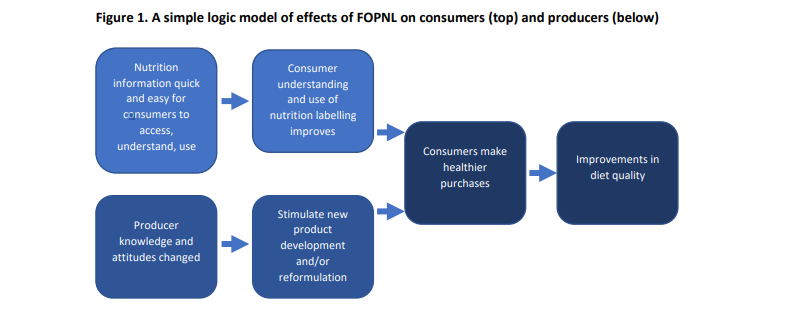
Reference: https://www.unicef.org/media/118716/file
Given below is a step-by-step look at how FOPNL drives positive health outcomes:
Accessible Nutrition Information
FOPNL provides quick and easy access to essential nutrition information, allowing consumers to readily understand and use the data to their benefit.
↓
Enhanced Consumer Understanding and Usage
With FOPNL, consumers better comprehend nutrition labels, assisting individuals in selecting healthier options, and fostering better dietary habits.
↓
Increased Producer Knowledge and Attitudes
FOPNL encourages food producers to become more knowledgeable and conscious about the nutritional content of their products, leading to healthier product offerings.
↓
Stimulated Product Development and Reformulation
Food producers are incentivized to innovate and reformulate their products to meet healthier standards. Companies create new products or improve existing ones to appeal to health-conscious consumers.
↓
Augmented Overall Diet Quality
With healthier purchases becoming the norm, consumers’ diet quality sees a marked improvement, reducing the intake of unhealthy components like added sugars, sodium, and unhealthy fats.
↓
Reduction in Overweight, Obesity, and Non-Communicable Diseases (NCDs)
The cumulative effect of better diet quality is a decrease in the prevalence of overweight, obesity, and related non-communicable diseases such as diabetes, heart disease, and certain cancers.
The primary goal of Front-of-Pack Nutrition Labeling (FOPNL) is to provide consumers with accurate, science-based, and transparent nutrition information, enabling them to make informed and balanced choices. FOPNL should motivate consumers to opt for nutrient-dense foods over energy-dense, nutrient-poor options, as recommended by dietary guidelines globally.
In order to serve this purpose, FOPNL must adhere to the following requirements:

Over 40 countries have implemented easy-to-understand front-of-package (FOP) nutrition labels, enabling consumers to quickly assess the healthfulness of food products. These labels use symbols, colors, and simple language to educate the public on nutritional content, support healthier choices, and encourage manufacturers to reduce salt and sugar in their products. Here are the examples of some FOPNL systems adopted by different countries:

The FDA has proposed a “high in” label, which is considered more effective than the food industry-backed “per serving” label due to its simplicity. The “high in” label eliminates the need for numbers and percentages, focusing instead on key nutritional information. The use of an exclamation point could further enhance its visibility for consumers making quick purchasing decisions.
The FDA has also suggested a color-coding system, though this approach may be confusing. Unlike Nutri-Score, which assigns a single summary color to represent a product’s overall nutritional quality, this label uses different colors for individual nutrients. A simplified “high in” label with a clear symbol would better support transparency in the food supply.
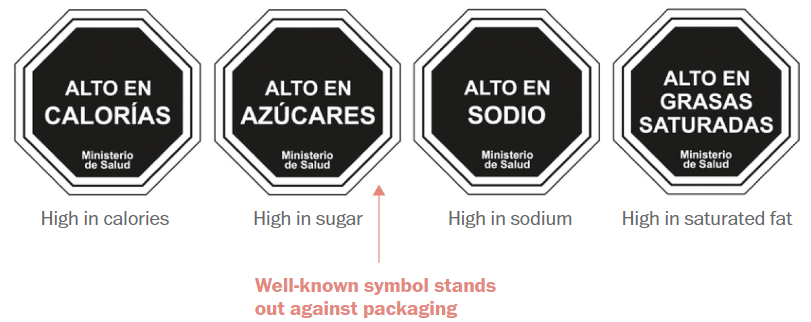
Chile’s warning labels on packaged foods and beverages serve as a leading example for other Latin American countries. These labels are consumer-friendly, utilizing a well-recognized stop sign symbol that stands out against packaging. They highlight essential nutritional information, helping consumers make informed choices. Since their introduction in 2016, these labels have prompted food companies to reduce sugar and salt in their products and have led to decreased purchases of sugary drinks and foods. Additionally, products with a warning label cannot be marketed to children or sold in schools.
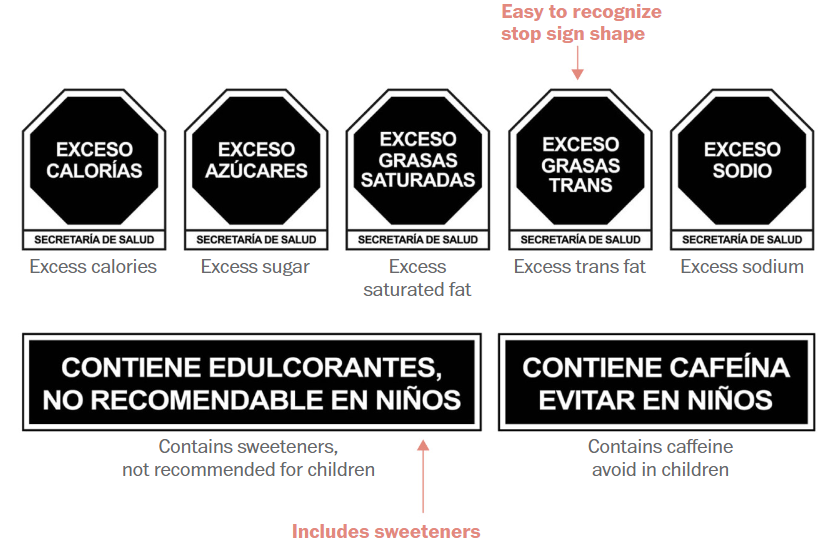
Mexico adopted similar stop-sign-shaped warning labels in 2020, which also include mandatory disclosures for non-sugar sweeteners like sucralose and stevia. This move addresses concerns observed in Chile, where the use of non-sugar sweeteners increased after the introduction of FOP labels, particularly in products that reduced sugar content to avoid carrying a warning label.

France introduced the voluntary Nutri-Score labeling system in 2017, which has since been adopted by many other European Union countries. Nutri-Score effectively communicates a product’s nutritional profile by assigning a score and using a color-coded letter grading system—green for healthier choices and red for less healthy ones—making it easy for consumers to understand the nutritional quality of food products at a glance.

The Health Star Ratings system, voluntarily implemented in Australia and New Zealand, simplifies choosing healthier products by assigning a star rating based on the product’s nutritional content. Products with higher nutritional quality receive more stars. This system has successfully motivated companies to reduce sugar and salt in their products to achieve higher ratings.
As regulatory standards become increasingly stringent, and consumer demand for transparency continues to rise, FOPNL has emerged as a critical component for enhancing consumer awareness. This has pushed for the integration of tech-assisted nutritional label management solutions to create and establish efficient FOPNL. These advanced tools not only streamline the labeling process but also ensure accuracy, compliance, and accessibility, thereby addressing the complexities associated with modern nutritional labeling.
Nutritional label management software, such as Smart Food Safe’s Smart Label, exemplifies this capability by offering features that automate and simplify the implementation of nutrition fact labels and the inclusion of FOPNL. Smart Label helps eliminate the manual errors that often plague traditional labeling methods, ensuring that all nutritional information is presented precisely and comprehensively on the front of the pack.
Embracing Smart Label means investing in a solution that not only meets today’s label management needs but also anticipates tomorrow’s challenges, ensuring sustainable success in the continuously progressing food industry.
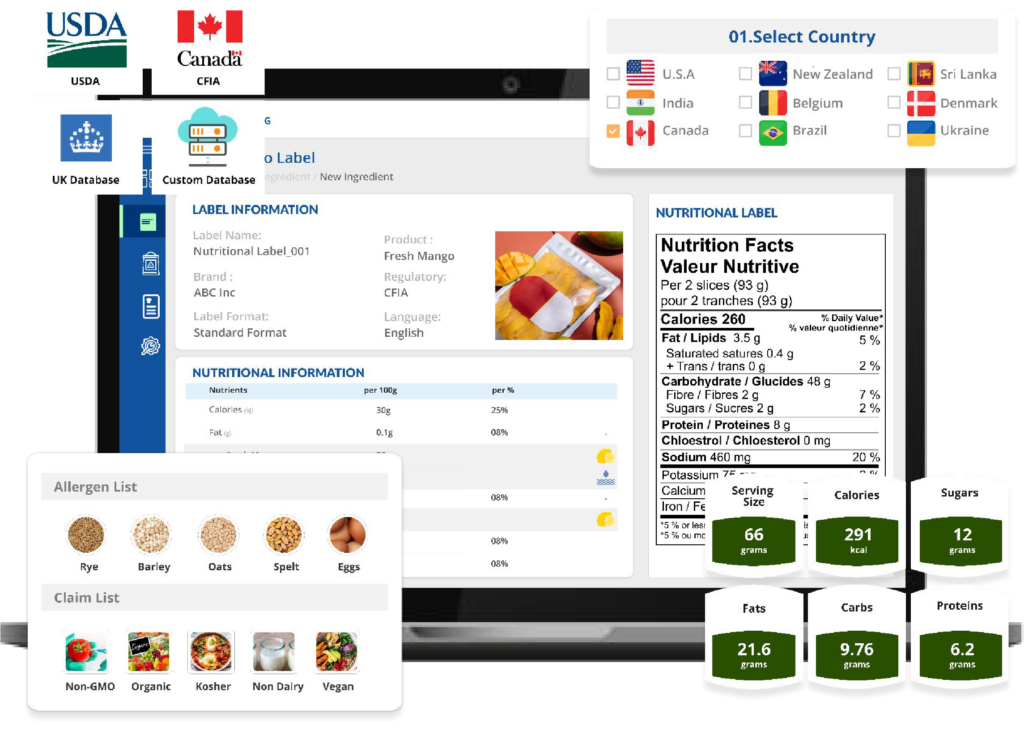
Make the process of implementing FOPNL simple with the digital label management features of Smart Label
Given the wide range of ultra-processed foods and drinks available in the market incorporated with a vast multitude of claims, streamlining the global information on nutritional awareness and properly translating them into comprehensible food labels is necessary. It helps in educating the consumers to make well-informed decisions and healthiest food choices. This is simply what Front-of-Package Nutritional Labeling (FOPNL) presents, paving the way for a more knowledgeable and healthier future.
“ FOPNL are either interpretive or warning labels that are applied to foods and beverages to educative consumers about the actual and/or relative healthiness of different products. Warning FOPNL actively tries to dissuade consumers from selecting less healthy options, whilst interpretive FOPNL requires that consumers make a judgment call based on the information provided. ”
FOPNL refers to nutrition labels displayed on the front of food packages, intending to help consumers make healthier food choices by providing simplified, easy-to-understand nutritional information in one place. FOPNL on pre-packaged foods and beverages offers quick and accessible information, enabling consumers to differentiate between healthy and unhealthy options. An evidence-based FOPNL system can also support other food policies, such as marketing restrictions aimed at children, school food regulations, and even taxation policies.
People need a straightforward method to make healthier purchases. Research shows that consumers prefer FOPNL, which is immediately visible and easily understandable as such labels reduce the effort required to identify unhealthy items, decreasing the likelihood of their purchase and increasing the intention to buy healthier alternatives.
Boost your food business’s hygiene standards with Smart Food Safe’s tech-driven solutions—streamline 4C processes to yield optimal results, and ensure compliance effortlessly.
Reference: https://www.unicef.org/media/118716/file
Given below is a step-by-step look at how FOPNL drives positive health outcomes:
Accessible Nutrition Information
FOPNL provides quick and easy access to essential nutrition information, allowing consumers to readily understand and use the data to their benefit.
↓
Enhanced Consumer Understanding and Usage
With FOPNL, consumers better comprehend nutrition labels, assisting individuals in selecting healthier options, and fostering better dietary habits.
↓
Increased Producer Knowledge and Attitudes
FOPNL encourages food producers to become more knowledgeable and conscious about the nutritional content of their products, leading to healthier product offerings.
↓
Stimulated Product Development and Reformulation
Food producers are incentivized to innovate and reformulate their products to meet healthier standards. Companies create new products or improve existing ones to appeal to health-conscious consumers.
↓
Augmented Overall Diet Quality
With healthier purchases becoming the norm, consumers’ diet quality sees a marked improvement, reducing the intake of unhealthy components like added sugars, sodium, and unhealthy fats.
↓
Reduction in Overweight, Obesity, and Non-Communicable Diseases (NCDs)
The cumulative effect of better diet quality is a decrease in the prevalence of overweight, obesity, and related non-communicable diseases such as diabetes, heart disease, and certain cancers.
The primary goal of Front-of-Pack Nutrition Labeling (FOPNL) is to provide consumers with accurate, science-based, and transparent nutrition information, enabling them to make informed and balanced choices. FOPNL should motivate consumers to opt for nutrient-dense foods over energy-dense, nutrient-poor options, as recommended by dietary guidelines globally.
In order to serve this purpose, FOPNL must adhere to the following requirements:
Over 40 countries have implemented easy-to-understand front-of-package (FOP) nutrition labels, enabling consumers to quickly assess the healthfulness of food products. These labels use symbols, colors, and simple language to educate the public on nutritional content, support healthier choices, and encourage manufacturers to reduce salt and sugar in their products. Here are the examples of some FOPNL systems adopted by different countries:
The FDA has proposed a “high in” label, which is considered more effective than the food industry-backed “per serving” label due to its simplicity. The “high in” label eliminates the need for numbers and percentages, focusing instead on key nutritional information. The use of an exclamation point could further enhance its visibility for consumers making quick purchasing decisions.
The FDA has also suggested a color-coding system, though this approach may be confusing. Unlike Nutri-Score, which assigns a single summary color to represent a product’s overall nutritional quality, this label uses different colors for individual nutrients. A simplified “high in” label with a clear symbol would better support transparency in the food supply.
Chile’s warning labels on packaged foods and beverages serve as a leading example for other Latin American countries. These labels are consumer-friendly, utilizing a well-recognized stop sign symbol that stands out against packaging. They highlight essential nutritional information, helping consumers make informed choices. Since their introduction in 2016, these labels have prompted food companies to reduce sugar and salt in their products and have led to decreased purchases of sugary drinks and foods. Additionally, products with a warning label cannot be marketed to children or sold in schools.
Mexico adopted similar stop-sign-shaped warning labels in 2020, which also include mandatory disclosures for non-sugar sweeteners like sucralose and stevia. This move addresses concerns observed in Chile, where the use of non-sugar sweeteners increased after the introduction of FOP labels, particularly in products that reduced sugar content to avoid carrying a warning label.
France introduced the voluntary Nutri-Score labeling system in 2017, which has since been adopted by many other European Union countries. Nutri-Score effectively communicates a product’s nutritional profile by assigning a score and using a color-coded letter grading system—green for healthier choices and red for less healthy ones—making it easy for consumers to understand the nutritional quality of food products at a glance.
The Health Star Ratings system, voluntarily implemented in Australia and New Zealand, simplifies choosing healthier products by assigning a star rating based on the product’s nutritional content. Products with higher nutritional quality receive more stars. This system has successfully motivated companies to reduce sugar and salt in their products to achieve higher ratings.
As regulatory standards become increasingly stringent, and consumer demand for transparency continues to rise, FOPNL has emerged as a critical component for enhancing consumer awareness. This has pushed for the integration of tech-assisted nutritional label management solutions to create and establish efficient FOPNL. These advanced tools not only streamline the labeling process but also ensure accuracy, compliance, and accessibility, thereby addressing the complexities associated with modern nutritional labeling.
Nutritional label management software, such as Smart Food Safe’s Smart Label, exemplifies this capability by offering features that automate and simplify the implementation of nutrition fact labels and the inclusion of FOPNL. Smart Label helps eliminate the manual errors that often plague traditional labeling methods, ensuring that all nutritional information is presented precisely and comprehensively on the front of the pack.
Embracing Smart Label means investing in a solution that not only meets today’s label management needs but also anticipates tomorrow’s challenges, ensuring sustainable success in the continuously progressing food industry.
Make the process of implementing FOPNL simple with the digital label management features of Smart Label
We Value your Privacy
We use cookies to enhance your browsing experience, serve personalized ads or content, and analyze our traffic. By clicking "Accept All", you consent to our use of cookies. Cookie Policy
Manage your cookie preferences below:
Essential cookies enable basic functions and are necessary for the proper function of the website.
Statistics cookies collect information anonymously. This information helps us understand how visitors use our website.
Marketing cookies are used to follow visitors to websites. The intention is to show ads that are relevant and engaging to the individual user.
 French
 Spanish
 Portuguese