


 English
▾
English
▾
English
▾
English
▾
What's hot this July? The weather, the headlines... and the developments everyone in food safety is talking about.
Whether it was evolving regulations, breakthrough science, global recalls or summer food safety reminders, this month's headlines offered plenty of food for thought. Let's trace the threads that connected this month's biggest stories.
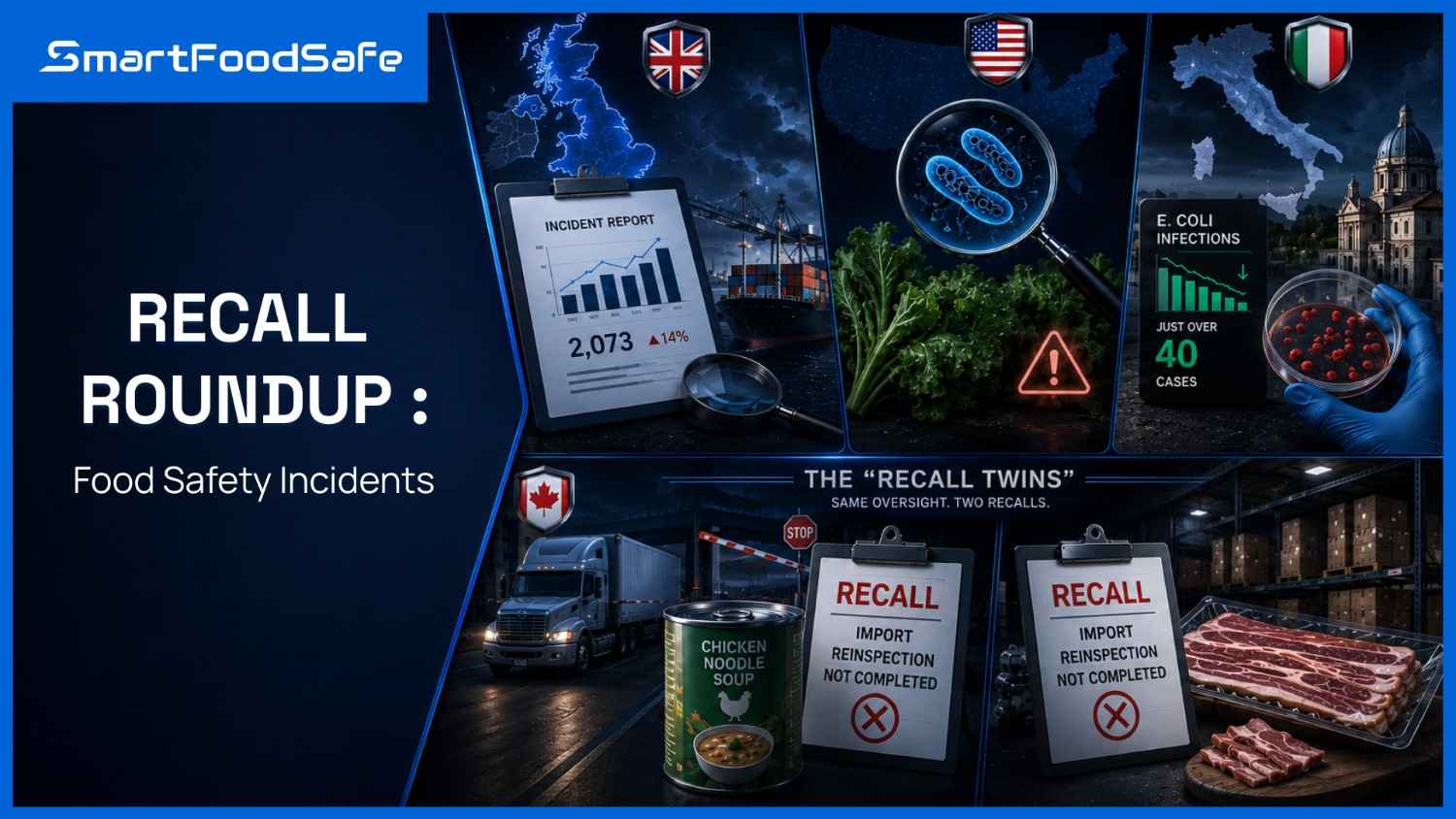
The United Kingdom's Food Standards Agency (FSA) reported 2,073 food and feed safety incidents across England, Northern Ireland, and Wales during the 2025-26 reporting year, marking a 14% increase over the previous year. Rather than signaling a decline in food safety standards, regulators attributed the increase to an increasingly complex food system. Global sourcing, longer supply chains, and the rapid growth of online food marketplaces are creating more opportunities for issues to be detected and reported.
food and feed safety incidents reported across England, Northern Ireland, and Wales in 2025-26 — a 14% increase over the previous year.
Across the Atlantic, the United States spent much of July battling a familiar seasonal threat: Cyclospora. Health authorities investigated several seasonal clusters and outbreak signals associated with Cyclospora infections, reinforcing a pattern seen almost every summer. The parasite, which spreads through contaminated food or water, is notoriously difficult to trace because symptoms often appear days after exposure and many fresh produce items have already passed through complex international supply chains by the time illnesses are reported. Once again, leafy greens, herbs, and fresh vegetables found themselves under the spotlight, reminding the industry that produce safety demands year-round vigilance, not just during harvest season.
Also read: 7 Food Safety Gaps Every Produce Business Should Address Before the Next Outbreak
Italy, meanwhile, provided one of the month's few encouraging headlines. The country's national hemolytic uremic syndrome (HUS) registry recorded just over 40 cases linked to E. coli infections in 2025, continuing a welcome decline after several more challenging years. Most cases still occurred in children under 15, but public health experts view the downward trend as evidence that sustained surveillance, faster diagnosis, and stronger prevention measures can make a measurable difference.
Then came what might be called the "Recall Twins." Two completely unrelated U.S. recalls occurred within days of each other for an almost identical reason, and it had nothing to do with contaminated food.
On July 23, a Canadian importer recalled chicken noodle soup after the product entered the U.S. without undergoing the required import reinspection. Just one day later, a bacon producer recalled approximately 12,000 pounds of smoked bacon for exactly the same regulatory oversight. In both cases, the products themselves were not found to be unsafe — the recalls were triggered solely because mandatory import procedures had not been completed.
In both cases, the products themselves were not found to be unsafe. The recalls were triggered solely because mandatory import procedures had not been completed.
California's SB 68 took effect on July 1, expanding written allergen information requirements for covered food facilities and restaurants, improving consumer access to allergen information at the point of purchase.
On the international stage, the Codex Alimentarius Commission finalized new guidance on precautionary allergen labelling ("may contain"), bringing greater scientific consistency to one of the food industry's most debated phrases. While Codex standards are voluntary, they often influence national regulations worldwide, making this an important development for global food manufacturers.
Meanwhile, the Joint FAO/WHO Expert Committee on Food Additives (JECFA) concluded its 102nd meeting in Nanjing, China, evaluating the safety of several food additives, including monk fruit extract and food-grade phosphates. These scientific evaluations continue to shape regulatory decisions across multiple countries.
In Asia, regulators also turned their attention to emerging and evolving risks. Japan proposed revisions to maximum residue limits (MRLs) for five agricultural chemicals while planning to revoke limits for 28 others based on updated risk assessments. South Korea, meanwhile, confirmed it is drafting dedicated regulatory standards for cell-cultured processed foods, broadening its oversight beyond cultivated meat as the next generation of food products moves closer to commercial reality.
South Korea's move broadens its oversight beyond cultivated meat as the next generation of food products moves closer to commercial reality.
July's enforcement headlines shared a common theme: governments are moving beyond issuing regulations and stepping up action on the ground.
In Vietnam, officials reported 58 food poisoning incidents during the first half of 2026, affecting more than 1,500 people, a 66% increase compared to the same period last year. In response, the country's Deputy Prime Minister called for stricter oversight of school cafeterias, placing greater emphasis on inspections, food handling practices, and accountability where vulnerable populations are served.
rise in Vietnam's reported food poisoning incidents in H1 2026 versus the same period last year — 58 incidents affecting over 1,500 people.
Across Africa, Nigeria's National Agency for Food and Drug Administration and Control (NAFDAC) intensified its nationwide food safety campaign, expanding laboratory testing, market surveillance, and compliance inspections. Regulators also urged consumers to avoid products lacking official registration numbers, reinforcing that food safety begins with traceability as much as enforcement.
Meanwhile, a broader regional effort emerged in Latin America. Ten countries, including Brazil, Argentina, Chile, Colombia, and Peru, launched 24 collaborative initiatives to strengthen risk analysis within national food safety systems. Coordinated by the Pan American Health Organization (PAHO), the FAO, and the University of Minnesota, the program aims to improve scientific decision-making, risk assessment, and regulatory capacity across the region.
The Latin America initiative aims to improve scientific decision-making, risk assessment, and regulatory capacity across the region.

One of the month's standout developments came from researchers at a U.S. university, who trained an AI model to identify poultry flocks at higher risk of Salmonella contamination, using nothing more than smartphone images of chicken droppings. With reported accuracy of up to 85% across different regions, the technology has the potential to provide producers with an early warning system long before laboratory test results are available. It may not be the most glamorous application of artificial intelligence, but it could be one of the most practical.
reported accuracy of a new AI model that flags Salmonella-risk poultry flocks from smartphone photos of chicken droppings.
The technology has the potential to give producers an early warning system long before laboratory test results are available.
One of the month's biggest headlines came from Stanford University, where researchers used artificial intelligence to identify a naturally occurring peptide that showed appetite-suppressing effects in preclinical studies. The findings suggest the compound may activate pathways related to GLP-1 signalling while potentially producing fewer gastrointestinal side effects than existing GLP-1 medications. Although the research remains at an early stage and has yet to be confirmed in human trials, it highlights how AI is accelerating the discovery of promising food- and health-related compounds.
Another study published on July 20 highlighted spermidine, a naturally occurring compound found in foods such as wheat germ, mushrooms, and aged cheese. Researchers reported that older adults who consumed higher levels of spermidine showed a stronger immune response following vaccination, adding to growing evidence that diet may play a role in supporting healthy aging.
Growing evidence suggests diet may play a meaningful role in supporting healthy aging.
The internet has an uncanny ability to turn the most ordinary moments into public conversations. This July, as temperatures soared across much of the Northern Hemisphere, social media feeds filled with reminders about keeping food cool, transporting picnics safely, and handling barbecue essentials with care. Food safety agencies, creators, and health professionals alike leaned into the season, transforming summer food safety into a surprisingly viral topic.

The timing was hardly accidental. July marks both National Grilling Month and National Picnic Month in the United States, when millions trade kitchens for backyards and dining tables for picnic blankets. It is also the time of year when the cold chain is most vulnerable, perishable foods spend longer outside refrigeration, and seemingly minor lapses in temperature control can become major food safety risks. The viral reminders, therefore, were more than seasonal content; they were timely interventions disguised as shareable posts.
One statistic, in particular, continued to circulate for its sheer ability to surprise:
Between 2002 and 2014, more than 1,700 people were treated in U.S. emergency departments after swallowing wire bristles that had detached from grill-cleaning brushes and become lodged in grilled food. Source: PubMed — Epidemiology of Wire-Bristle Grill Brush Injury in the United States, 2002–2014
It is an unusual hazard, but an enduring reminder that food safety extends beyond ingredients and into every tool, surface, and habit involved in preparing a meal. The next time you fire up the grill, spare a thought for the brush before you admire the grill marks.

 French
 Spanish
 Portuguese