
 English
▾
English
▾
English
▾
English
▾

In January 2026, the U.S. Departments of Health and Human Services (HHS) and Agriculture (USDA) released the 2025–2030 Dietary Guidelines for Americans, including a striking inverted food pyramid that departs from the MyPlate model used since 2011. This new visual and its recommendations have sparked discussion and sometimes confusion among experts and consumers alike. Below, we break down what the new pyramid actually says, what science it’s based on, and what it means for your plate and your health.
A: The USDA and HHS have reintroduced a pyramid graphic, but it’s flipped compared to older models. At the wide top (what you’re supposed to eat most of) are:
At the narrow bottom (eat less often) are whole grains, and by implication, refined grains and highly processed carbohydrates are positioned even lower.
This inversion signals a fundamental shift: food quality and nutrient density take precedence over the old grain-centric approach that dominated for decades. Gone is the old practice of putting breads and cereals at the base; instead, the pyramid emphasizes foods that are rich in essential nutrients, quality protein, and bioavailable fats.
A: MyPlate was criticized for:
Today, over 50% of calories in the U.S. come from ultra-processed foods, according to NIH-backed research. The new model attempts to reflect how modern dietary patterns actually impact chronic disease risk, not just theoretical balance.
A: The guidelines make two of the boldest moves:
Adults are encouraged to consume between 1.2 and 1.6 grams of protein per kilogram of body weight per day, a significant increase from the old standard of 0.8 grams/kg. This is intended to support muscle maintenance, metabolic health, and satiety, especially in aging populations and active adults.
The guidelines argue that “no amount of added sugars or non-nutritive sweeteners is considered part of a healthy diet,” and recommend keeping added sugar under 10 grams per meal. This reflects growing evidence linking high added sugar intake to obesity, type 2 diabetes, and cardiometabolic diseases.
In addition, the guidelines explicitly call out foods with artificial flavors, petroleum-based dyes, artificial preservatives, and low-calorie sweeteners as items to avoid as part of a “real food” approach.
A: The new guidance draws on emerging research in several key areas:
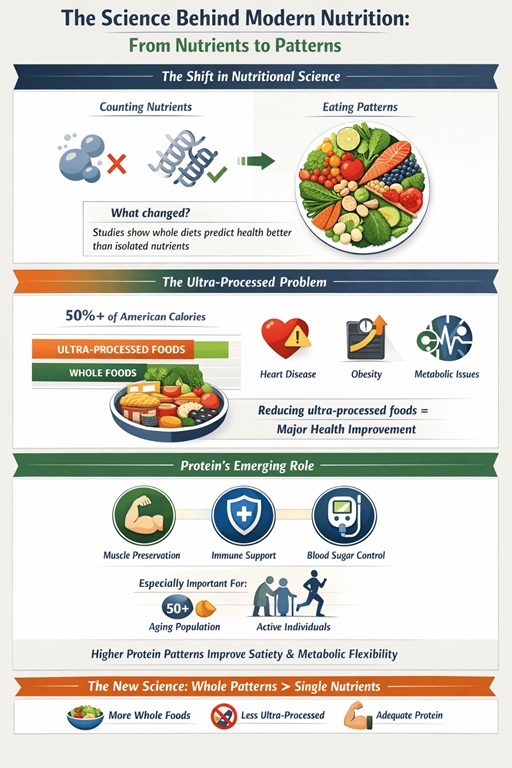
Instead of focusing on single nutrients (like fat or carbohydrate percentages), the science increasingly points toward whole dietary patterns as stronger predictors of long-term health outcomes. Patterns rich in vegetables, lean proteins, legumes, nuts, and fruits consistently associate with reduced risk of chronic diseases in large cohort studies.
Ultra-processed foods, which make up more than half of American calories, have been linked to higher rates of obesity, heart disease, and metabolic dysfunction. Reducing exposure to these foods is a major pillar of the new guidelines.
Research indicates that adequate protein intake supports muscle preservation, immune function, and metabolic flexibility, especially important as people age or engage in regular physical activity. Higher protein patterns are also shown to improve satiety and help regulate blood glucose.
A: One provocative aspect of the new guidance is a reframing of dietary fats:
This reflects evolving debate in nutrition science about the context of saturated fats (e.g., whole foods vs. processed foods) and their impact on health outcomes. However, experts disagree: many cardiovascular researchers still advise cautious intake, especially for populations at risk for heart disease.
A: Carbohydrates remain part of the diet, but the emphasis has shifted:
This reflects a growing body of evidence that foods with high glycemic load and low nutrient density contribute to insulin resistance, obesity, and other metabolic issues.
A: While most coverage focuses on nutrition, the guidelines implicitly link food quality and safety. For example:
Although food safety isn’t the headline, the science underlying dietary patterns recognizes that how food is produced, processed, and prepared affects health outcomes.
A: Nutrition professionals and public health advocates have noted several positive aspects:
 Prioritization of Nutrient-Dense Foods
The inverted pyramid places protein, healthy fats, fruits, and vegetables front and center, which can improve nutrient intake quality.
Strong Stance Against Added Sugars and Ultra-Processed Foods
Recognizing that over half of U.S. calories come from ultra-processed foods, the guidelines offer clear language to discourage these items.
Emphasis on Real Food and Balanced Patterns
Instead of focusing on individual nutrients or macronutrient ratios, the guidelines promote eating intact, whole foods, a strategy associated with better long-term metabolic and cardiovascular health.
A: The new recommendations are not without potential limitations.
 Saturated Fat Ambiguity
Though the pyramid encourages full-fat dairy and meats, it still suggests limiting saturated fats, a mismatch that critics argue could confuse consumers.
Emphasis on Animal Products
Some experts caution that a heavy focus on meat and dairy may overlook the protective benefits of plant-based protein sources like legumes and soy, which are more consistently linked with reduced cardiovascular risk.
Practical Adoption Challenges
Shifting national food culture, including school meals, SNAP programs, and community nutrition, requires time, infrastructure, and education. The pyramid’s ideals may outpace people’s access to fresh, affordable whole foods.
The new food pyramid is a paradigm shift that moves U.S. nutrition guidance toward real food first, discourages added sugars and highly processed items, and resets macro priorities (notably protein) with updated science in mind.
However, the science is complex and nuanced. Key considerations include:
If the new pyramid leaves you with anything, let it be this:
Because real food still matters, context still matters, and considered decisions—carried out consistently—have the greatest impact.

 French
 Spanish
 Portuguese