


 English
▾
English
▾
English
▾
English
▾
You must have heard the famous quote by Henry Ford, "Quality means doing it right when no one is looking," but what does it really mean for global industries? How can enterprises ensure quality at all times and in all facets of their operations? Addressing this query in a contemporary and efficient manner brings forth the solution of quality management software.
Quality management systems have evolved considerably since their initial days characterized by manual inspection logs and paper checklists. Nowadays, a missed deviation, a supplier issue that hasn't been resolved, or a gap in documentation can silently lead to a product recall, a failed audit, or customer relationship damage, which might require years to rebuild. This very pressure is the reason why an increasing number of companies, ranging from food businesses expanding their operations to giant manufacturers, decide to rely on specially designed software to maintain their quality processes organized, traceable and under control.
The global quality management software market was valued at over $11 billion in 2024 and is forecast to approach $21 billion by 2030. That growth reflects something real: companies that rely on spreadsheets and shared folders to manage quality are finding it harder to keep up as regulations tighten, supply chains grow more complex and customers expect greater transparency.
Quality Management Software is a digital solution designed to streamline and augment an organization's quality control processes. It helps businesses maintain consistent quality standards, comply with regulations and improve overall efficiency. At its core, it replaces scattered spreadsheets, email chains and paper records with one connected system where every document, training record, audit finding and supplier assessment lives in the same place and every action leaves a traceable trail.
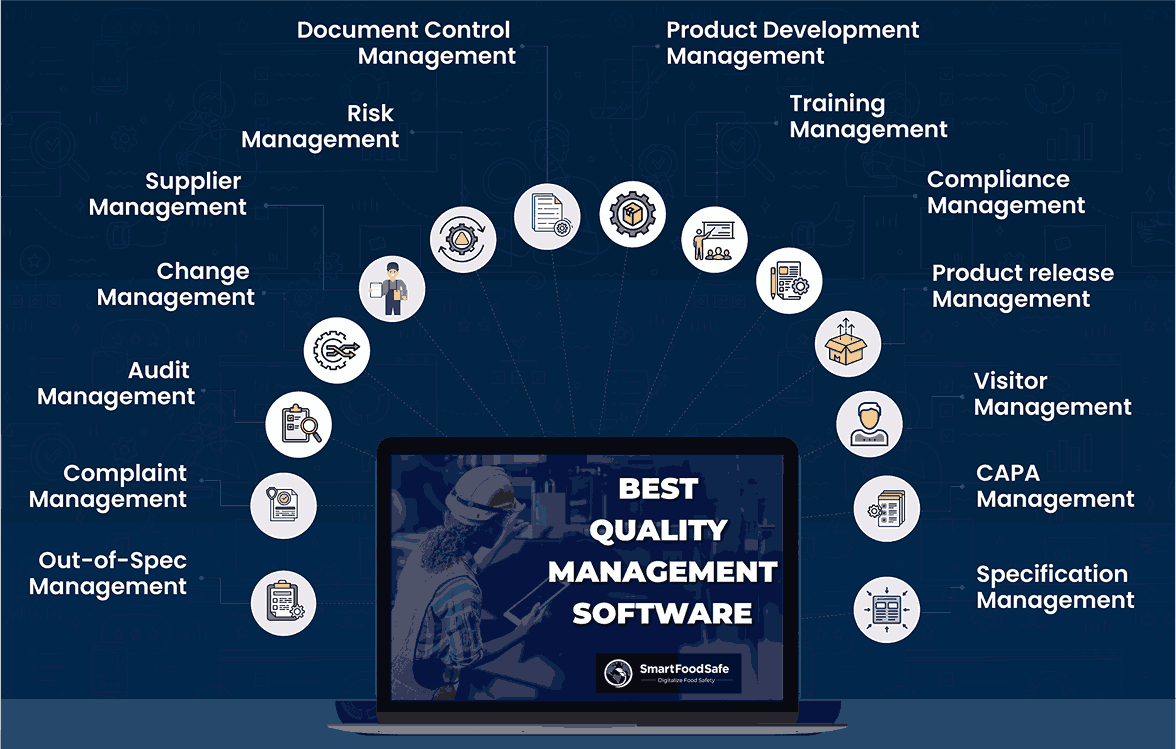
Here are the major features to look for when considering a QMS:
When selecting Quality Management Software, it is essential to align the features with your specific business requirements and processes. Keep in mind factors like ease of use, vendor support, implementation time and the software's ability to adapt to your organization's unique needs. One thing buyers frequently underestimate is the importance of end-user adoption. A system packed with features means very little if the team avoids using it because it is hard to navigate. Asking for a live trial or a real demonstration against your own use cases, not a scripted walkthrough, tells you far more than any features comparison chart. A thorough evaluation and demonstration of the software against your business use cases will help in making an informed decision.
Before diving into specific platforms, it helps to get clear on what you actually need. Some companies are primarily trying to get audit-ready. Others want to cut down on rework and complaints eating into their margins. Some are replacing a patchwork of spreadsheets with something more structured. Your starting point changes which features matter most and which platform makes the most sense for your size, industry and budget.
Here's a list of 8 quality management software for you to choose from:
Overview
Smart Food Safe is an AI-powered, cloud-based Quality Management System (QMS) trusted by enterprise organizations worldwide to digitize, automate, and standardize quality, food safety, and compliance processes. With 18+ configurable modules covering the entire quality and food safety lifecycle, the platform centralizes document control, audit management, CAPA, supplier quality, complaints, training, and more into a single integrated system. By replacing disconnected spreadsheets, paper-based records, and point solutions, Smart Food Safe helps organizations improve visibility, standardize quality processes, simplify compliance, enhance product quality, and stay audit-ready across the enterprise.
Smart Food Safe's suite of Quality Management Solutions:

Features
Pricing: Contact Smart Food Safe directly for a quote tailored to your team size and product requirements.
Considerations: Smart Food Safe is a comprehensive Quality Management System with strong capabilities in quality management and food safety. Designed for mid-sized to enterprise organizations, it supports businesses across industries where quality and compliance are essential with configurable quality applications covering the full quality lifecycle.

Overview
ETQ Reliance represents a quality management system to handle crucial business processes and raises overall quality benchmarks. Its distinguishing factors lie in its user-friendly, adaptable nature, making it an optimal solution for businesses with varied and distinctive needs. Through its web-based interface, it facilitates swift implementation and frequent updates, aligning seamlessly with evolving quality management demands.
Features
Pricing: Contact for a subscription-based quote.
Considerations: ETQ is a strong fit for mid-to-large enterprises that need configurability and global scalability. Organizations with simpler quality processes or smaller teams may find the breadth of the platform more than they need. Teams that previously relied on direct database access for custom reporting may also need to adjust to the cloud model's approach to data handling.

Overview
MasterControl's eQMS stands as a prominent brand within the life sciences industry, widely adopted in various verticals. Tailored for compliance and quality management across multiple phases like product development, clinical trials, supplier management, regulatory risk, manufacturing and post-market use, it's best suited for global enterprises with extensive product lifecycle portfolios.
Features
Pricing: Quote-based, contact for pricing.
Considerations: MasterControl is built for regulated industries with complex quality requirements. Teams without dedicated IT support or prior QMS experience may face a steeper onboarding curve.

Overview
Qualityze is a cloud-based electronic Quality Management System (eQMS) designed for organizations in the life sciences and manufacturing industries. Built on the Salesforce platform, it offers modules for document management, nonconformance, CAPA, audits, supplier quality, change control, risk management, and complaint handling to support regulatory compliance. The platform primarily serves mid-sized and enterprise organizations.
Features
Pricing: Contact Qualityze for a quote.
Considerations: Qualityze works best for organizations already embedded in the Salesforce ecosystem. If Salesforce is not part of your current tech stack, integration options outside that environment may be limited. Teams transitioning from simple spreadsheet-based systems should also factor in time for onboarding, as the platform's enterprise depth can feel overwhelming without a structured implementation plan.

Overview
Sparta Systems' TrackWise serves as an eQMS software platform tailored for GMP-regulated organizations, aiming to enhance visibility and streamline efficiency within competitive markets. Positioned as a comprehensive QMS solution, it holds the capability to seamlessly integrate into complex enterprise software ecosystems, facilitating real-time connections with ERP, CRM, LIMS and MES applications.
Features
Pricing: Contact Sparta Systems directly for a quote.
Considerations: TrackWise is designed for large, heavily regulated organizations with dedicated IT and quality teams. Smaller companies or those without substantial internal resources to manage implementation and ongoing configuration may find the process more demanding than expected.

Overview
SmartSolve, developed by Pilgrim, an IQVIA company, stands as an eQMS software marketed for overseeing compliance, risk, quality and supplier chains within the life sciences domain. Aligned with the ISO 9001 standard, their QMS software offers workflows, document management and process oversight. Providing flexibility, it can be deployed as a cloud-based solution or installed on-premise. It extends its capabilities to encompass electronic signatures, audits, analytics and validation tools alongside its core features.
Features
Pricing: Limited public pricing data is available.
Considerations: SmartSolve is positioned firmly at the enterprise end of the life sciences market. Companies evaluating it should factor in implementation complexity and budget accordingly, as the platform requires meaningful internal coordination to deploy effectively.

Overview
Qualio is an eQMS designed specifically for start-ups, small to mid-size businesses and life sciences companies in the scale phase, incorporating FDA, cGMP and ISO requirements as standard for pharma, biotech and medical device manufacturers.
Features
Pricing: The platform has a platform fee with additional per-user annual costs. Pricing scales with team size.
Considerations: Qualio is purpose-built for life sciences companies at the startup-to-mid-market stage. Larger enterprises with complex multi-site operations or deep integration requirements may outgrow the platform as their quality programs mature.

Overview
ComplianceQuest is a flexible Quality Management System (QMS) built natively on Salesforce to help life sciences and manufacturing firms speed product and process innovation, minimize risk and drive continuous improvement. Through CQ's unified data model, informed decisions can be made swiftly, addressing issues promptly. Furthermore, it offers advanced analytics and utilizes AI-driven applications to identify trends, proactively preventing potential quality issues.
Features
Pricing: The modular pricing structure allows organizations to start with core modules and add more as their operations grow.
Considerations: ComplianceQuest delivers the most value to organizations already running on Salesforce. If your business does not use Salesforce, the platform can still be adopted, but you lose some of the native data sharing and unified reporting that makes it compelling.
Smart Food Safe's quality management solution distinguishes itself by leveraging the following functionalities in one place, vital for the smooth and effortless supervision of quality maintenance processes:
Enhancing Compliance Standards
Our comprehensive digital quality management system ensures strict adherence to the highest standards at every phase of product development. By utilizing Smart Food Safe's solutions of quality management modules, businesses not only maintain these standards but also enhance overall efficiency and profitability.
Built for Configurability, Not One-Size-Fits-All
Smart Food Safe is different from other quality management platforms which usually force a company to change the way they do things to fit the software. Instead, Smart Food Safe is a very adaptable platform that changes itself based on how a company, through its modular architecture, can only get the applications they need without compromising a connected quality ecosystem. With features such as AI-driven functionalities, customizable workflows, and full quality lifecycle management, companies can harmonize quality, compliance, and food safety processes without switching between multiple disconnected systems.
Cost Management and Operational Efficiency
Our primary module, Smart CAPA, empowers businesses to efficiently handle and monitor customer complaints through a centralized platform. By organizing and tracking complaints, timely resolutions become routine, ensuring customer satisfaction and minimizing disruptions.
Streamlined Audit Operations
Our system simplifies audit management with Smart Audit, automating audit scheduling, task assignment and checklist creation. This enables businesses to conduct audits efficiently, facilitating comprehensive reporting and effortless compliance. Because everything from the audit schedule to the findings and follow-up actions sits in the same system, nothing slips between cycles. Teams can pull a complete audit history at any point, not just when an inspector is on site.
Structured Documentation
Smart Doc provides a digital repository for quality program documents, SOPs, certifications and compliance records. With features like version control, document storage, retrieval and sharing, it ensures accessibility and accuracy throughout the organization.
Supplier Quality Management
Smart Supplier transforms supplier management by employing quality risk-focused assessment and monitoring processes. Evaluate, track performance and communicate seamlessly with vendors, ensuring adherence to quality and compliance standards. For food businesses managing ingredients across multiple suppliers and origin points, having assessment history, corrective actions and performance scores in one place makes procurement decisions easier and supplier relationships more transparent.
Effortless Specification Management
Manage product specifications seamlessly through their life cycle with Smart Specification. Create, store, modify and communicate specifications, ensuring alignment with industry standards and promoting collaboration across departments.
Quality Reporting and Analytics
Access detailed reports and analytics showcasing quality metrics, trends and performance indicators, empowering informed decision-making based on data insights. The dashboards are built by people who understand quality programs, not generic reporting tools that require IT help to configure. That means quality managers spend less time building reports and more time acting on what the data shows.
Seamless Integration and Scalability
Ensure smooth data flow and scalability among diverse systems to adapt to expanding business requirements via voice, Bluetooth and IoT integration. As more equipment becomes connected, from cold chain sensors to automated production line monitors, the ability to pull real-time data into your quality system without manual entry removes one of the most persistent sources of error in food production environments.
On-the-Go Accessibility
Utilize mobile devices for instant access to our software, facilitating real-time monitoring, updates and approvals, enabling efficient workflow management even while on the move or away from the office. For businesses managing multiple production sites, farm operations, or field teams, this means inspections get logged when they happen, not reconstructed later from handwritten notes.
Smart Food Safe is one of the best quality management software options for enterprise businesses because it is easy to use, designed to handle compliance, audits and corrective actions without complexity. Its cloud-based platform allows big teams to manage quality and food safety efficiently while scaling as the business grows.
Implementation timelines vary widely. Cloud-based platforms designed for small and mid-sized businesses, like Smart Food Safe, can typically be up and running within a few weeks. Enterprise platforms with deep customization, multi-site rollouts, or formal system validation requirements can take several months. The honest answer is that the vendor's go-live timeline is only part of the picture, internal readiness, data migration and user training are usually where implementation time is actually spent.
Yes, most modern cloud-based QMS platforms are built to support multiple sites, user roles and geographies from a single system. Multi-site functionality typically includes location-specific reporting, role-based access by site and centralized visibility for management. Language support varies by vendor, so if your team operates in multiple languages, it is worth confirming this during your evaluation.
AI in quality management software in 2026 does a few genuinely useful things. It analyzes patterns across large volumes of quality data to surface trends that would take a human analyst hours to find manually. During investigations, it suggests likely root causes based on similar past events. It monitors compliance in real time and flags deviations as they emerge. Some platforms use it to auto-generate change summaries when documents are updated, cutting down on the administrative effort involved in document review cycles. The practical value of AI features varies significantly between platforms, it is worth asking vendors for a concrete demonstration rather than taking a features list at face value.
Yes, options have expanded considerably. Cloud-based and modular platforms make it possible to start with core features, document control, audit management and corrective actions, and add modules as the business grows. For food businesses specifically, Smart Food Safe is designed with small and growing teams in mind, offering the compliance depth you need without the enterprise overhead you don't. Pricing is available upon request and is structured to match the scale of your operations.
The short answer is industry focus. Most QMS platforms on this list serve a broad range of sectors and ask food businesses to adapt their workflows to a general-purpose system. Smart Food Safe covers the full picture of food and agricultural quality management, from farm and environmental monitoring to laboratory information management and visitor oversight, in a single connected platform. For businesses where food safety and traceability are not add-on features but the core of what compliance means, that focus makes a real practical difference.

 French
 Spanish
 Portuguese