



A meal can pass through ingredient checks, preparation, cooking, packaging and final inspection, yet still reach a passenger with an undeclared allergen. In airline catering, that possibility carries serious consequences because passengers have limited opportunities to verify what is on their tray or obtain immediate medical assistance once a flight is airborne.
A reported incident in October 2024 highlights the importance of getting these controls right. A passenger on an international flight allegedly received a meal containing shrimp despite informing the cabin crew about her shellfish allergy. She suffered a severe allergic reaction, forcing the aircraft to divert to Paris for emergency medical treatment. In June 2025, she filed a lawsuit over the incident, raising questions about how allergen information was communicated and verified during meal service.
Source: The Straits Times – Passenger sues airline after allergic reaction
For airline catering facilities, allergen management must therefore extend beyond identifying ingredients. It requires consistent controls across procurement, storage, food preparation, packaging, dispatch and communication with airline personnel.
Understanding Food Allergens and the Risks They Pose
Food allergens are substances, usually proteins in certain foods, that trigger an abnormal immune response in people with food allergies. Unlike food intolerances, which generally involve non-immune reactions, food allergies can cause reactions ranging from mild symptoms to life-threatening anaphylaxis.
Common symptoms include:
- Skin reactions such as itching, hives and swelling.
- Digestive symptoms such as vomiting and abdominal pain.
- Respiratory difficulties, including wheezing and shortness of breath.
- Severe systemic reactions, including anaphylaxis, which can affect breathing and blood circulation.
The allergens that require declaration depend on the applicable regulations. For example, the United States recognises nine major food allergens: milk, eggs, fish, Crustacean shellfish, tree nuts, peanuts, wheat, soybeans and sesame. UK and EU food information rules identify 14 regulated allergens, including mustard, celery, lupin and sulphites. Airline caterers serving international routes must account for the relevant requirements across their markets.
Cross-contact is another critical concern. It occurs when an allergen is unintentionally transferred from one food, ingredient, utensil, surface or piece of equipment to another. For instance, using the same cutting board to prepare a peanut-containing dessert and an alternative dessert without effective cleaning can introduce an allergen into food that was not intended to contain it.
Importantly, cooking does not necessarily eliminate allergenic proteins. The presence of an allergen can therefore remain a concern even after food has undergone heat treatment.
For passengers with food allergies, an incorrectly prepared or identified meal is not simply a dietary inconvenience. It can become a serious medical emergency.
Why Is Allergen Management More Challenging in Airline Catering?
Airline catering operates under conditions that differ considerably from conventional food service. Facilities must prepare large volumes of meals, accommodate different dietary requirements and deliver precisely identified orders within strict flight schedules.
Several characteristics make allergen control particularly demanding.
Multiple menus and dietary requirements
A single catering operation may prepare standard, vegetarian, vegan, religiously compliant and medically requested meals. Each menu can have a different ingredient and allergen profile. Substituting an ingredient in one recipe can also change its allergen status, making accurate information essential throughout preparation.
High-volume, time-sensitive production
Catering facilities often work against fixed aircraft departure schedules. Multiple meal varieties may be prepared simultaneously, increasing the importance of production sequencing, equipment separation and effective cleaning between preparations.
Complex ingredient supply chains
Recipes may rely on sauces, marinades, dressings, bakery ingredients and processed products sourced from different suppliers. An ingredient that appears allergen-free by its common name may contain derivatives or additives that introduce an additional allergen.
Multiple operational handoffs
A meal may move from purchasing and receiving teams to kitchen staff, assembly operators, packaging personnel, dispatch teams, ground handlers and airline cabin crew. Allergen information must remain accurate as responsibility changes hands.
International regulatory differences
Catering facilities serving multiple airlines or destinations may need to accommodate different allergen declaration requirements, ingredient specifications and customer expectations. A labelling approach suitable for one market may not satisfy another.
These challenges make allergen management a coordinated operational responsibility rather than a task limited to the kitchen or quality assurance department.
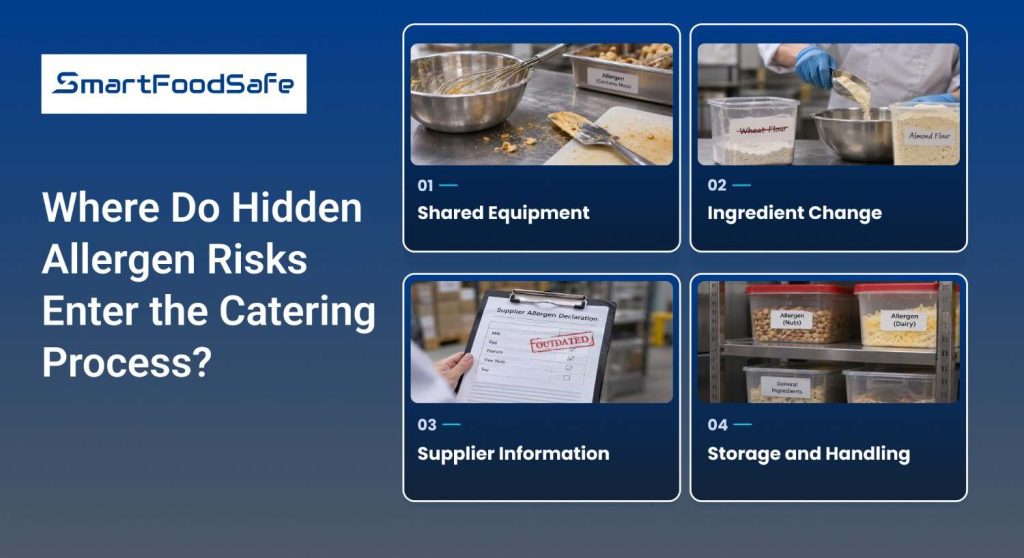
Where Can Allergen Control Break Down Across Airline Catering Operations?
Allergen-related failures can occur at several stages of meal production and delivery. Understanding these points helps catering facilities identify where preventive controls need to be strengthened.
1. Ingredient sourcing and receiving
An ingredient may contain an undeclared or unexpected allergen because of incomplete supplier information, formulation changes or inadequate specification reviews. If receiving personnel do not identify the discrepancy, the ingredient can enter production without the necessary controls.
2. Storage and ingredient handling
Poor segregation of allergenic ingredients can result in accidental mixing, spillages or the transfer of residues between containers. Open packaging, shared storage areas and incorrectly identified ingredients increase the possibility of cross-contact.
3. Food preparation and cooking
Shared utensils, mixers, work surfaces and processing equipment can transfer allergenic residues between recipes. For example, preparing a seafood-containing sauce using equipment that is subsequently used for a meal intended for someone with a shellfish allergy can introduce an avoidable risk.
4. Recipe changes and ingredient substitutions
A supplier may discontinue a product, change its formulation or provide an alternative ingredient. If the catering facility makes the substitution without reviewing the allergen profile, the recipe documentation and final meal information may no longer be accurate.
5. Meal assembly and packaging
Cross-contact can occur when different meal types are assembled in the same area. A misplaced garnish, incorrect portion or packaging mix-up can also change the allergen profile of an otherwise correctly prepared meal.
6. Labelling and meal identification
An accurately prepared meal can still become a passenger safety risk if it receives the wrong label, meal code or identification tag. Incorrect information can prevent airline personnel from distinguishing an allergy-specific meal from other special meals.
7. Dispatch and onboard handover
The final meal count, packaging identification and passenger-specific meal requirements must match the airline’s service information. Incomplete handover records or unclear communication can result in the wrong meal being loaded, identified or served.
The central issue is that a control failure at one stage can undermine the work completed at every preceding stage. A correct recipe, for instance, offers little protection if the wrong meal is ultimately served.
What Makes Allergen Control Systems Vulnerable to Failure?
Individual control failures are often symptoms of wider weaknesses in the food safety management system. Even when catering facilities have allergen procedures in place, gaps in information, accountability and verification can make those procedures ineffective.
Four systemic weaknesses deserve particular attention.
Fragmented allergen information
When supplier specifications, ingredient records, recipes, production instructions and meal labels are maintained separately, employees may work with different versions of the same information. This makes it difficult to maintain consistency when ingredients or menus change.
Weak change management
A change in supplier, ingredient formulation, recipe, equipment or production process can affect the allergen profile of a meal. Without a formal review and approval process, the change may reach production before its food safety implications are assessed.
Overreliance on standard operating procedures
Having a cleaning procedure does not necessarily demonstrate that it removes allergenic residues effectively. Cleaning methods need to be validated for the equipment, food residues and allergens involved, with routine verification to confirm that procedures are followed.
Unclear ownership and communication
When procurement, production, quality assurance and dispatch teams operate with separate responsibilities but no shared accountability, critical information can be overlooked. The absence of clearly assigned responsibilities also makes it difficult to investigate recurring failures.
These weaknesses demonstrate why allergen management cannot depend solely on employee awareness or documented procedures. The entire control system must work consistently under routine production conditions and during unexpected operational changes.
9 Essential Controls for Safer Allergen Management in Airline Catering
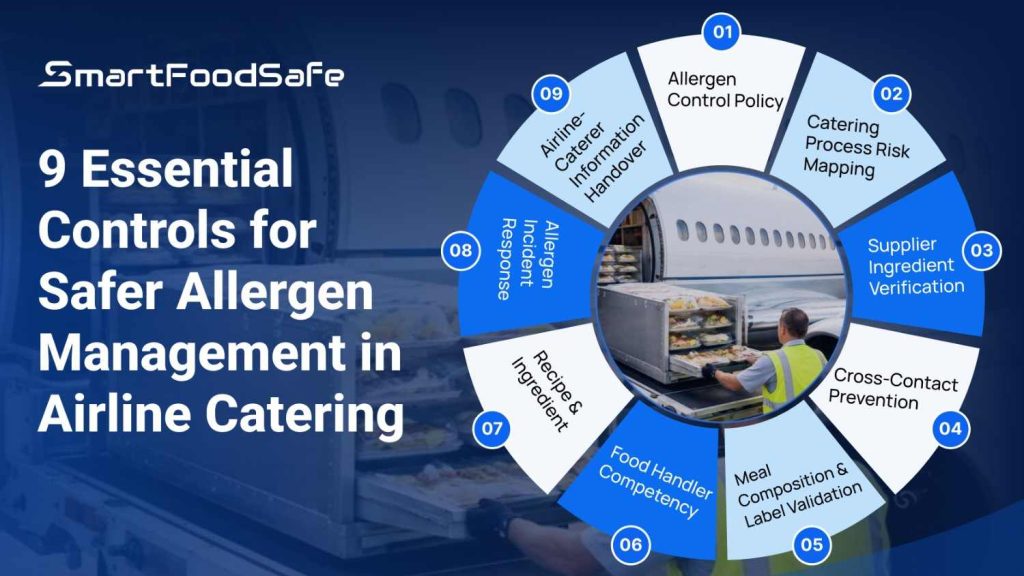
An effective allergen management programme requires preventive measures at every stage of catering operations. The following nine controls can help facilities minimise allergen exposure and maintain consistency from ingredient sourcing to final meal delivery.
1. Conduct a comprehensive allergen risk assessment
Identify all allergens present in raw materials, ingredients, recipes and finished meals. Map potential cross-contact points across receiving, storage, preparation, equipment, packaging and transportation. Review the assessment whenever menus, ingredients, suppliers or production processes change.
2. Verify suppliers and ingredient specifications
Obtain accurate ingredient declarations and allergen information from approved suppliers. Review product specifications, technical documents and formulation updates before accepting new or substituted ingredients. Establish a process for communicating changes that could affect allergen status.
3. Segregate allergenic ingredients during storage
Store allergenic materials in clearly identified, designated areas wherever practical. Use sealed containers, appropriate separation and clear identification to prevent accidental mixing, spills and contact with non-allergenic ingredients.
4. Control recipes, menus and ingredient substitutions
Maintain approved recipes with complete ingredient and allergen information. Any substitution should undergo an allergen risk assessment before approval. Ensure updated information reaches purchasing, kitchen, packaging and quality teams before the revised recipe enters production.
5. Establish controlled production schedules
Where practical, schedule meals without particular allergens before meals containing them. Use designated preparation areas or physical separation when the risk assessment requires it. Define procedures for production changeovers and line clearance to prevent residues or packaging from carrying over between meal types.
6. Validate cleaning procedures and control shared equipment
Use dedicated utensils, cutting boards and equipment wherever feasible. Where equipment must be shared, establish cleaning procedures appropriate to the allergen and the equipment design. Validate cleaning effectiveness and use suitable verification methods, including allergen-specific testing where appropriate.
7. Train employees in allergen awareness and handling
Provide role-specific training to procurement, receiving, preparation, assembly, cleaning, packaging and dispatch personnel. Employees should understand allergen sources, cross-contact risks, segregation requirements and escalation procedures. Assess practical competency rather than relying only on training attendance.
8. Strengthen meal identification and labelling controls
Establish checks to ensure meal labels, ingredient declarations and special-meal identification match the approved recipe and final product. Verify packaging during assembly and before dispatch. Any discrepancy should trigger a hold until the meal’s identity and allergen status have been confirmed.
9. Maintain traceability and corrective action procedures
Maintain records connecting ingredients, suppliers, recipes, production batches, finished meals and dispatch details. Establish clear procedures for isolating potentially affected meals, investigating deviations, notifying relevant airline personnel and implementing corrective actions. Regular traceability exercises can help determine whether information can be retrieved quickly and accurately.
Together, these controls create multiple layers of protection. The objective is not simply to prevent allergens from entering a meal, but also to ensure that any potential failure is identified before that meal reaches a passenger.
How Can Catering Facilities Measure Allergen Control Effectiveness?
An allergen management programme is only effective when its controls work consistently in practice. Catering facilities should track measurable indicators to identify weaknesses, monitor compliance and prevent recurring failures.
| Performance indicator | What it measures |
| Allergen-related incidents and near misses | Potential exposure events and recurring risks |
| Supplier and ingredient review compliance | Whether allergen information and formulation changes are assessed |
| Cleaning verification results | Effectiveness of allergen cleaning procedures |
| Production and changeover compliance | Whether segregation and line clearance procedures are followed |
| Labelling and meal identification errors | Accuracy of allergen declarations and meal identification |
| Training and audit findings | Employee competency and compliance with established procedures |
| Corrective action effectiveness | Whether identified failures are resolved and prevented from recurring |
Risk-based allergen residue testing can also help verify cleaning effectiveness where appropriate. However, test results should be evaluated alongside cleaning validation and other preventive controls, rather than treated as proof that an entire production process is allergen-free.
Regularly reviewing these indicators helps quality teams identify recurring problems and determine where procedures, equipment or employee practices need improvement.
Why Passenger Safety Depends on Every Department
Allergen management requires coordination across every department involved in preparing and delivering airline meals. Each team has a distinct responsibility:
| Department | Key responsibility |
| Procurement and supplier management | Verify ingredient specifications and allergen information. |
| Menu planning and product development | Assess allergen risks in recipes and ingredient substitutions. |
| Receiving and warehouse teams | Verify incoming ingredients and maintain storage segregation. |
| Kitchen and production teams | Follow approved recipes, segregation and cleaning procedures. |
| Quality assurance | Oversee risk assessments, control verification and corrective actions. |
| Packaging and dispatch | Verify meal identity, labelling and handover information. |
| Airline personnel | Communicate passenger meal requirements and verify meal identification before service. |
Clear ownership at each stage helps prevent allergen information from being lost or misinterpreted during operational handovers. When departments follow shared procedures and communicate changes promptly, allergen controls become more consistent across the catering process.
Strengthening Allergen Management Through Digital Food Safety Solutions
Managing allergen information across suppliers, ingredients, recipes, production records, employee training and corrective actions can become challenging when information is scattered across spreadsheets, paper records and disconnected systems. This can make it difficult for teams to access current information, track changes and maintain consistency across catering operations.
A connected Food Safety and Quality Management System (FSQMS) can help bring these processes together by providing a structured approach to:
- Ingredient and specification management: Maintain ingredient specifications, allergen details and bills of materials.
- Supplier management: Centralise supplier documentation, approvals and reassessment records.
- Document control: Maintain approved recipes, allergen procedures and cleaning instructions with version control.
- Label management: Manage ingredient declarations, allergen statements and label versions, updating them when recipes or ingredients change.
- Employee training: Assign and track role-specific allergen control training.
- Audit management: Conduct internal audits, document findings and monitor compliance.
- Non-conformance and CAPA management: Record deviations, investigate root causes and track corrective actions through to effectiveness verification.
Smart Food Safe brings these interconnected food safety, quality and compliance management processes together through a unified, cloud-based FSQMS platform. As a one-stop solution, it enables catering facilities to manage supplier and ingredient information, control documentation, oversee employee training, conduct audits and manage non-conformances and corrective actions within a single connected environment.
By reducing reliance on disconnected systems and scattered records, Smart Food Safe helps teams improve operational visibility, maintain consistent processes and establish clearer accountability across their quality and compliance operations.
While digitalisation cannot replace physical allergen controls, effective cleaning or employee competency, it can provide the management structure and documented oversight needed to support their consistent implementation. Combined with robust operational practices, a connected FSQMS can help airline catering facilities strengthen allergen control and maintain greater confidence in the safety of the meals they prepare and serve.