


What separates an acceptable new dietary ingredient from one with an inadequately supported safety notification?
The answer lies not just in identifying the ingredient, but in providing scientific evidence that establishes its identity and demonstrates that it is reasonably expected to be safe under its intended conditions of use.
On October 19, 2026, the U.S. Food and Drug Administration (FDA) issued final guidance outlining the identity and safety information manufacturers and distributors should include in New Dietary Ingredient Notifications (NDINs).
The guidance finalizes recommendations covering three key areas: ingredient identity, history of use or other evidence of safety, and the scientific basis for concluding that an NDI is reasonably expected to be safe. For dietary supplement manufacturers introducing new ingredients into the U.S. market, understanding these expectations can help identify documentation gaps and prepare scientifically supported notifications.
What Is a New Dietary Ingredient (NDI), and When Is Notification Required?
Under Section 413(d) of the Federal Food, Drug, and Cosmetic Act (FD&C Act), an NDI is a dietary ingredient that was not marketed in the United States before October 15, 1994.
Dietary ingredients include vitamins, minerals, herbs and other botanicals, amino acids, dietary substances used to supplement the diet, and their concentrates, metabolites, constituents, extracts, and combinations.
Under Section 413(a)(2) of the FD&C Act and 21 CFR 190.6, manufacturers or distributors generally must submit an NDI notification at least 75 days before introducing or delivering for introduction into interstate commerce a dietary supplement containing the NDI.
An exception applies when the NDI and other dietary ingredients in the supplement have been present in the food supply as articles used for food in forms that have not been chemically altered.
The notification must provide the basis for concluding that the dietary supplement containing the NDI will reasonably be expected to be safe under its intended conditions of use.
Important: An NDI notification is a premarket notification, not an FDA approval. FDA does not certify an ingredient as safe simply because the 75-day notification period has passed.
Sources: FD&C Act, Section 413 (21 U.S.C. § 350b) | 21 CFR 190.6 – Requirement for Premarket Notification | 21 U.S.C. § 321(ff) – Dietary Supplement Definition
5 Areas to Strengthen Ingredient Identity and Safety Documentation
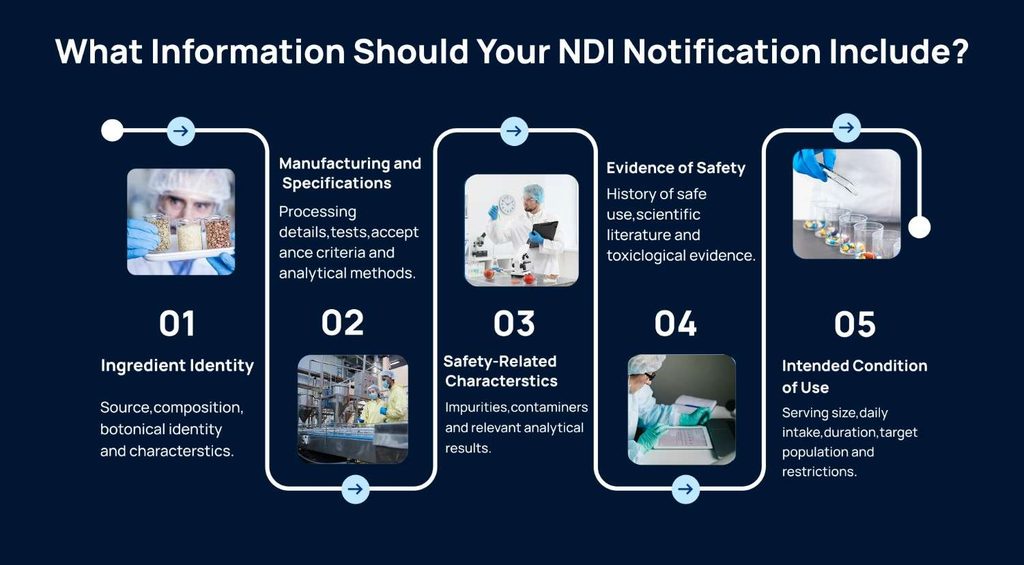
A strong NDI notification should establish what the ingredient is, how it is manufactured, and whether the available safety evidence applies to the specific material being introduced.
Here are five areas manufacturers should review.
1. Ingredient Identity and Composition
Provide a clear description of the NDI, including its source, composition, physical characteristics, and identification methods. For botanical ingredients, include the Latin binomial name and author citation, plant part used, and relevant preparation details. Also identify other ingredients and components in the finished supplement.
2. Manufacturing Process and Specifications
Describe the manufacturing process, including relevant processing conditions, in-process controls, and quality checks. Include specifications in a structured format covering:
- Tests performed on the ingredient.
- Acceptance criteria or numerical limits.
- Analytical methods used to verify results.
Specifications may address identity, composition, purity, strength, and relevant contaminants. Supporting analytical data should demonstrate that the established specifications are met.
3. Contaminants and Safety-Related Characteristics
Identify impurities and contaminants associated with starting materials, manufacturing, extraction, or purification. These may include residual solvents, heavy metals, pesticide residues, and microbial contaminants, where relevant. Explain how manufacturing controls and analytical testing address these potential safety concerns.
4. History of Safe Use and Scientific Evidence
Provide evidence supporting the ingredient’s safety, including documented human consumption history, scientific literature, or relevant toxicological studies.
When relying on historical consumption, consider the amount consumed, frequency and duration of use, and characteristics of the consuming population. FDA generally recommends at least 25 years of widespread use when history of safe use alone is used to establish safety.
Where historical evidence does not support the proposed conditions of use, additional scientific evidence may be needed to address the gaps.
5. Intended Conditions of Use
Describe how the supplement containing the NDI will be consumed. Include serving size and form, maximum NDI amount per serving, frequency and duration of use, maximum total daily intake, instructions for use, target population, and restrictions on use.
The safety assessment should demonstrate why the available evidence supports these specific conditions. FDA generally assumes daily lifetime use at the highest recommended serving size unless the notification specifies restrictions.
FDA reference: New Dietary Ingredient (NDI) Notifications and Related Issues; Identity and Safety Information About the NDI – Final Guidance, October 2026.
Does Your Safety Evidence Match the Ingredient You Plan to Market?
A study involving a similar ingredient does not automatically establish the safety of the ingredient being notified. Differences in composition, source material, or manufacturing processes can affect whether existing evidence is relevant.
For example:
- Botanical extracts: Different plant parts, extraction methods, or concentrations can produce different compositions.
- Fermentation-derived ingredients: The production microorganism and processing conditions can influence the final ingredient.
- Microbial ingredients: Strain identification and relevant safety characteristics help establish comparability.
FDA generally recommends using safety studies conducted on the same NDI or dietary supplement described in the notification. When studies involve a related but different material, manufacturers should provide qualitative and quantitative comparisons and explain scientifically why the findings remain relevant.
FDA reference: Final NDI Guidance – Section VII, Question 4: Safety Studies Involving Similar but Not Identical Test Articles.
What Should Manufacturers Do After Submitting an NDI Notification?
Ingredient oversight should continue after submission. Changes in suppliers, manufacturing processes, specifications, or formulations may affect the ingredient’s identity and safety profile.
Manufacturers should:
- Verify supplier consistency: Review supplier information and ingredient specifications.
- Track ingredient lots: Connect incoming batches with production and finished-product records.
- Assess process changes: Evaluate changes in sourcing, extraction, and manufacturing.
- Maintain supporting evidence: Keep analytical results, specifications, and safety records accessible.
- Monitor post-market safety: Review complaints and adverse events and meet applicable serious adverse event reporting obligations.
These are recommended quality practices, not additional requirements introduced by the October 2026 NDI guidance.
Manufacturers should also understand that under 21 CFR 190.6(d), FDA may assign a new filing date if additional information submitted during the notification process constitutes a substantive amendment.
Sources: 21 CFR 190.6(d) | FDA Guidance on Adverse Event Reporting and Recordkeeping for Dietary Supplements.

Maintaining these practices helps manufacturers identify potential changes in ingredient quality and safety and keep relevant supporting information accessible.
How Can Digital Documentation Support NDI Readiness?
Maintaining NDI readiness requires more than collecting ingredient specifications and safety records. Manufacturers need reliable processes to organize supplier information, control document revisions, track changes, and maintain accessible quality records.
What if all your essential quality, ingredient, and compliance processes could be managed in one place?
That’s where Smart Food Safe comes in. Its comprehensive, cloud-based platform brings ingredient specification management, supplier documentation, document control, change management, and quality recordkeeping together in one connected ecosystem.
By replacing fragmented processes with a centralized approach, Smart Food Safe helps manufacturers improve information visibility, maintain consistent records, and strengthen their documentation practices to support ongoing NDI readiness.
Explore how Smart Food Safe can simplify your quality and compliance processes. Book a demo today!