


 English
▾
English
▾
English
▾
English
▾

Have a quick look at your environmental monitoring program. Have you ever thought of the possibility that your environmental monitoring program might have some shortcomings that may sooner or later lead to outbreaks and recalls?
A closer look at the number of yearly recalls and outbreaks confirms that much has not changed related to the traditional environmental monitoring program for most food processors. There is a famous saying, “You can not control what you do not know”. This brings us to the question of why food companies around the globe have not yet shifted to a risk-based enhanced approach to environmental monitoring.
Have a quick look at your environmental monitoring program. Have you ever thought of the possibility that your environmental monitoring program might have some shortcomings that may sooner or later lead to outbreaks and recalls?
A closer look at the number of yearly recalls and outbreaks confirms that much has not changed related to the traditional environmental monitoring program for most food processors. There is a famous saying, “You can not control what you do not know”. This brings us to the question of why food companies around the globe have not yet shifted to a risk-based enhanced approach to environmental monitoring.
Put simply, EMP is a significant tool in recognizing sources of contamination and non-compliant areas in any food manufacturing unit in order to evaluate the efficiency of sanitation and monitoring procedures in place. It represents characterizing and ensuring the cleanliness of the environment to be equally important as maintaining hygiene practices in the processes and activities for ensuring food safety.
In general, any environmental monitoring program operates by assembling and carrying out activities associated with microorganisms, and allergen monitoring related to all components in the environment, including contact and non-contact surfaces, air, and water testing.
An effective environmental monitoring system in food processing includes four key areas: surface testing (food contact and non-contact surfaces), air monitoring (to detect airborne contaminants), water testing (process water and cleaning systems), and allergen monitoring (to prevent cross-contact). These together form a complete environmental monitoring procedure in the food industry, helping identify contamination sources and verify sanitation effectiveness.
Each type should be linked to specific zones, sampling frequency, and corrective actions. A structured, risk-based approach ensures better detection of hazards and improves overall food safety control.
Most often nowadays even after establishing the most effective sanitation protocols, food supply chains face many challenges in terms of their food safety expectations. Unidentified loopholes in the environmental monitoring plan can result in food safety incidents.
An apt example would be the multistate recall incident tied to the deadly outbreak of listeriosis in 2015 associated with frozen dairy products such as ice cream, frozen yogurt, sherbet, and frozen snacks that resulted in 3 deaths and 10 hospitalizations across four states. This issue can be mainly accounted for reasons including inadequate monitoring of those sanitation protocols, testing for the wrong pathogens, less attention to clean areas that are not visible, being unaware of all the prevailing risks to be handled, and improper scheduling of sampling.
In reality, if you are unable to find any pathogenic risk in the environment from the monitoring activities it implies that either you are not looking enough or you are looking at the wrong areas.
Despite the Preventive Controls for Human Food rule implemented by the Food Safety Modernization Act (FSMA), food industries have not been able to keep up with it which potentially results in contamination and occurrence of hazards. All of this can eventually lead to costly and catastrophic repercussions such as enormous wastage and endangering consumers.
The remodeling of environmental monitoring programs in food industries benefits the food sector to enhance food safety in various ways. A shift in the implementation of EMP in food processing industries can help them to identify pathogen-harboring regions and cross-contamination sites much more competently. As a result, such programs will be capable of tackling the various food safety risks with ease and detecting any positive environmental monitoring results as an early indicator, and correcting the issue before any regulatory authority finds out.
However, some uncertainties related to the number of samples to be collected and the locations to be concentrated for testing are weak points that food companies still face in proper EMP execution. By integrating a digitalized system to carry out the environmental monitoring process, they can make its implementation much more easier and precise.
FDA has also issued guidelines for food industries to follow through for the Control of Listeria monocytogenes in Ready-To-Eat Foods which can also be considered as a functional tool for a proper environmental monitoring program. The steps involved in building an appropriate EMP can be summarized as follows:
The first step in how to set up an environmental monitoring program is to pinpoint and document possible microorganism sources across all physical areas and cross-contamination vectors such as employees, equipment, and pests. Special attention should be given to niche or hard-to-reach areas, including concealed spaces and indirect contact surfaces that are often overlooked in a typical environmental monitoring plan for the food industry.

Once contamination sources are identified, categorize the facility into zones based on risk levels (Zone 1 to Zone 4). This zoning approach helps prioritize monitoring efforts and ensures that high-risk food contact surfaces receive more focused attention within the overall environmental monitoring program and sampling plan.
Developing a structured environmental monitoring program and sampling plan is essential to ensure effective testing. This includes selecting appropriate sampling locations, identifying target pathogens and indicator organisms, and ensuring coverage across all critical areas of the facility.
Sampling frequency should be determined based on risk assessment. High-risk zones require more frequent testing, and sampling should be conducted at different times before, during, and after production, to strengthen the environmental monitoring plan for the food industry.
Establish compliance limits for microorganisms based on regulatory standards, industry best practices, and historical data. Clear thresholds help determine when results are acceptable and when corrective actions are required within the environmental monitoring program.
If results are non-compliant, immediate corrective actions such as cleaning and disinfection must be implemented. Re-sampling should follow to verify effectiveness, ensuring the issue is resolved as part of a strong environmental monitoring program and sampling plan.
A thorough documentation process is essential at every stage of how to set up an environmental monitoring program. Proper records demonstrate compliance, support audits, and help track trends for continuous improvement.
Some guidelines that food manufacturers can note down to perfect their environmental monitoring program are:
Being mindful of these guidelines, it is essential to examine whether the environmental monitoring program that you have implemented is working efficiently. Our product Smart EMP is equipped to help build, monitor, evaluate and validate your environmental monitoring process quite effortlessly.
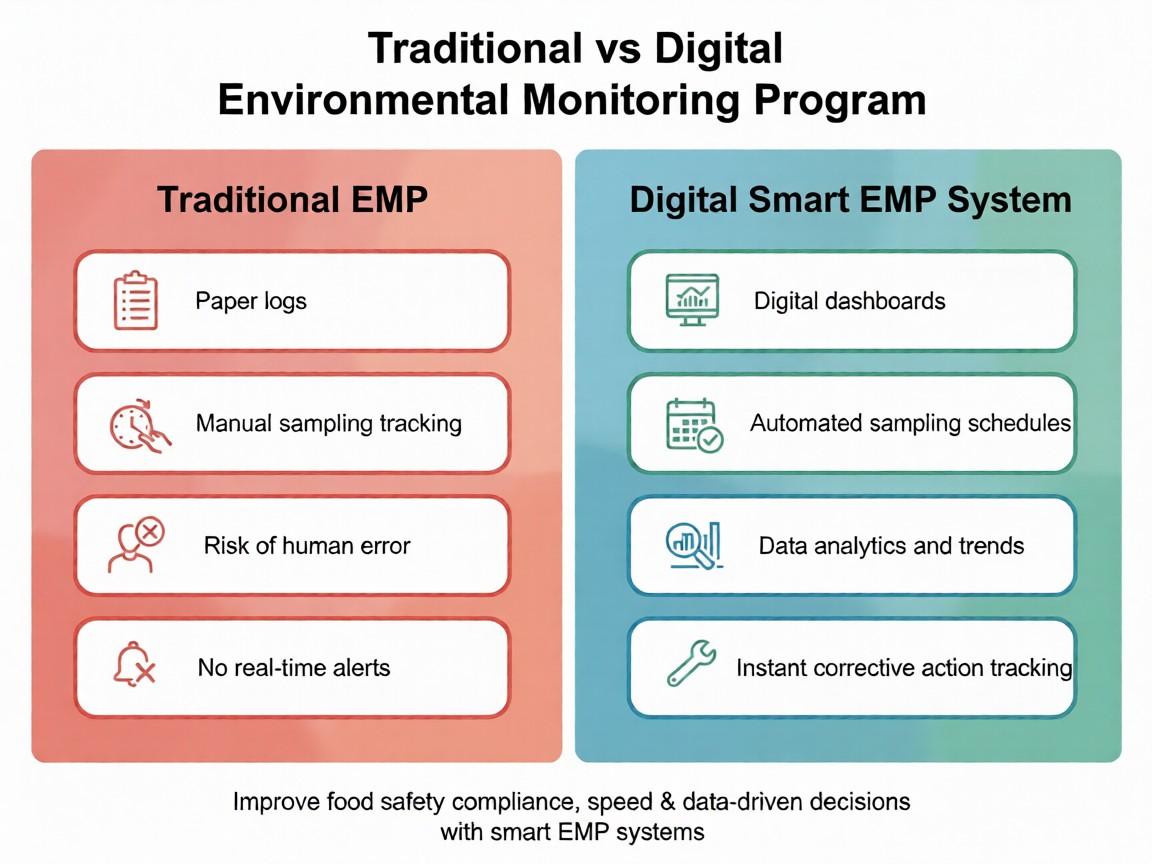
As the food industry strides towards preventative food safety culture, environmental monitoring programs become an integral and uncompromisable part of any food company. This means that only the most dynamic implementation of an environmental monitoring program can completely serve its purpose to be a baseline of defense for food safety.
That is why adopting our product Smart EMP can be said to be an apt choice as it can help food processors create an EMP program from scratch digitally with no or little knowledge and ensure the monitoring frequencies and corrective actions are implemented as needed.
Smart EMP not only digitalizes but also automates the environmental monitoring program by confirming the operational efficiency of cleaning and sanitation programs as intended and thus reducing the risk of environmental borne contamination to the products and in turn, reducing the chance of product recalls.
Our software can be used to onboard any existing EMP or create a new EMP program digitally in less than a few weeks and it is important to remember that the cost-benefit from having a working EMP would always outweigh the cost of the software.
The different smart features provided by Smart EMP include Digital Plant Layout, Heat and Harborage Map, Setting up Zones, Test and Limits, Planned and Random Scheduling, Predefined Corrective Action plan, Real-Time Data Analytics, and Customized Notifications. With these features, our EMP Software can smartly transform environmental monitoring to achieve the much-needed remodeling in maintaining a safe and hygienic food production environment and reduce the recall risk to businesses.
Sampling should be done at different stages, before production (to verify cleaning), during production (to detect active risks), and after production (to validate sanitation effectiveness). The timing depends on the objective of the test.
Commonly overlooked areas include drains, equipment undersides, conveyor joints, and other hard-to-clean surfaces where moisture and residues accumulate. These locations often act as harborage points for pathogens.
Effectiveness is measured through trend analysis, reduction in positive results over time, and the ability to detect issues early. Consistent data review and corrective action closure are key indicators of a strong system.
Yes, even small facilities can implement a basic monitoring approach by focusing on high-risk areas, simple swab testing, and periodic review. The complexity can scale based on production size and risk level.

 French
 Spanish
 Portuguese