


 English
▾
English
▾
English
▾
English
▾

‘Inventory is just money, sitting around in another form,’ as stated by Rhonda Adams in USA Today, single-handedly demonstrates why mastering efficient inventory management is critical for any business dealing with physical goods.
Every aspect concerning the products, from timely procurement to accurate reception, monitoring, and storage, constitutes inventory management. Precise execution in these areas is paramount as errors directly affect the company’s financial performance. By reducing lost sales, inventory misplacement, and unnecessary ordering, effective inventory control enhances profitability and enterprise productivity.
Inventory management entails a spectrum of procedures and processes vital for the seamless functioning of businesses involved in selling goods. It revolves around the meticulous handling of ordering, receiving, storing, tracking, and accounting for all products within a business’s supply chain. Essentially, it acts as the backbone of supply chain management, ensuring the availability of products to meet consumer demand.
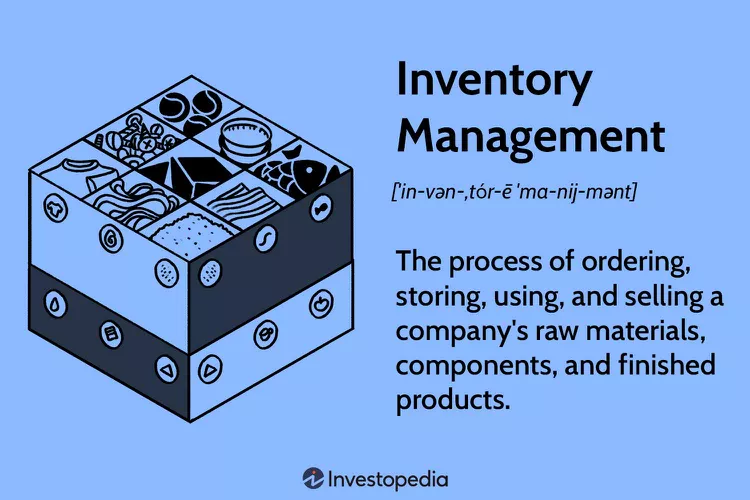
Reference: https://www.investopedia.com/terms/i/inventory-management.asp
At its core, inventory management ensures that businesses have the right products available in the right quantities, at the right time, and in the right locations. It serves as a strategic imperative for any enterprise engaged in the sale of goods. The repercussions of inadequate inventory management are stark – a lack of stock leads to lost sales opportunities, while overstocking incurs redundant costs and ties up capital. Thus, a proficient inventory management system is indispensable for elevating the operational success of businesses.
While often used interchangeably, inventory management and inventory control refer to different facets of operations. Inventory management extends beyond mere stock control, encompassing all the activities from warehouse management to logistics coordination, ensuring a continuous flow of goods from procurement to final destination.
Inventory control, also known as stock control, is the vigilant monitoring and management of a company’s inventory levels to align with consumer demand and emerges as a subset of inventory management. It focuses on maintaining optimal stock levels to prevent understocking or overstocking scenarios, thereby augmenting cost-efficiency and customer satisfaction.
Navigating inventory management can be riddled with bottlenecks, much like steering through uncharted waters. Below, we outline three prevalent challenges encountered in this domain:
Limited Visibility
Inadequate insight into inventory whereabouts, current stock levels, and sales data across various online and offline platforms can severely impede supply chain efficiency. The absence of real-time inventory tracking, cohesive systems integration, and systematic management often leads to inadvertent overselling, stock shortages, and delayed reorders from suppliers.
Tracing Complexity
Inadequate inventory traceability not only obscures stock transparency but also poses significant risks to consumer health and product safety. Insufficient control mechanisms, such as a lack of lot numbering for perishable or hazardous items, may hinder swift product recall or contamination mitigation efforts. Implementing lot tracking aids in prioritizing shipments based on factors like expiry dates or branding hierarchy, ensuring operational efficiency.
Scalability Struggles
As businesses expand, managing inventory becomes increasingly intricate. While smaller enterprises might initially contend with limited inventory space and control tools, larger operations face challenges related to inventory turnover rate, SKU proliferation, and storage optimization. Effective inventory management hinges on monitoring key performance indicators (KPIs) tailored to each SKU, facilitating better insights and operational control.
Startups and small business owners often dive into product sourcing and selling without a solid inventory management strategy. Yet, neglecting this aspect can lead to issues that affect customer satisfaction and financial gains. By incorporating the following steps, enterprises can pave the way for contemporary inventory management to sustain in the competitive global marketplace:
Proper inventory management is required for the smooth operation of any business, ensuring that products are available when needed while minimizing costs and risks. By conducting a comprehensive risk assessment, it is possible to determine related setbacks, such as unexpected sales spikes, inventory miscalculations, or supply chain disruptions. A risk assessment matrix helps prioritize these risks and develop strategies to address them effectively.Moreover, regular audits play a crucial role in ascertaining inventory precision and uncovering discrepancies between actual stock and records by providing valuable insights into the state of inventory. Strong supplier relationships can point to a steady flow of goods by closely working with them to anticipate and resolve inventory obstacles when necessary.
Moving forward, a proactive approach to inventory management will be establishing smart solutions for risk assessment, regular audits, and strategic supplier relationships, as key to refining inventory activities and powering business growth.
Revolutionize your approach to inventory management with Smart Food Safe, a best-in-class quality and food safety management solution, that can be applied to maximize stock utilization and drive profitability. Our software modules can serve to eliminate production bottlenecks and amplify supply chain performance with real-time insights and automated processes to manage the complexities of inventory control effortlessly, safeguarding against costly human errors that can impede progress.
Smart Food Safe’s Smart Supplier streamlines the procurement process, allowing for supplier management and ensuring that only the highest quality ingredients enter the inventory for storage. Smart Specification maintains detailed records of product specifications, ensuring compliance with product requirements.
Smart Compliance offers automated verification of product specifications to ensure that all products in the inventory meet industry standards. With Smart Lab, inventory supervisors can efficiently monitor and control product quality through laboratory information management involved in rigorous testing and analysis.
Smart Record consolidates all inventory data into one integrated system, providing one-place visibility and control over stock levels, while Smart Docs enables structured document management, ensuring that all necessary records are easily accessible and up-to-date.
Inventory management being a non-negotiable factor in running a business nowadays, Smart Food Safe attempts to digitally consolidate all attributes of inventory management into one integrated system, strengthening enterprise abilities to stay ahead of the curve and unlock new levels of supply chain excellence.

 French
 Spanish
 Portuguese