


 English
▾
English
▾
English
▾
English
▾
Have you ever heard the idiom, 'To err is human'? Being human means we all make mistakes, and we are expected to learn from them. But some human errors made in regard to food safety practices could cost severe consequences for consumer health and food companies.
Hence, relying too much on humans might lead to human errors, which can sometimes culminate in a scenario beyond repair. Some examples of human error that can happen in a food processing setting would be the imprecise reading of instructions, wrong tool usage, performing a process or activity incorrectly or not at the designated time, or lack of a proper food safety culture.
These human errors can be categorized as intentional and unintentional, or accidental. Just as the name suggests, intentional human errors are ones committed with an intention for a profitable cause, whereas unintentional human errors have no particular motivation or pre-planning and can occur due to multiple reasons. Both types of mistakes can ultimately have legal and regulatory repercussions.
The accurate approach to tackling food safety issues caused due to human error is building a foolproof food safety and quality system where a human mistake can be identified or eliminated before any adverse outcome, and the problem can be secured. This is where due diligence has a role to play.
Due diligence in food safety simply means demonstrating proof that the food business has undertaken all the necessary protocols to prevent food safety violations by implementing proper food safety practices for every component of the food production chain.
According to Food Safety Act 1990, an act of the Parliament of the United Kingdom, food safety due diligence defense concerns people charged who can prove to have taken all reasonable precautions to avoid the commission of the offense by themselves or by a person under their control. This helps food enterprises set up their business in good order and decreases the chances of things going wrong.
The Act does not define what "reasonable" looks like, that is determined case by case. However, enforcement authorities and courts look for one consistent factor: that controls were documented and operational before the incident occurred, not introduced in response to it. Records created after a complaint or inspection carry no legal weight as due diligence evidence. This is why the structure and timing of your food safety documentation matters as much as its content.
Hazard Analysis and Critical Control Point (HACCP) is a powerful tool when it comes to showing due diligence in a food company. This is because the records of your HACCP depict the competence of your food safety system. Critically, these records must be generated at the time of the activity; post-incident documentation, however thorough, is not accepted as due diligence evidence by enforcement authorities, and hygiene practices, along with exhibiting that the food you produce is safe to consume. The HACCP system contributes to identifying all probable hazards that can enter the food supply chain and ways to mitigate the hazards in order to produce safe foods. Appropriate execution of HACCP involves monitoring, verification, and validation of the processes as well.

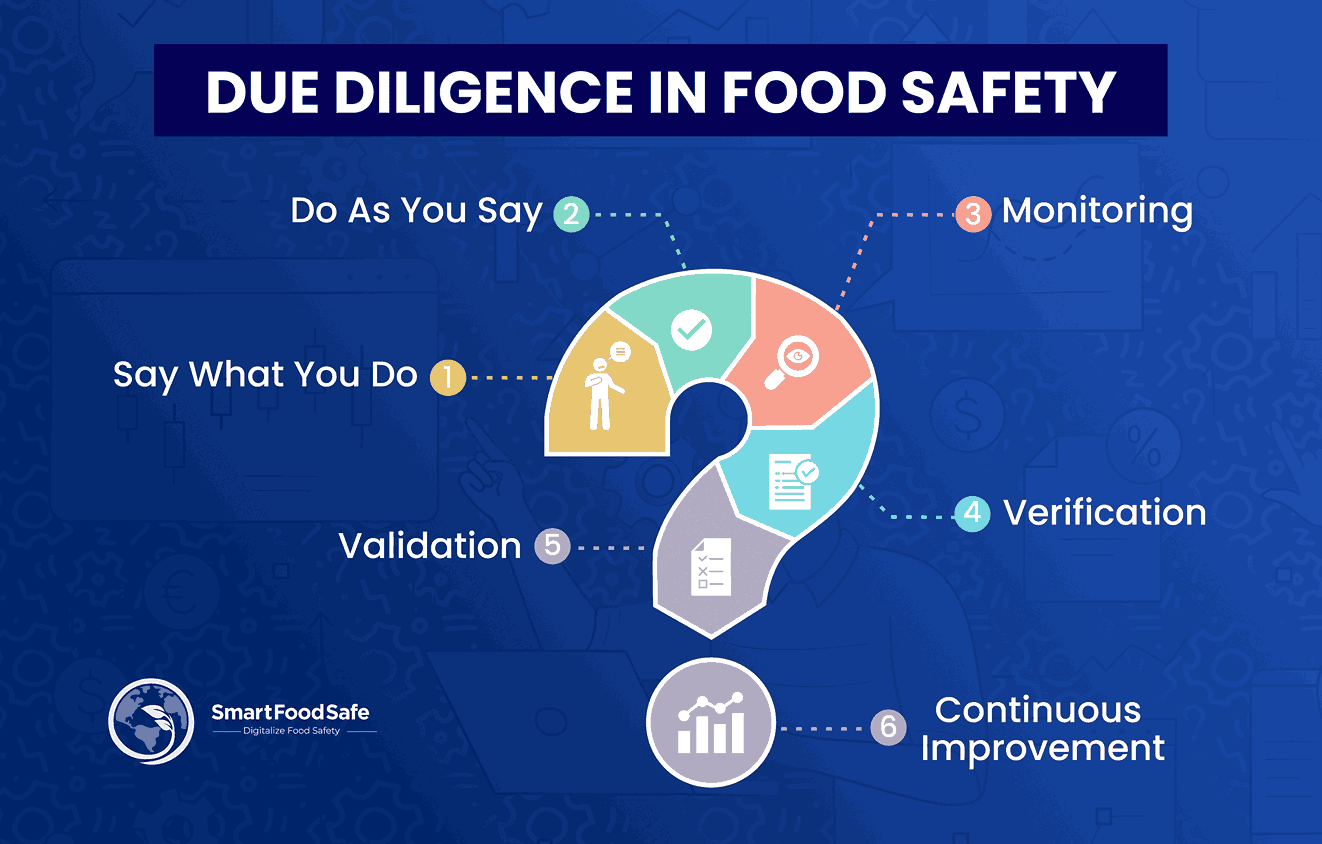
Monitoring is an integral part of a food safety system to evaluate whether established process control points and preventive control points are regulated through real-time observations and measurements. The efficiency of an operational food safety system can be examined through the verification process, which is often associated with a specific time stamp and ensures the system is administered correctly. Validation proves the working of the monitoring activities and the conducted verification procedures, usually referring to a time range. This includes reanalyses and verification audits to bring improvements to the food safety system continuously.
It is important to distinguish between having a HACCP plan and being able to use it as legal defence. Courts and enforcement bodies look specifically at three things:
A HACCP plan that exists as a document but is not reflected in daily operational records does not satisfy the due diligence standard. The records are the evidence, the plan is only the framework.
Food industries face several challenges in establishing optimized monitoring, verification, and validation processes to help eliminate food safety issues caused by human error.
Overcoming these challenges is a must to illustrate that the food enterprises are in compliance with the established food safety standards and are doing what they are supposed to do as per due diligence, that is, say what you do and do as you say.
In the context of acquisitions, or third-party audits in the food and beverage sector, due diligence takes on a more specific meaning. Operational due diligence is an independent assessment of a facility's food safety systems, regulatory standing, and operational reliability, conducted before a business decision is finalised. Technical due diligence in food manufacturing typically evaluates:
Regulatory compliance status: active certifications (BRC, SQF, FSSC 22000, IFS), open non-conformances, history of enforcement actions, and whether HACCP documentation is current and site-specific.
Supplier qualification: whether an approved supplier programme exists, whether audits and questionnaires are conducted and on file, and whether raw material specifications are version controlled.
Equipment and infrastructure: calibration records for critical measurement instruments, preventive maintenance logs, and allergen management validation.
People and training: competency records, training frequency, and staff turnover rates assessed against the procedural knowledge retention risk they create.
Gaps in any of these areas represent a quantifiable liability, both from regulatory exposure and the cost of bringing systems up to standard post-transaction. Sellers with organised, current records close transactions without renegotiation. Buyers use these findings to price risk accurately.
Across all of the challenges outlined above, the following represents the minimum operational baseline a food business must be able to demonstrate:
Supplier controls
HACCP and hazard management
Training and competency
Hygiene and environmental controls
Traceability
Audit and management review
A transition to tech-enabled solutions to handle the elaborate operations in the food supply chain is an excellent route for managing due diligence while minimizing and preventing food safety incidents due to human-made mistakes. SmartFoodSafe delivers innovative software products that can facilitate establishing an expert food safety system in your organization, which in turn reduces the excessive dependence on human abilities and assists in carrying out food safety practices. Our modules provide features such as scheduling, notification, audit log, workflow, reporting, training, and many more, which can contribute to exercising due diligence effectively.

Instead of relying solely on memory, factory operators can use scheduling tools to assign specific time periods for different production processes and other resource management activities and keep track of one-time or recurring tasks. As tasks are scheduled, they are automatically added to the assigned user's built-in user calendar as well as sent by email to be added to their email calendar. Scheduling helps avoid issues due to personnel forgetting to carry out an instruction. In addition, the automated scheduling system can aid in decreasing the dependency on staff to carry out time-consuming tasks.
In case you need a reminder to carry out any actions, the notification feature can be utilized to stay updated on the current and pending actions. The configurable notification capability lets the user decide when and how a user needs to be notified for which actions by email, SMS, or through in-app notifications. Using this tool, the operator will never miss out on a task.
The audit log records function performed by each personnel and provide real-time access to transactions in record keeping. An audit log enables the user to track each and every activity done to review prior changes and make new modifications.
Workflow is a feature that enables the digital transfer of documents from one location to another effortlessly, as the user can assign how each document needs to move digitally. Workflow can also help bring real-time transparency to the entire document management system and provide access authority to different personnel as assigned.
Custom reporting tools help you monitor compliance and trends and provide a summary of the executed operations, which can be important while conducting verification and validation. This feature is highly customizable according to the needs of each food company through various representation modes such as pie charts, bar graphs, etc, to streamline the reporting process.
The easiest way to eliminate human error-related food safety issues is through making the personnel undergo proper training about the various food safety standards and proactive actions to be executed to minimize the risks to a safe level. Our training software can schedule, assign and manage training requirements with self-learning and group-learning options for different groups of employees.
Any practical activity or process within a food enterprise comprises a certain margin of human error. This is why food companies need to incorporate digitalized applications whenever and wherever possible for an enhanced food supply chain by dodging the hurdles posed by human error and bias, and SmartFoodSafe enables you to do it with ease and cost-effectively.
Some of the most common human errors include missed CCP checks, incorrect temperature recording, poor allergen handling, skipped sanitation procedures, improper labeling, and failure to follow SOPs consistently. These issues often occur due to manual processes, fatigue, inadequate supervision, or lack of real-time monitoring systems.
Food companies can demonstrate due diligence through time-stamped monitoring records, corrective action logs, employee training records, supplier documentation, internal audit reports, and traceability evidence. Regulators typically assess whether these controls were active before the incident occurred.
Digital recordkeeping improves compliance by automating data capture, reducing paperwork errors, creating audit trails, and providing real-time visibility into food safety activities. It also helps businesses retrieve records quickly during audits, recalls, or regulatory inspections.
Traceability helps food businesses identify affected products, suppliers, and distribution points quickly during contamination events or recalls. Strong traceability systems reduce response time, minimize business disruption, and support regulatory compliance requirements.
Verification frequency depends on product risk, process complexity, regulatory requirements, and audit standards. High-risk operations may require daily verification activities, while broader system reviews are often conducted weekly, monthly, or quarterly.
Food manufacturers can reduce manual dependency by implementing digital food safety software for scheduling, monitoring, alerts, workflow management, training, reporting, and electronic recordkeeping. Automation helps improve consistency and operational accountability.
Before an audit, businesses should verify that monitoring records are complete, corrective actions are closed, supplier documents are current, training records are updated, and internal audits have been conducted. Auditors typically focus on operational evidence rather than documented procedures alone.
Common signs include incomplete records, inconsistent SOP execution, poor hygiene practices, lack of management involvement, repeated audit findings, delayed corrective actions, and employees treating food safety tasks as paperwork rather than operational controls.
Yes. Small food businesses can implement scalable due diligence systems by focusing on structured documentation, employee training, supplier control, traceability, and digital tools that simplify monitoring and recordkeeping without requiring large operational budgets.
Food safety software centralizes records, automates workflows, tracks corrective actions, stores audit histories, and enables quick access to compliance documentation. This helps organizations stay prepared for regulatory inspections and certification audits year-round.
Food safety compliance means meeting regulatory or certification requirements, while due diligence refers to proving that all reasonable precautions were actively implemented to prevent food safety failures. Due diligence focuses heavily on evidence, consistency, and operational execution.

 French
 Spanish
 Portuguese