


 English
▾
English
▾
English
▾
English
▾
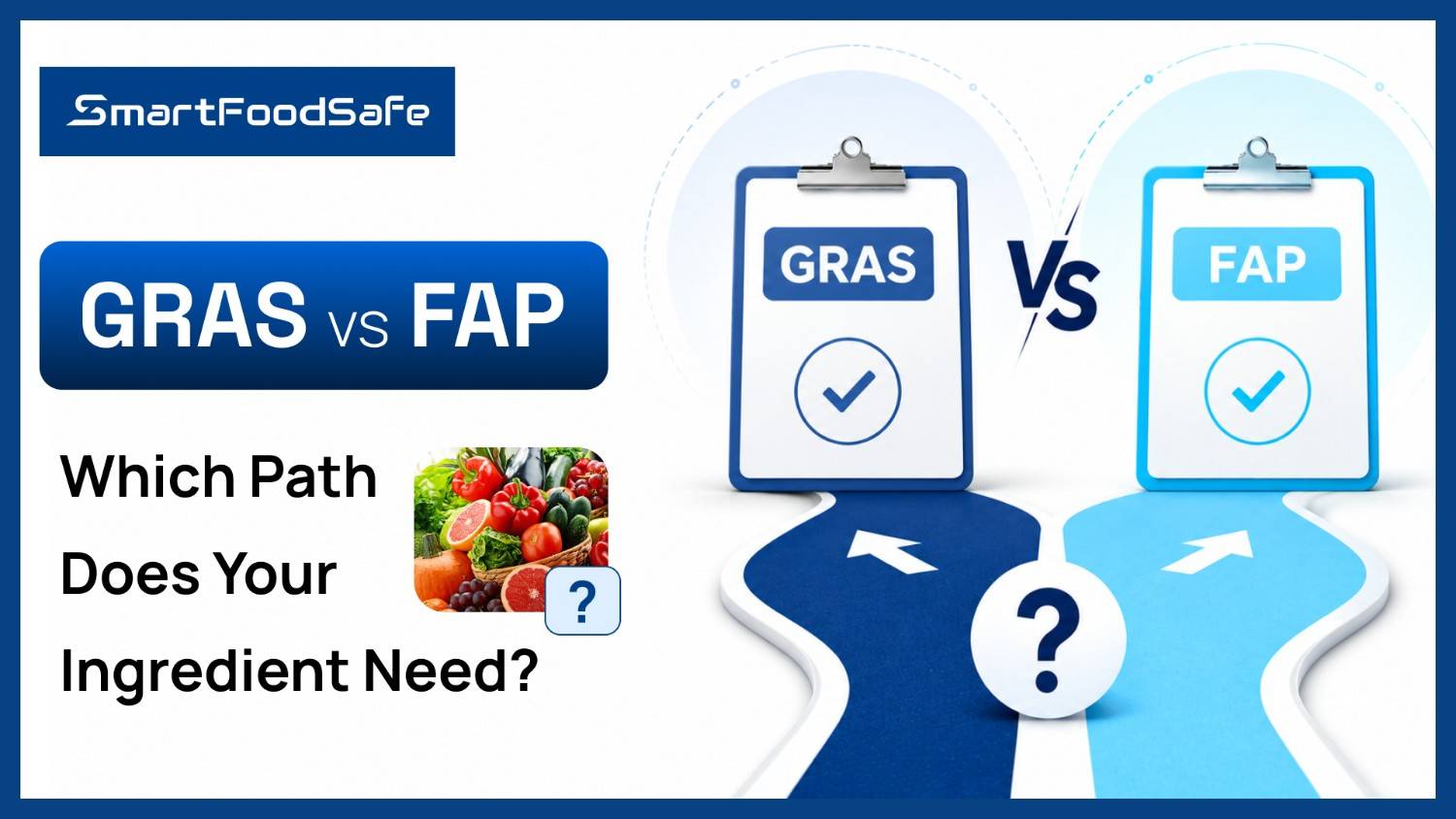
How do you know if a new food ingredient is safe and legally permitted for use?
That question matters whenever a manufacturer introduces a new sweetener, protein, extract, preservative, or functional ingredient. Safety is essential, but manufacturers also need to establish the appropriate regulatory basis for the ingredient and its intended use.
Two key regulatory pathways are GRAS (Generally Recognized as Safe) and Food Additive Petitions (FAPs). While both address the use of ingredients in food, they serve different regulatory purposes.
So, which pathway applies to your ingredient, and what does each one require? Let's break down GRAS vs FAP in simple terms.
GRAS stands for Generally Recognized as Safe, a regulatory status that allows certain substances to be used in food without going through the full FDA food additive approval process.
Under U.S. law, a substance added to food is generally considered a food additive unless it qualifies for an exception such as GRAS. For an ingredient to qualify as GRAS, its safety must be generally recognized by qualified experts based on scientific procedures or, for substances used in food before 1958, through experience based on common use in food.
Importantly, GRAS status is tied to the ingredient's intended conditions of use. An ingredient is not automatically GRAS simply because it is natural, has been used for a long time, or is considered safe. Its safety must be supported for how, where, and at what level it is intended to be used in food.
Not every ingredient needs to go through the full food additive approval process. The GRAS provision provides a pathway for substances whose safety is already generally recognized by qualified experts under their intended conditions of use.
This helps manufacturers bring safe, well-supported ingredients to market while maintaining a level of safety consistent with the requirements applied to food additives.
For food manufacturers, establishing GRAS status is more than a regulatory step. It provides a documented basis for using an ingredient in a specific food application and can support smoother product development and stronger compliance.
A well-supported GRAS determination can help manufacturers:
However, GRAS status is specific to the conditions of use. It does not automatically cover every food, concentration, or application.
For example, a sweetener may have a GRAS determination for use at a certain level in specific food categories. If a manufacturer wants to use it at a higher level or introduce it into a different type of food, the existing determination may not necessarily cover that new use and may need to be evaluated separately.
Under the current framework, a company can determine that an ingredient is GRAS without notifying the FDA. However, it must have a scientifically and legally defensible basis for the conclusion, supported by qualified expert review where appropriate.
Companies can also voluntarily submit a GRAS Notice to FDA with the scientific basis and proposed conditions of use. FDA may respond that it has "no questions" about the company's conclusion.
This does not mean the FDA has formally approved the ingredient. The responsibility for meeting the GRAS standard remains with the manufacturer.
In both approaches, the key consideration is the same: the safety determination must apply to the ingredient under its specific intended conditions of use.
GRAS oversight is receiving increased attention in 2026. FDA plans to propose a rule requiring GRAS notifications for new substances claimed to be GRAS, moving beyond today's voluntary notification approach.
At the same time, FDA has begun reassessing established food chemicals such as BHA, BHT, and ADA under its expanded post-market safety program.
For manufacturers, this potential change could mean greater emphasis on documenting the scientific basis, intended use, and safety assessment of new ingredients and keeping that information ready for regulatory review.
An ingredient qualifies as GRAS when its safety is generally recognized by qualified experts for its intended conditions of use. Manufacturers can review FDA regulations, GRAS Notices, and other FDA resources when assessing an ingredient's regulatory status.
This becomes especially important with newer ingredients. For example, a plant-based beverage containing a novel protein or new sweetener cannot be considered GRAS simply because it is plant-derived or similar to an existing ingredient.
In short, GRAS status depends on both the ingredient and how it will be used, not simply where it comes from or how long a similar ingredient has been on the market.
If a substance added to food is not GRAS for its intended use and does not have another applicable FDA authorization, it may be considered an unapproved food additive, making the food adulterated under U.S. law.
For manufacturers, this can lead to:
More importantly, ingredient compliance does not end once a product reaches the market. FDA can reassess food chemicals when new scientific information becomes available.
Butylated hydroxyanisole (BHA) has been used as a preservative to help prevent food from spoiling. Yet in 2026, FDA launched a comprehensive reassessment of BHA as part of its broader post-market review of food chemicals.
For manufacturers, the lesson is important: an ingredient's regulatory history does not mean its status should be ignored forever. Scientific evidence, regulatory assessments, and permitted uses may continue to be reviewed.
FDA also launched reassessments of BHT and azodicarbonamide (ADA) in 2026. BHT is used to help prevent spoilage of fats and oils, while ADA is used in certain flour and dough applications.
These examples illustrate the difference between being legally authorized for a particular use and being permanently free from regulatory scrutiny.
| Parameter | GRAS | Food Additive Petition |
|---|---|---|
| FDA premarket approval | Not required when GRAS criteria are met | Required |
| Safety basis | Generally recognized by qualified experts | FDA evaluates submitted safety information |
| Regulatory route | GRAS determination or notification | Formal FDA petition |
| Intended use | Must meet GRAS criteria for that use | Must be authorized for the proposed use |
| FDA involvement | Notification is currently voluntary | FDA authorization is required |
The simplest distinction is: GRAS is an exception to the food additive definition. A Food Additive Petition is a formal pathway for obtaining FDA authorization for a food additive.
A Food Additive Petition (FAP) may be needed when an ingredient does not qualify for a GRAS exception and its proposed use requires FDA authorization.
Example: A manufacturer develops a new preservative for packaged foods but cannot establish that its safety is generally recognized by qualified experts.
Example: An additive permitted in baked goods is proposed for use in beverages at a higher concentration.
Example: A new ingredient has promising safety studies, but there is not enough scientific evidence or expert consensus to support a GRAS conclusion.
Example: A manufacturer developing a new food coloring cannot automatically use the GRAS pathway simply because the coloring ingredient appears safe.
Therefore, whenever an ingredient or its proposed use does not have a valid GRAS or other legal basis, FDA food additive authorization may be required.
A practical GRAS assessment generally involves:
A Food Additive Petition (FAP) is a formal request to FDA to authorize a specific food additive use. The manufacturer must provide enough information for the FDA to evaluate the proposed use and its safety.
Unlike GRAS, a manufacturer cannot market a food additive for a proposed use simply because its own assessment concludes that it is safe. FDA must authorize the use before the additive can be legally marketed for that purpose.
Natural or plant-derived does not automatically mean GRAS.
Changing the concentration, food category, or conditions of use can change the regulatory assessment.
A GRAS conclusion needs a defensible scientific basis and organized supporting evidence.
The current BHA, BHT, and ADA reassessments demonstrate why manufacturers should continuously monitor FDA developments rather than treating ingredient compliance as a one-time task.
Incorrectly treating an ingredient as GRAS when it requires food additive authorization can create significant compliance risks.
Manufacturers should:
Digital food safety systems can help manufacturers manage regulatory documents, control versions, document changes, maintain compliance records, and improve audit readiness.
Food innovation may begin with an ingredient, but responsible manufacturing begins with knowing whether, why, and how that ingredient belongs in the food supply.
GRAS and FAP are not merely regulatory routes to navigate. They represent a manufacturer's responsibility to put sound science behind every ingredient and every intended use.
Do not let compliance be the last question you ask. Make it the first assurance you build into the product.
Because in food manufacturing, the strongest innovation is not simply what reaches the market, but what can withstand scrutiny once it gets there.
No. A substance that meets the GRAS criteria does not require FDA premarket approval for that GRAS use.
Yes, under the current framework. However, FDA is planning proposed changes that would require notifications for new substances claimed to be GRAS.
There is no fixed timeline. It depends on the ingredient, available scientific evidence, intended use, exposure, and expert review required.
GRAS is an exception to the food additive definition when the legal requirements are met. Food additives generally require FDA premarket authorization.
No. Natural does not automatically mean GRAS. The ingredient must meet the applicable safety standard for its intended conditions of use.

 French
 Spanish
 Portuguese