


 English
▾
English
▾
English
▾
English
▾
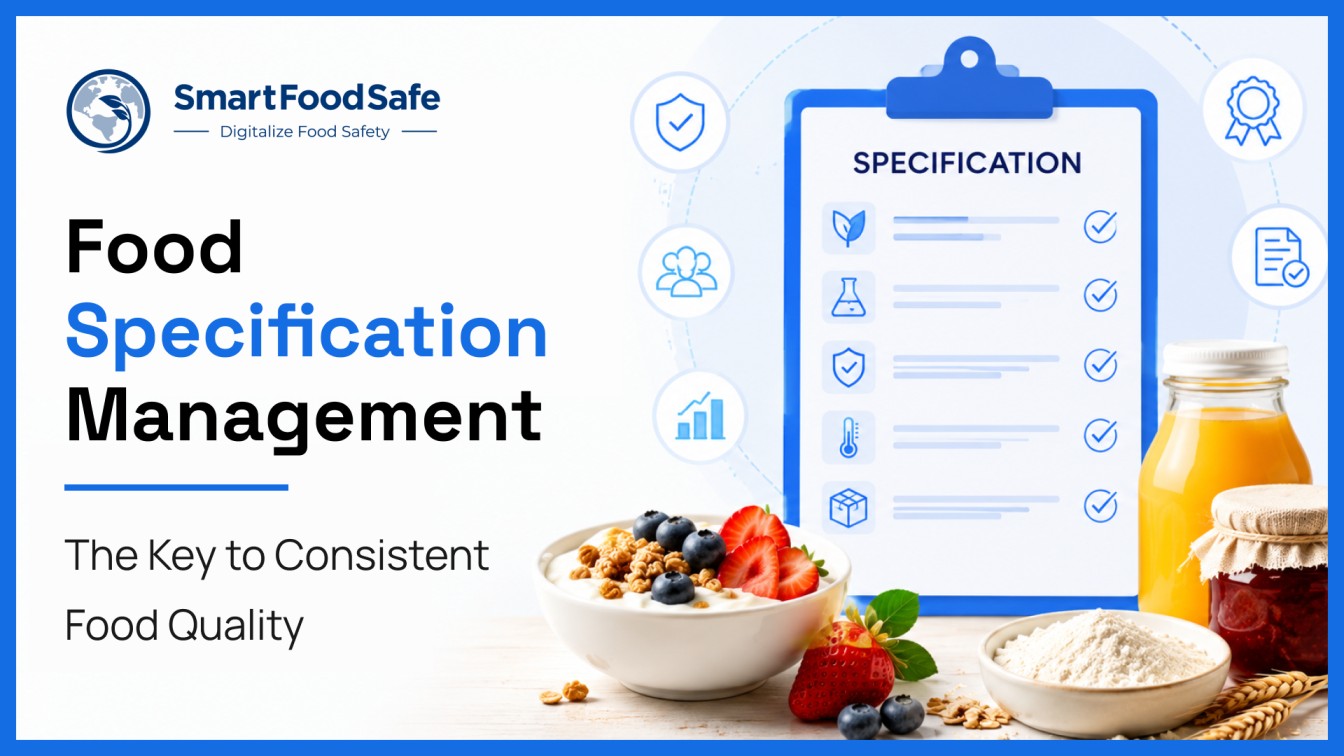
Have you ever wondered how your favorite food product tastes, looks, and performs the same every time you buy it?
A food specification (or "spec") is a document that defines exactly what a food product should be, including its ingredients, appearance, taste, quality, and safety requirements. It outlines the physical, chemical, microbiological, and sensory characteristics a product must meet.
For example, a specification may define the colour and sweetness of a strawberry jam or the protein content and baking performance of flour, helping ensure the final product meets the same quality standards every time.
Food specifications are the foundation of food quality. They help ensure products are made with the right ingredients, produced under the right conditions, and delivered with the same quality every time. By creating a shared understanding across suppliers, manufacturers, and customers, specifications minimize errors, reduce quality issues, and support compliance.
Not all food specifications serve the same purpose. Some focus on the ingredients and suppliers that form the foundation of a product, while others define how that product should be manufactured, packaged, and presented to consumers.
To make this easier to understand, food specification management can be viewed through three interconnected pillars:
Each pillar plays a critical role in protecting food quality. Together, they create a structured framework that helps food businesses maintain consistency, meet compliance requirements, and deliver products that meet customer expectations from source to shelf.
| Pillar | What It Covers | Simple Meaning |
|---|---|---|
| What goes into the product | Supplier and raw material specifications | Are we using the right inputs? |
| How the product is made | Process specifications | Are we making it the right way? |
| What leaves the facility | Finished product, packaging, and label specifications | Are we delivering the right final product? |
While food businesses may manage many different documents, most specifications fall into six practical categories.
Supplier specifications define the standards a supplier must meet before ingredients, packaging, or services can be approved. They help businesses receive safe, reliable, and high-quality materials from trusted sources.
For example, a spice supplier may need to provide food safety certificates and quality test reports with every delivery.
Raw material specifications describe the requirements for ingredients used to make a product. They help ensure only the right ingredients enter production.
For example, a flour specification may define its quality, moisture level, allergen status, and storage conditions.
Process specifications outline how a product should be made, handled, or stored during production. They help food businesses produce safe and consistent products every time.
For example, cooked chicken may need to reach a specific temperature before it can be packaged.
Finished product specifications define what the final product should look, taste, and perform like before it reaches consumers.
For example, a strawberry yogurt specification may describe its colour, flavour, texture, nutritional values, and shelf life.
Packaging specifications define the requirements for the containers and materials used to protect a product. They help preserve product quality during storage and transportation.
For example, a juice bottle specification may define the bottle size, material, and sealing requirements.
Label specifications define the information that appears on a product label. They help ensure consumers receive accurate information and that regulatory requirements are met.
For example, a cereal label may include ingredients, allergens, nutrition facts, storage instructions, and product claims.
Supplier → Raw Material → Process → Finished Product → Packaging → Label
| Specification Type | What It Includes |
|---|---|
| Supplier | Supplier approvals, certifications, Certificates of Analysis (COAs), quality and compliance requirements |
| Raw Material | Ingredient specifications, composition, quality attributes, allergens, microbiological limits, storage requirements |
| Process | Manufacturing instructions, processing parameters, temperature controls, handling and storage procedures |
| Finished Product | Product description, appearance, taste, texture, nutritional values, shelf life, quality standards |
| Packaging | Packaging material, dimensions, seal integrity, barrier properties, food-contact requirements |
| Label | Product name, ingredient list, allergen declarations, nutrition facts, storage instructions, claims, barcodes |
Food specifications should reflect the legal and commercial requirements of the markets where a product is made and sold. In practice, that means they must align with national food laws, labeling rules, and any customer or certification requirements that apply.
Developed by the Food and Agriculture Organization (FAO) and the World Health Organization (WHO), Codex Alimentarius provides internationally recognized food standards, guidelines, and codes of practice. Many countries use Codex as a foundation for their food regulations, making it an important reference for product specifications, labeling, food additives, and food safety requirements.
In the United States, food specifications are heavily influenced by the Food and Drug Administration (FDA) and the Food Safety Modernization Act (FSMA). These regulations focus on preventive food safety controls, ingredient declarations, allergen labeling, traceability, and product compliance. Foods regulated by the USDA, such as meat, poultry, and egg products, may have additional requirements.
The European Union operates under a comprehensive food regulatory framework that includes Regulation (EC) No. 178/2002 (General Food Law), Regulation (EC) No. 852/2004 (Food Hygiene), and Regulation (EU) No. 1169/2011 (Food Information to Consumers). Together, these regulations influence product composition, food safety controls, traceability, and labeling requirements.
Following Brexit, the United Kingdom retained much of the existing EU food legislation while introducing UK-specific requirements. Food businesses must comply with the Food Safety Act 1990, regulations enforced by the Food Standards Agency (FSA), and labeling requirements applicable to products sold within the UK market.
The Food Standards Australia New Zealand (FSANZ) Food Standards Code establishes requirements for food composition, safety, production, labeling, and contaminants. It serves as the primary regulatory framework for food businesses operating in Australia and New Zealand.
Canada's food industry is governed by the Safe Food for Canadians Act (SFCA) and the Safe Food for Canadians Regulations (SFCR). These regulations emphasize preventive controls, traceability, licensing, and food safety management practices, all of which influence food specification requirements.
In India, food specifications must comply with regulations established by the Food Safety and Standards Authority of India (FSSAI). The Food Safety and Standards Act, 2006, and its associated regulations govern food composition, additives, contaminants, packaging, labeling, and food safety requirements.
In addition to government regulations, many food manufacturers follow Global Food Safety Initiative (GFSI) benchmarked certification programs such as BRCGS, SQF, and FSSC 22000. These schemes require businesses to maintain accurate and up-to-date specifications for raw materials, packaging, processes, and finished products as part of their food safety management systems.
Key principle: Legal requirements establish the baseline, but many retailers and foodservice customers have additional expectations. A well-developed specification should capture both to ensure compliance and customer satisfaction.
An effective food specification serves as a single source of truth for a product. To achieve this, it should include the following essential components:
A food specification is made up of measurable criteria known as specification parameters. These parameters help define what a product should look like, contain, and perform like. Think of them as checkpoints that help ensure every batch meets the same quality, safety, and customer expectations.

These parameters work together to create a complete picture of a product. While some focus on quality and consumer experience, others help ensure food safety, regulatory compliance, and supply chain consistency.
Imagine a packaged strawberry yogurt. A simple specification may say: the product must contain milk and strawberry puree, must be pink in color, smooth in texture, free from foreign matter, packed in a sealed cup, stored at 2–8°C, and labeled correctly for milk and any other allergens. It may also define the shelf life, fill weight, acceptable pH range, and microbiological limits. This is what turns a vague product idea into something manufacturing, QA, and procurement can actually control. The exact legal requirements for ingredients, allergens, and label presentation depend on the market where the product is sold.
Effective food specification management is not just about creating specifications. It is about ensuring they remain accurate, approved, traceable, and aligned with product, supplier, and regulatory requirements throughout their lifecycle.
A strong specification management process typically follows this flow:

Managing food specifications shouldn't mean chasing spreadsheets, digging through email chains, or worrying about outdated information. Smart Specifications brings product, supplier, packaging, and labeling data into one centralized platform, helping food businesses stay compliant, connected, and audit-ready.
| Traditional Specification Management | With Smart Specifications |
|---|---|
| ❌ Specifications scattered across spreadsheets and shared drives | ✅ Centralized repository for all specifications and related documents |
| ❌ Time-consuming approval and review processes | ✅ Automated workflows, approvals, and notifications |
| ❌ Manual allergen and ingredient updates | ✅ Centralized allergen and ingredient management |
| ❌ Limited visibility into changes and revisions | ✅ Complete audit trail with version control |
| ❌ Supplier information managed separately | ✅ Seamless supplier collaboration and specification sharing |
| ❌ Risk of outdated or duplicate documents | ✅ Real-time access to the latest approved specifications |
| ❌ Difficult compliance tracking | ✅ Built-in compliance monitoring and review reminders |
The Result: Less time managing documents. More time ensuring food safety, compliance, and product quality.
Smart Specifications transforms food specifications from static documents into a connected, controlled, and collaborative source of truth across your supply chain.
A food specification is a document that defines exactly what a food product should be, including its ingredients, appearance, taste, quality, and safety requirements. It outlines the physical, chemical, microbiological, and sensory characteristics a product must meet.
Food specifications create a shared understanding across suppliers, manufacturers, and customers. They help ensure products are made with the right ingredients, produced under the right conditions, and delivered with the same quality every time, minimizing errors and supporting compliance.
Most specifications fall into six categories:
An effective specification typically includes product identity, ingredient declaration, compositional standards, microbiological criteria, physical parameters, chemical contaminants, allergen status, nutritional information, shelf life and storage requirements, labelling requirements, process controls, and a sampling and testing plan.
Food specifications are shaped by a mix of international, national, and certification standards, including Codex Alimentarius, FDA and FSMA requirements in the US, EU Food Law, UK Food Law, the FSANZ Food Standards Code, Canada's SFCR, FSSAI standards in India, and GFSI-recognized schemes such as BRCGS, SQF, and FSSC 22000.
Specifications should be reviewed and updated whenever there is a product reformulation, supplier change, packaging update, regulatory change, or customer requirement revision, as part of an ongoing lifecycle rather than a one-time activity.
Traditional specification management relies on spreadsheets, PDFs, email chains, and manual sign-offs, which makes tracking changes and ensuring compliance difficult. Digital specification management centralizes documents, automates approval workflows, and maintains a complete audit trail and version history.
By maintaining version control, traceability, and complete records of approvals and supporting documentation, businesses can quickly demonstrate compliance and respond to audits, investigations, or customer inquiries without scrambling through scattered files.

 French
 Spanish
 Portuguese