Smart Food Safe

Notification Bar
Smart Food Safe is participating in the IAFP Annual Meeting, on July 26-29 in New Orleans, Louisiana, Meet Us There

Food Safety Management

Food Safety News from June 2026

July 05, 2026 | Written by Smart Food Safe Team

Food Safety Management

Food Safety News from June 2026

July 05, 2026

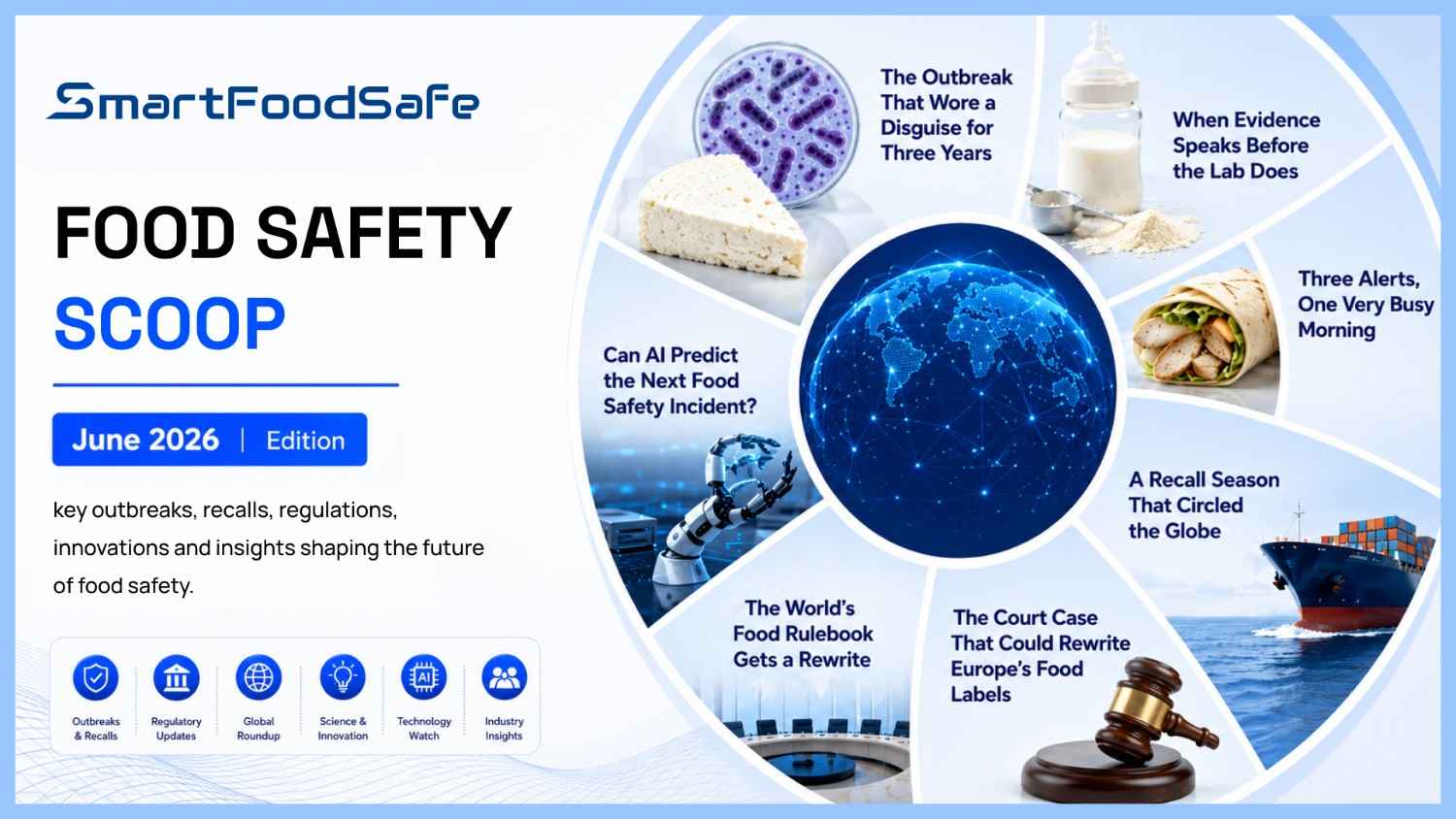
Food Safety Scoop – June Edition

Food Safety Scoop – June Edition

The Complete Roundup of Global Food Safety News, Regulations, Technology, Compliance, Recalls, Research, and Industry Developments from June 2026

Introduction

What does it take to keep a batch of soft cheese, a tin of infant formula, and a shipment of pistachios safe across three continents at once? June 2026 offered plenty of answers. The month opened with World Food Safety Day on 7 June, spotlighting the scale of the global foodborne illness burden, and closed with regulators from Washington to Canberra chasing Listeria in cheese, botulism in baby formula, and undeclared allergens on ingredient labels. Between recalls, certification shakeups, and a fast-moving wave of AI adoption inside food safety programmes, the month captured an industry working hard to stay ahead of risk. Here is what mattered.

Major Food Recalls

Cheese dominated recall headlines worldwide this June. In the United States, a Maryland dairy producer expanded its recall to cover every cheese product made at its facility after Listeria monocytogenes turned up in product and environmental samples, a recall that rippled outward to several regional distributors who had repackaged the same soft cheese under different retail names. USDA's Food Safety and Inspection Service separately flagged a ready-to-eat pasta salad for misbranding and undeclared allergens, and a chicken Caesar wrap for possible Listeria contamination. Across the Atlantic, the UK's food safety regulator recalled a soft cheese for Listeria, a doughnut product for undeclared hazelnuts, and prepped fruit sold at several major supermarket chains for possible Salmonella. In Australia, the national food standards authority recalled a soybean snack range for an undeclared egg allergen.

Major food recalls across the US, UK, and Australia in June 2026

Foodborne Illness Outbreaks

Two multistate US outbreaks defined the month. A Listeria monocytogenes outbreak tied to soft cheese from the same Maryland producer grew to twelve confirmed illnesses and one death across four states, keeping FDA and CDC investigators active through late June. Separately, three infants in California, Pennsylvania, and Washington were hospitalized with botulism after consuming a powdered infant formula, which its maker recalled in mid-June even before its own product tested positive for Clostridium botulinum, calling it a precaution based on the epidemiological signal from CDC. All three infants received BabyBIG antitoxin treatment and survived. In the UK, the prepped fruit Salmonella recall mentioned above triggered a nationwide alert. Both US outbreaks underscore how epidemiological and traceback data, not just lab-confirmed contamination, now drive fast regulatory action.

Regulatory and Compliance Updates

Regulatory momentum built steadily across regions. New EU restrictions on Bisphenol A in food packaging extend existing limits on infant bottles to cover most packaging starting in July, with stricter PFAS packaging controls following in August, both grounded in EFSA risk assessments. In Britain, the Food Standards Agency moved its entire public website to GOV.UK on 25 June, while continuing its Future Food Regulation Programme and pursuing an SPS alignment agreement with the EU that would remove routine certificates and border checks for agri-food goods. The FSA and Food Standards Scotland also published first-of-their-kind hygiene guidance for cell-cultivated meat production. In Oceania, FSANZ opened public comment on permitting cell-cultured duck biomass from Pekin duck embryonic stem cells, with submissions closing 22 July.

Food Technology and AI Innovations

Artificial intelligence kept reshaping how food safety gets managed. FDA expanded its internal generative AI tool into a new version alongside a new data platform consolidating more than forty application and submission systems for staff use in inspections and reviews. At a recent industry lecture, the Institute of Food Technologists' president pointed to an AI market valuation for the food and beverage industry of roughly sixteen billion dollars in 2025, growing above thirty nine percent annually, driven by machine learning and computer vision tools catching contamination on production lines in real time. A university study published mid-June made the economic case for unified, cross-tier traceability systems, finding that coordinated blockchain and AIoT adoption across producers, manufacturers, and retailers cuts costs and intercepts unsafe food more effectively than fragmented, company-by-company tracking.

ISO, GFSI and Certification Updates

Certification bodies spent June preparing for a wave of standard transitions. FSSC 22000 Version 7 is expected around late Q1 or early Q2 of 2026, bringing alignment with GFSI's 2024 Benchmarking Requirements and a clearer structure for categorising the food supply chain, following ISO's 2025 withdrawal of its prerequisite programme series in favour of updated documents, a change already prompting certified sites to ask auditors whether to adopt it early. SQF Edition 10's release schedule was pushed to the first half of 2026 due to complexities in the GFSI benchmarking process. Across GFSI-recognised schemes, unannounced audits continue gaining weight as the sharper test of a site's real-world food safety culture.

World Food Safety Day and Global Awareness

World Food Safety Day on 7 June carried real scientific weight this year. WHO and FAO used the theme "From burden to solutions, safe food everywhere" to launch updated global estimates of foodborne disease burden, drawing on roughly twenty five thousand datapoints gathered over five years of work, giving countries their first national-level estimates of illness, death, and disability-adjusted life years linked to unsafe food. The EU Food Safety Platform ran a week-long multi-stakeholder dialogue from 1 to 7 June, while the UK's food safety regulator marked the day at a Parliamentary reception, noting it investigates around 2,000 food safety incidents every year. The consistent message: foodborne illness is largely preventable, and the data now exists to target interventions where they matter most.

Looking Ahead

July brings its own reckoning. The EU's Bisphenol A restrictions on food packaging take effect, with PFAS packaging limits following a month later. FSANZ's comment window on cell-cultured duck biomass closes 22 July, and the food safety community converges on New Orleans from 26 to 29 July for the industry's largest annual meeting, with symposium topics including AI-powered pathogen detection, predictive modelling, and technologies for improving recall management. With FSSC 22000 Version 7 still pending and SQF Edition 10 expected before year end, certified manufacturers have a narrow window to prepare before the next round of standard transitions begins.

DMS stands for Document Management System. It is a software platform that facilitates the storage, organization, retrieval, and management of digital documents and files. DMS helps streamline document workflows, improve collaboration, enhance security, and provide efficient access to information within an organization.

A centralized document repository is a single, organized location where various types of documents and files are stored and managed. It serves as a central hub for storing, accessing, and sharing documents, providing a convenient and secure way to store and retrieve information within an organization or a specific project.

A digital document management system offers numerous benefits, including improved document organization, easy access and retrieval, enhanced collaboration and version control, increased data security, streamlined workflows, reduced physical storage needs, and improved regulatory compliance.

Common challenges in managing compliance documentation include: keeping up with changing regulations, organizing and storing large volumes of documents, ensuring accuracy and completeness, coordinating updates across multiple departments, and maintaining accessibility for audits or inspections.

An ideal document management system for the food industry should have features like version control, access controls, document classification, audit trails, search functionality, integration with existing systems, compliance with food safety regulations, and the ability to handle various file types (e.g., recipes, quality control documents, certificates).

Quality and Food Safety Management Software

Food Safety and Quality Management Software to streamline processes, track compliance, ensure traceability and maintain audit readiness with global quality and food safety standards

Quality and Food Safety Management Software

Food Safety and Quality Management Software to streamline processes, track compliance, ensure traceability and maintain audit readiness with global quality and food safety standards
1