


 English
▾
English
▾
English
▾
English
▾
With an estimated 4.67 million cases of food poisoning in Australia each year, leading to 47,900 hospitalizations and 38 deaths, it is essential to raise awareness about safe food practices. The economic cost of food poisoning is a staggering $2.1 billion annually. In this context, it is paramount for the Australian food industry to examine and confirm that they are equipped with effective food safety management strategies.
The Food Standards Code in Australia, developed by Food Standards Australia New Zealand (FSANZ), is a comprehensive set of standards covering food production, processing, labeling, and handling across Australia, its states and territories, and New Zealand. These standards aim to minimize foodborne illness risk and ensure a consistent approach to food safety across the country. For food businesses, this means complying with strict guidelines to maintain consumer health and confidence.
Australia’s approach emphasizes preventive measures over reactionary ones, urging businesses to identify potential hazards and put controls in place to reduce contamination risk.
The Code covers several critical aspects of the food supply chain, including:
Each standard addresses specific areas, from personal hygiene and temperature control to supplier verification, offering a blueprint for thorough food safety management.
The main objectives of the Food Standards Code are to:
The Food Standards Code is divided into four distinct chapters, each addressing specific areas of the food supply chain:
This chapter outlines standards that apply to all foods produced in Australia, its states and territories, and New Zealand. It covers:
This chapter focuses on product-specific standards. It details legal requirements for different categories of food products, including:
Chapter 3 establishes food safety requirements exclusively for Australia. It mandates proper food handling practices for businesses and includes standards on:
This chapter targets the agricultural sector, focusing on the production and processing of primary commodities. It includes regulations on:
All food businesses operating in Australia must comply with the Australia New Zealand Food Standards Code to operate legally. To ensure compliance, Australian food businesses must adhere to both national standards set by FSANZ and local state or territory regulations. Each state has a food authority that oversees compliance, often conducting regular inspections. Failure to comply with regulations can lead to penalties, closure, or legal consequences, making it essential for businesses to stay informed on updates to food safety laws and guidelines. By following these regulations, food businesses help maintain public trust and contribute to a safer food supply chain.
Australia is stepping into a new era with the introduction of a digital food assurance system, an initiative poised to reshape the country’s approach to food safety. Launched on January 29, 2024, this system represents a visionary leap toward streamlined regulatory processes and enhanced global competitiveness for Australian agriculture. By embracing digital transformation, Australia aims to position itself at the forefront of food safety and quality on the world stage.
At the core of this transformation is the Trusted Agrifood Exports Mission, an ambitious project led by the Commonwealth Scientific and Industrial Research Organisation (CSIRO), Australia’s national science agency. This initiative is a coordinated effort among government bodies, industry leaders, and experts to modernize the collection, management, and analysis of food safety data. In doing so, Australia seeks to address inefficiencies in the current system, which often struggles to keep pace with the rapidly growing demands of a global market.
The vision for a digital solution is clear: streamline food safety management, reduce regulatory bottlenecks, and empower Australian food businesses to achieve more efficient compliance. This shift will also simplify interactions with global markets, strengthening Australia’s reputation as a reliable exporter of safe, high-quality food products.
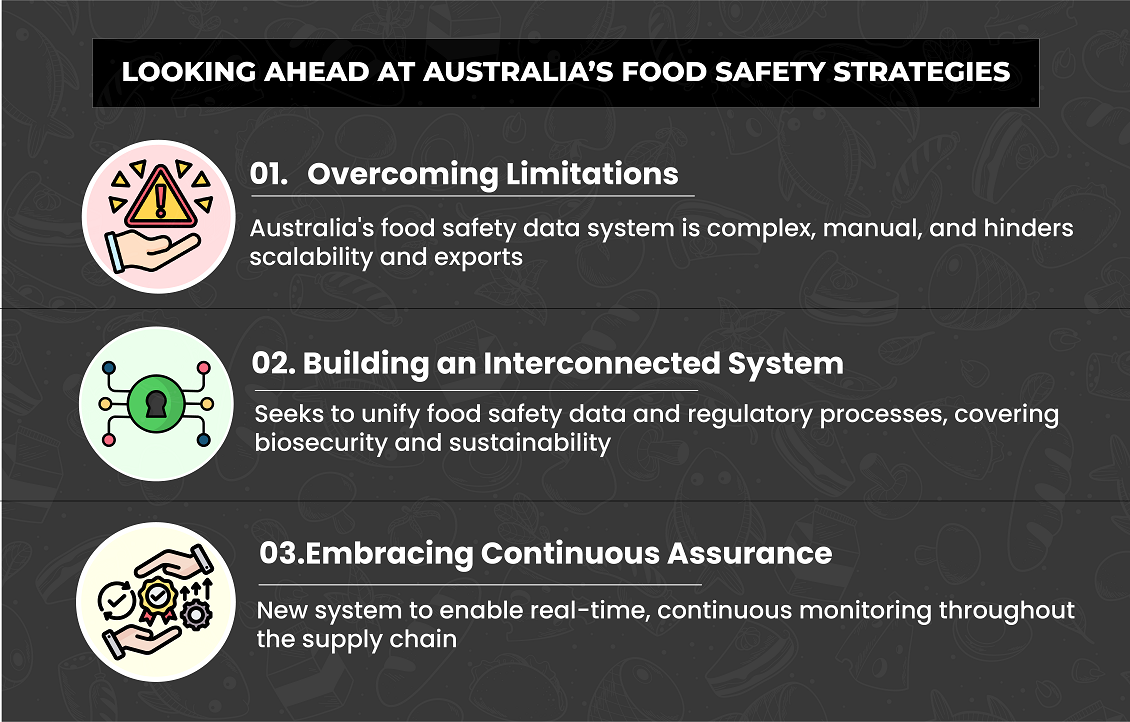
1. Overcoming the Limitations of the Current System – Currently, Australia’s food safety data management is complex, labor-intensive, and scattered across multiple channels. As highlighted by Dr. Ryan McAllister, the leader of the digital transformation project, the existing system involves burdensome reporting processes and manual steps, which slow down operations and inflate costs, tending to hamper the export potential and limits the scalability of Australia’s food safety measures.
2. Building an Interconnected Food Assurance System – CSIRO’s digital food assurance system aims to foster a unified approach to food safety, bringing together insights from various regulatory agencies, including the Department of Agriculture, Fisheries and Forestry (DAFF), and state-level authorities. The project’s focus extends beyond food safety to include other critical assurances, such as biosecurity, product quality, animal welfare, provenance, and environmental sustainability. It emphasizes the need for streamlined data collection, which the current, paper-based methods fail to provide. In contrast, the new digital system will utilize specialized modules designed to manage compliance data and evaluate risks at critical control points. This approach promises a smoother, more integrated food safety management experience that benefits producers, regulators, and consumers alike.
3. Embracing Continuous Assurance and Data-Driven Decisions – A significant component of this digital transformation is the concept of continuous assurance. With the integration of advanced digital technologies, the new system will enable real-time monitoring across the entire supply chain, from farms to processing facilities and beyond. Continuous assurance allows for data collection and risk assessment at every stage, enhancing transparency and minimizing the likelihood of foodborne incidents. By leveraging technology, Australia’s food industry will enjoy reduced regulatory pressures and new opportunities for growth. Furthermore, the continuous assurance model will strengthen Australia’s food brand globally, reinforcing its reputation for safety and quality.
As Australia embarks on this digital journey, the long-term potential is immense. CSIRO’s efforts to modernize the country’s food safety infrastructure pave the way for more efficient regulatory processes, new market opportunities, and sustainable growth in agriculture. By focusing on innovative digital solutions, Australia is preparing its food industry to thrive in an increasingly interconnected and data-driven world. Through this initiative, Australia will not only safeguard public health but also bolster its economic resilience and market position, setting a high standard for food safety practices worldwide.
As Australia pivots towards a digitally driven food safety landscape, Smart Food Safe stands ready with solutions tailored to meet the evolving needs of Australian food businesses. The platform’s customizable modules—ranging from environmental monitoring and sanitation to supplier management and audit readiness—allow businesses to address their unique operational challenges. This adaptability not only enhances regulatory alignment with the latest standards but also provides actionable insights that help Australian businesses scale sustainably, cut costs, and gain a competitive edge. As Australia advances its food safety infrastructure, Smart Food Safe stands as a reliable partner in ensuring seamless integration with digital assurance systems and positioning businesses for success in the global market.

 French
 Spanish
 Portuguese