


 English
▾
English
▾
English
▾
English
▾
What if the meal that made you sick didn't just "go bad"… but failed in a very specific way?
When people fall ill after eating contaminated food, the immediate reaction is to call it food poisoning. But a more important question often goes unasked:
Was it the bacteria itself that made you sick or the toxin it left behind?
That one question draws a clear line between the two.
Foodborne illness is a broad term, and not every case happens for the same reason. In some situations, live bacteria enter the body and cause infection. In others, toxins already formed in the food trigger illness the moment they are consumed.
From the outside, both can look almost identical. The symptoms may feel the same, and the source may not be obvious. But the difference lies in what caused the illness, how quickly it develops, and how the body responds.
Understanding this helps you recognize risks sooner, respond more effectively, and take the right steps to prevent it from happening again.
Food poisoning usually refers to illness caused by infectious organisms such as bacteria, viruses, or parasites that enter the body through contaminated food or water.
In simple terms, the harmful microorganism is still active when the food is eaten. Once inside the body, it multiplies or infects the digestive system and causes illness.
The contamination reaches the body through food, and then the organism itself causes the illness. In many cases, symptoms do not appear immediately because the pathogen needs time to grow or interfere with the body.
Food intoxication happens when a person eats food that already contains toxins produced by bacteria, fungi, or other contaminants.
Here, the microorganism itself may no longer need to be alive. The problem is the toxin it produced before the food was eaten.
This is why food intoxication often causes a faster onset of symptoms than food poisoning.
The toxin is already present in the food. Once consumed, it affects the body directly, often triggering symptoms quickly.
Although both are linked to contaminated food, they are not the same.

This is why people sometimes say, "I got food poisoning after eating that meal," when the actual problem may have been food intoxication.
The confusion is understandable because both conditions can cause:
From a consumer's point of view, the symptoms may look similar. But from a food safety perspective, the origin of the illness is different, and that difference affects prevention and response.
For example, if a person gets sick after eating chicken salad left out too long, the issue may be toxin formation from bacteria such as Staphylococcus aureus. If someone becomes ill after eating undercooked poultry, the cause may be a live bacterial infection such as Salmonella.
Food poisoning often has these characteristics:
| Aspect | Food Poisoning (Infection-Based) | Food Intoxication (Toxin-Based) |
|---|---|---|
| Cause | Caused by live microorganisms entering the body through contaminated food | Caused by toxins already present in the food before consumption |
| Onset of Symptoms | Symptoms may take longer to appear (hours to days) as the organism grows or infects the body | Symptoms appear quickly (often within minutes to hours) as toxins act immediately |
| Fever | Fever is more common as the body fights infection | Fever is less common since it is a toxin reaction, not an infection |
| Duration | Can last longer as the body needs time to eliminate the pathogen | Usually shorter but can be intense and sudden |
| Severity | Ranges from mild to severe; higher risk for vulnerable groups | Can be sudden and severe; certain toxins (e.g., botulinum) can be life-threatening |
| Food Appearance | Food may appear spoiled or contaminated | Food may look, smell, and taste normal despite being unsafe |
| Effect of Heating | Proper cooking can often kill the microorganisms | Some toxins are heat-stable and may not be destroyed by reheating |
| Underlying Risk | Linked to poor hygiene, undercooking, or cross-contamination | Linked to improper storage, temperature abuse, or delayed refrigeration |
Both conditions may cause:
However, some patterns can suggest one over the other.
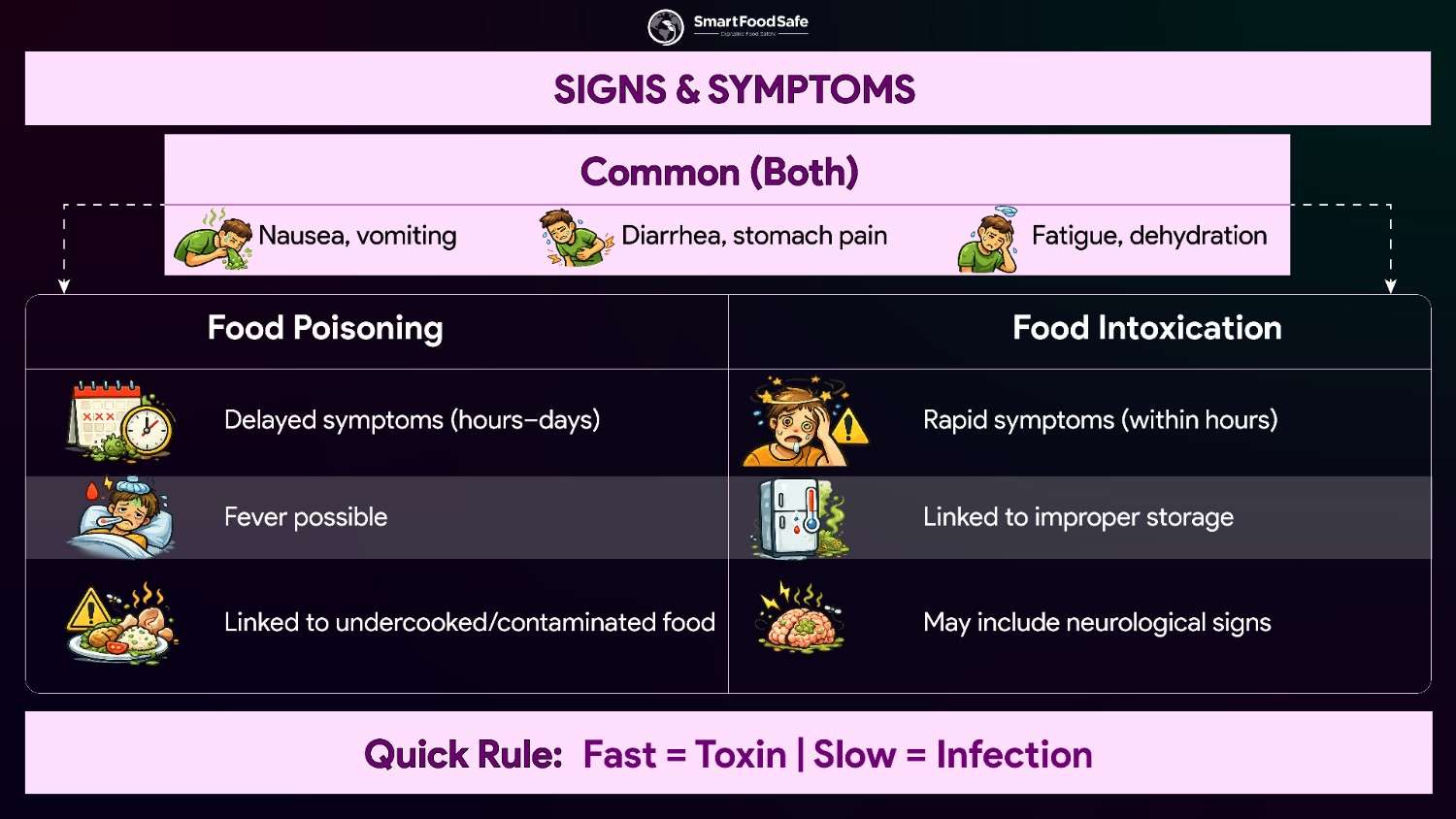
A person eats undercooked chicken and falls sick the next day with diarrhea, cramps, and fever, typical of food poisoning caused by Salmonella.
Poultry remains one of the most common sources of Salmonella outbreaks globally, with repeated incidents linked to contaminated chicken and eggs.
A person eats a cream-filled pastry left unrefrigerated and becomes sick within hours, pointing to toxin-related illness from Staphylococcus aureus.
Food safety data consistently shows that improper storage of ready-to-eat foods is a major cause of rapid-onset illness due to toxin formation.
A person consumes poorly preserved food and develops serious neurological symptoms, indicative of botulism, a rare but severe toxin-based illness.
Health agencies continue to warn that improper processing and storage can lead to high-risk, toxin-related foodborne incidents.
The first step in both cases is to assess severity. Mild cases often improve with rest and hydration, but some situations require urgent medical care.
Seek medical help if there is:
Food intoxication, especially botulism, can become a medical emergency. Rapid symptoms affecting the nervous system should never be ignored.
The good news is that both food poisoning and food intoxication are largely preventable.
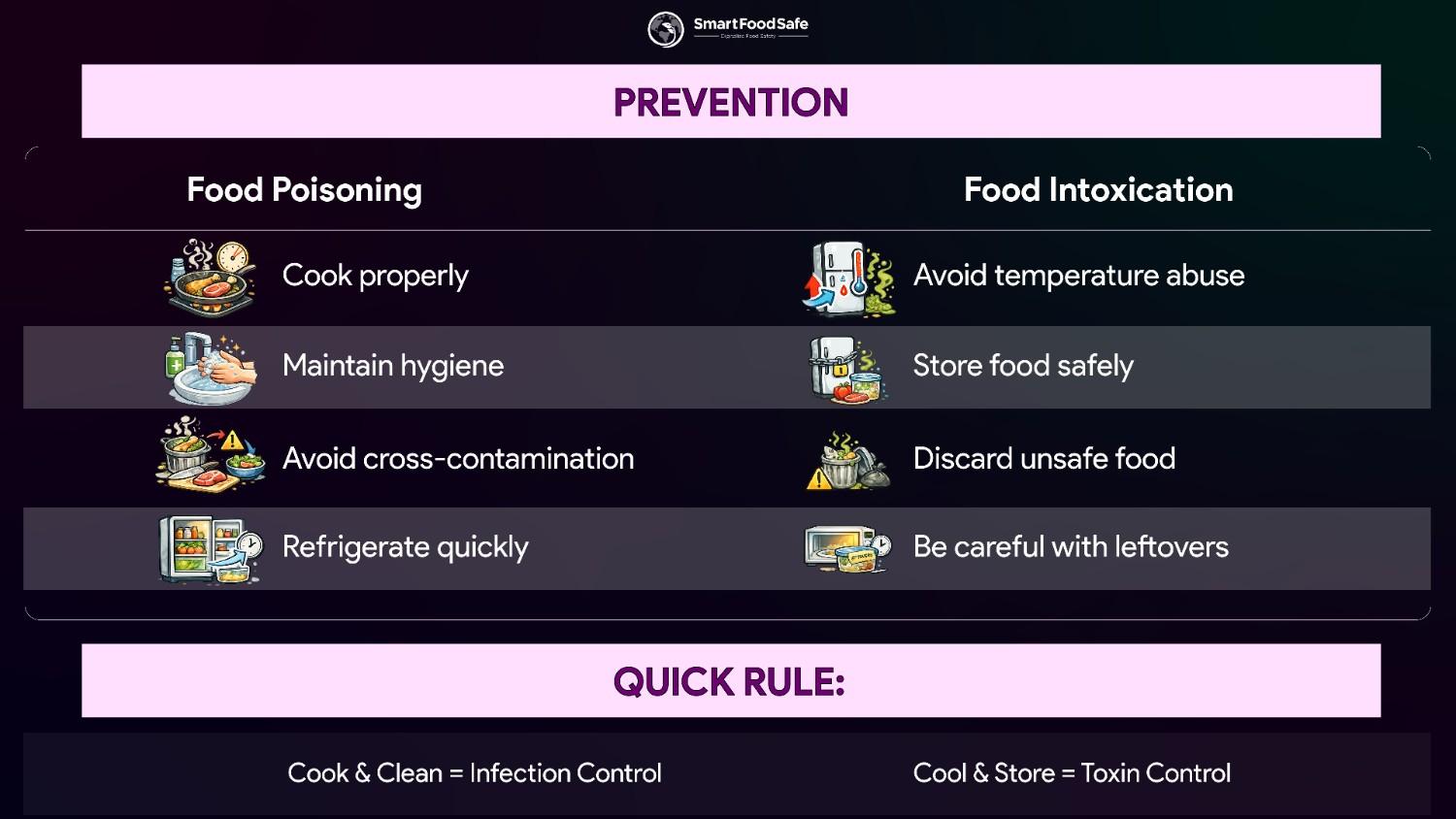
In homes, restaurants, food processing facilities, and catering operations, both food poisoning and food intoxication point to the same larger issue: failures in hygiene, temperature control, storage, or process management.
A strong food safety program helps reduce risk through:
If gaps in your process are what lead to risks, then strengthening your system is the most effective way to prevent them.
With Smart Food Safe, food businesses can move beyond manual checks and reactive fixes to a proactive, digital food safety system that:
This results in fewer risks, faster response, and stronger control over both contamination and toxin-related hazards, helping you prevent foodborne illness before it starts.
Food poisoning and food intoxication are closely related, but they are not the same.
Food poisoning is caused by ingesting live harmful organisms that infect the body.
Food intoxication is caused by toxins already present in food before it is eaten.
The difference lies in the source of harm, speed of onset, and mechanism of illness. Food poisoning often develops more slowly and may involve infection, while food intoxication tends to appear faster because the toxin acts directly on the body.
For consumers and food handlers alike, the message is clear: safe cooking, proper storage, hygiene, and temperature control are essential. Prevention is always easier than treatment.

 French
 Spanish
 Portuguese