


 English
▾
English
▾
English
▾
English
▾
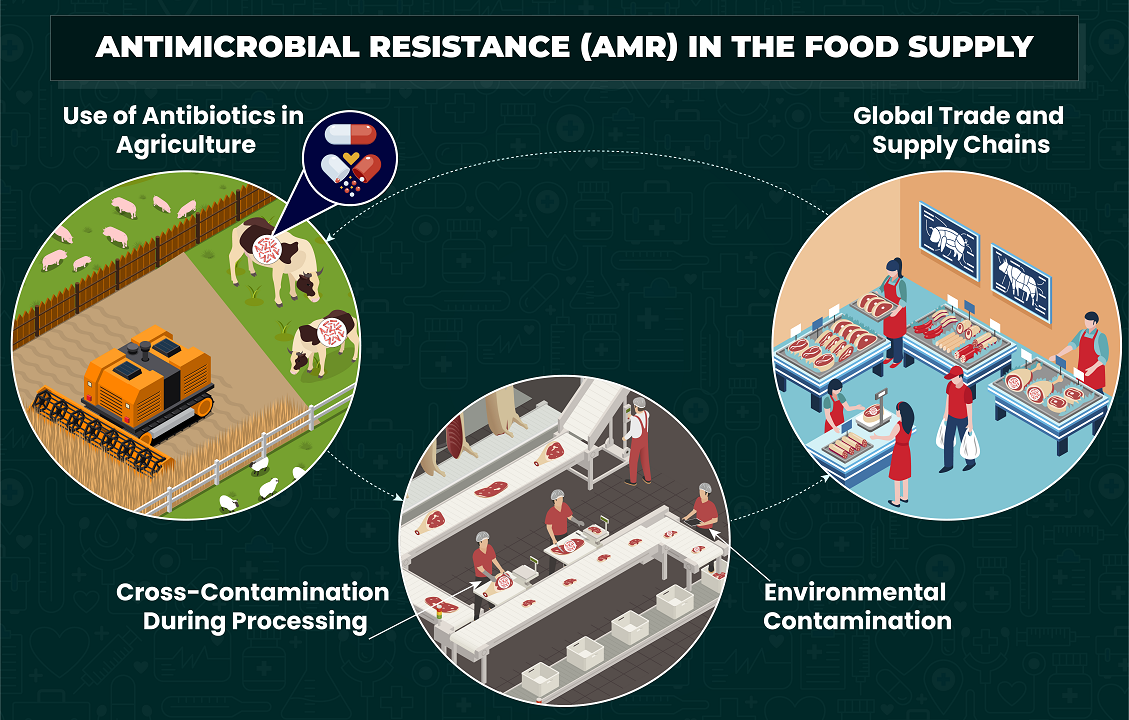
Did you know food supply is one of the key impacted areas for antimicrobial resistance (AMR), posing a significant challenge to global public health?
The extensive use of antibiotics in agriculture and animal husbandry has contributed to the emergence of antimicrobial-resistant bacteria (ARB) that contaminate food products. These resistant strains, once ingested, can cause infections that are difficult or impossible to treat with standard antibiotics, posing severe risks to food safety, human health, and the global economy. This article explores the critical role of controlling AMR in the food supply, identifies sources of contamination, and offers prevention strategies to mitigate its spread.
Antimicrobial resistance occurs when microorganisms, such as bacteria, viruses, fungi, or parasites, develop the ability to survive exposure to drugs that were previously effective in treating infections caused by them. This resistance can arise naturally through mutations or be acquired by bacteria through horizontal gene transfer from other bacteria. AMR is particularly concerning in the food supply because resistant bacteria can be transmitted to humans through consumption, handling, or cross-contamination of food.
The World Health Organization (WHO) has warned that if AMR continues to spread, we could enter a post-antibiotic era where minor infections or routine surgeries could become life-threatening. The dangerous cycle of the transference of AMR from animals to humans via food, resulting in the efficacy of antibiotics for treating human infections being reduced, putting millions at risk and straining healthcare systems.
Beyond the health implications, uncontrolled AMR also threatens food security and the agricultural economy. Effective control and prevention measures in the food supply are therefore essential to safeguard both human health and the economic vitality of the food industry, ensuring that antibiotics remain effective for future generations.
Here is a breakdown of how antimicrobial resistance can enter and prevail in the food supply chain:
AMR can impact individuals at any stage of life and affects the healthcare, veterinary, agriculture, and food sectors, making it one of the most pressing public health challenges worldwide. Tackling AMR in the food supply requires a multi-faceted approach that addresses the root causes of resistance and promotes sustainable practices across the food chain. Below are several key strategies for food supply chain partners to control and prevent AMR:
One of the most critical steps in combatting AMR is to reduce the overuse and misuse of antibiotics in food-producing animals.
Many retailers and food manufacturers are shifting toward sourcing antibiotic-free or organically raised animals to reduce AMR risks.
Ensuring a risk-based food safety management system (FSMS) can substantially minimize AMR risks.
Food processing plants and facilities must adhere to strict hygiene standards to prevent cross-contamination and the spread of resistant bacteria.
Surveillance and monitoring systems are essential for detecting the contamination of AMR in the food supply. This information can help identify trends, hotspots of resistance, and sources of contamination, enabling authorities to take targeted action.
Food industries should be able to support, if not contribute, to the continuous study and research on developing pathways to minimize AMR causes.
Continued research and innovation are necessary to develop new tools, technologies, and strategies for combatting AMR.
Food companies can run educational programs to inform their employees about AMR risks and responsible antibiotic use.
Food businesses adopting these strategies introduce a unified and holistic approach, which is required to ensure a safe and secure food supply free from the threat of untreatable infections.
Smart Food Safe emerges as an enabler for innovative ways to diminish AMR risks pertaining to food industries by offering diverse software solutions for proactive risk-based food safety management. Below are some ways in which our modules serve to aid food supply chain partners in remediating AMR risks:
Smart Farm allows real-time monitoring of farming protocols for producers, ensuring that organic and antibiotic-free standards are maintained across farms. Smart Farm can ease the transition to sustainable, antibiotic-free food production methods.
Smart Supplier equips food businesses to track supplier adherence to antibiotic use policies and facilitate sourcing antibiotic-free products wherever possible. It helps to set compliance benchmarks and makes it easier to manage suppliers that align with antibiotic-free initiatives.
Smart HACCP digitalizes detecting and managing food safety hazards, enabling food companies to quickly identify potential contamination risks related to AMR and take swift preventive actions.
Smart EMP transforms environmental monitoring programs by providing a risk-based approach to continuously verify the effectiveness of their sanitation protocols, equipping enterprises to respond proactively to contamination risks, and helping prevent microorganisms causing AMR from taking hold in food production environments.
Smart CAPA helps businesses efficiently address non-compliances that cause any gaps in antimicrobial stewardship or hygiene practices to be promptly resolved, preventing the recurrence of issues that could contribute to AMR risks.
Smart Lab enables comprehensive and prompt testing and analysis of microbial samples by advancing laboratory information workflow management, allowing food companies to detect antimicrobial-resistant bacteria early in the production process.
Smart Audit can help ensure compliance with internal guidelines and external regulations within a food industry regarding antimicrobial use, preventing misuse and overuse of antibiotics.
Smart Record enhances data collection and analysis by providing a one-stop platform for tracking antimicrobial use, and food safety management with digital record management incorporated with state-of-the-art technology features such as Bluetooth, Voice, and IoT integration.
Smart Docs’ document compliance management functionalities ensure all antimicrobial use policies, sanitation protocols, and AMR mitigation regulatory requirements are effectively documented and easily accessible. With Smart Docs, food businesses can maintain up-to-date records of antimicrobial guidelines, supplier agreements, and internal audit reports.
Smart Training offers a learning management platform for ascertaining that employees are well-trained in hygiene, sanitation, and responsible antimicrobial use, helping mitigate AMR risks through informed practices.

 French
 Spanish
 Portuguese