


 English
▾
English
▾
English
▾
English
▾
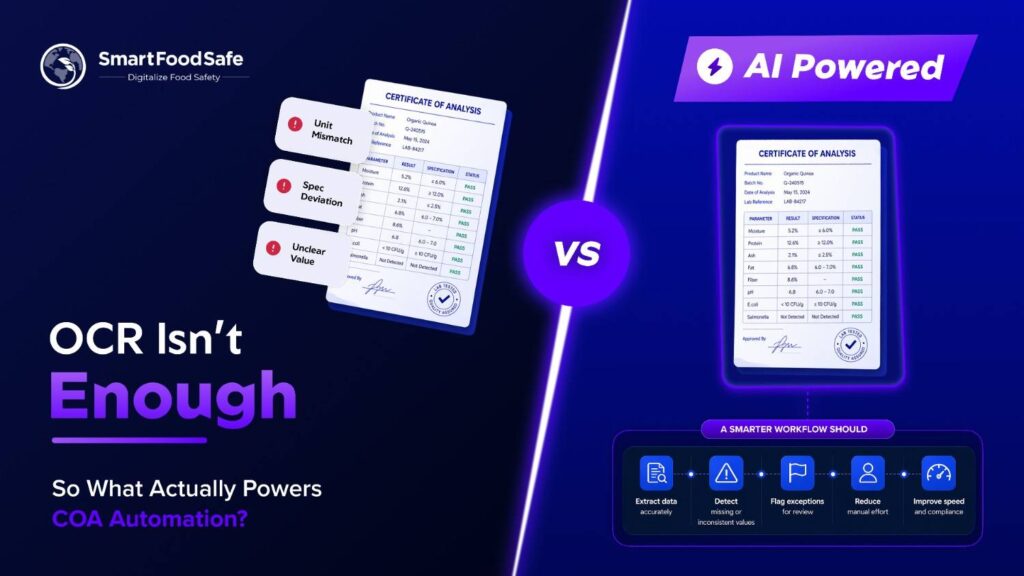
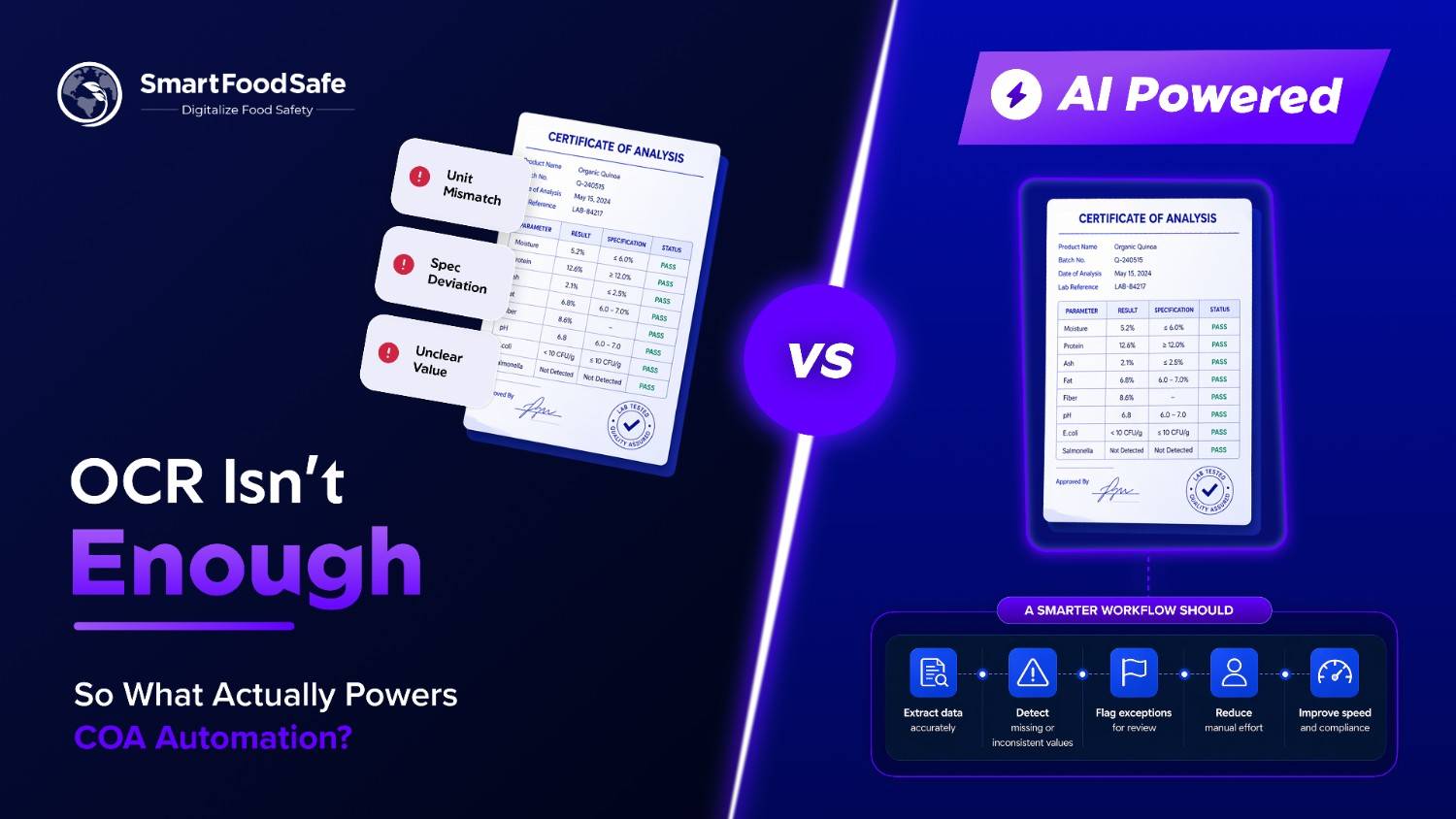
A single Certificate of Analysis can determine whether your product ships, gets held, or triggers a compliance risk and yet in many organizations, these decisions still depend on manual reviews or basic OCR tools that struggle to keep up with real-world complexity.
Certificates of Analysis are fundamental to quality, compliance, and release decisions across industries like food, pharma, and cosmetics, but the way they are handled has not evolved at the same pace as the risk they carry.
The issue isn't whether AI can help. It's that most conversations around "AI in COA workflows" are too vague. Simply saying "AI can automate COAs" hides the real question: what kind of AI is actually needed to handle the complexity of these documents?
Because not all AI is equal. And in COA processing, the difference between basic OCR and a well-designed AI stack is the difference between partial automation and a truly reliable workflow.
Let's break it down.
Before diving into different types of AI, it is important to understand where the real problem begins.
OCR, or Optical Character Recognition, is built to convert images and PDFs into readable text. It does that well. But that is also where its capability ends. It does not understand context, relationships, or the meaning behind the data it extracts.
In a COA, OCR might extract:
But it cannot determine:
This gap between reading data and understanding it is where most OCR-based workflows fall apart. A small change in layout, formatting, or structure can break the process, forcing teams back into manual review.
To truly automate COA workflows, you need multiple layers of AI that can interpret, validate, and connect the data in a way that aligns with real quality and compliance decisions.
This is where everything begins.
Document AI builds on OCR, but goes further by understanding how documents are structured.
Instead of just pulling text, it can:
This is what makes it possible to handle real-world variability without relying on rigid templates.
Once the data is extracted, the next challenge is making sense of it because in COAs, the same meaning can be expressed in many different ways.
You might see:
"ND", "Not Detected", "Absent"
Or
"Pass", "Complies", "Within Limits"
This is where context-driven AI comes in, combining techniques from Natural Language Processing and machine learning.
It helps:
This is where the process moves from information to action because extracting and understanding data is only part of the job. The real goal is to make consistent, reliable decisions.
This layer allows systems to:
For example:
COA formats are not static. Suppliers change layouts, formats evolve, and new variations appear constantly.
A system that depends on fixed rules will always struggle to keep up.
Adaptive models change that.
They:
Instead of breaking when something changes, the system becomes more capable with use.
Not every risk is obvious. Some issues do not violate specifications directly but still signal something is off.
For example:
Anomaly detection, a key part of modern artificial Intelligence systems, helps surface these subtle signals.
It adds a layer of insight that goes beyond standard checks and helps teams stay ahead of potential risks.
Finally, even the best data has limited value without a structured process around it.
This layer ensures that:
This is what creates accountability and audit readiness across the workflow.
A reliable COA workflow is not built on a single tool or model. It is a combination of multiple AI capabilities working together, each handling a specific part of the process.
What sets it apart:
Basic OCR stops at reading text. A well-designed AI workflow connects, validates, and acts on that data, creating a system that quality teams can rely on consistently.
Smart Food Safe focuses on the parts of COA workflows that typically slow teams down, data extraction, document handling, and review.
Turn COAs into structured, usable data
Bring clarity to incoming supplier documents
Make document review faster and more reliable
What this means for your team
So, can AI really handle COA workflows?
Yes it can, but not in the way it is often portrayed. Basic OCR on its own falls short, and generic AI claims do not address the real complexity involved.
What works is a thoughtfully designed combination of Document AI, NLP, machine learning, and decision-driven logic that can extract, interpret, and validate data in the context of real quality requirements.
The bigger risk today is not adopting AI too early. It is continuing to rely on OCR-based processes that were never built for the complexity and variability of modern COA data.
Remember, if your workflow still relies on manual checks or rigid templates, the problem is not the process itself, it is the limitation of the technology behind it.

 French
 Spanish
 Portuguese