


 English
▾
English
▾
English
▾
English
▾
Ever heard of the ‘butterfly effect’, how a tiny change in one part of a system such as a single butterfly flapping its wings can cause a huge, significant effect elsewhere, even a hurricane on the other side of the world?
As fascinating as that sounds, the recent breakthrough from a research study on phenology reveals a possibility that is equally exciting for businesses as this notion. It was found that researchers can predict plant growth cycles, like leaf production and flowering time, with much more accuracy than ever before. The study of how plants and animals respond to seasonal shifts, and phenology has long been a field of observation rather than prediction.
This science presents profound implications for food businesses as the forecasting methods can pave the way to tools that can be poised to transform how food businesses manage their supply chains by making use of the information hence obtained, adapting to climate change, and planning for the future.
Phenology is more than just observing when trees bud or flowers bloom. For food production, it’s the unseen driver behind crop yields, harvest schedules, and market availability. Studies show that plants in the U.S. are flowering three to four weeks earlier than they did 150 years ago due to rising temperatures. This shift isn’t just a scientific curiosity—it’s a game-changer for agriculture.
Imagine a vineyard planning its harvest. An early bloom might seem like a blessing, but it can throw off the entire production cycle if it doesn’t align with workforce schedules, equipment availability, or even consumer demand. Similarly, supply chain managers for major food corporations must consider how such changes affect everything from shipping logistics to the shelf life of their products.
And now, the latest development covers how the researchers have cracked a vital part of the phenological code. By incorporating the rate of springtime warming—what scientists call “warming velocity”—into predictive models, we can now forecast the timing of plant growth and flowering with unprecedented accuracy. This advancement means that food producers can equip themselves with a powerful capability to anticipate and adapt to the changing seasons, even as climate change continues to challenge the status quo.
At the heart of this advancement lies an unexpected discovery: a 19th-century dataset meticulously documenting the timing of plant and animal activity across the U.S. This treasure trove of historical phenological data provided researchers with a rare opportunity to test their models against nearly two centuries of environmental change.
The inclusion of warming velocity in these models proved to be the missing piece of the puzzle. By accounting for how quickly temperatures rise during spring, scientists could predict phenological events like flowering and leaf production with remarkable precision. This offers food supply chain stakeholders the ability to forecast the timing of key agricultural events, enabling them to carry out their operations in accordance with these schedules.
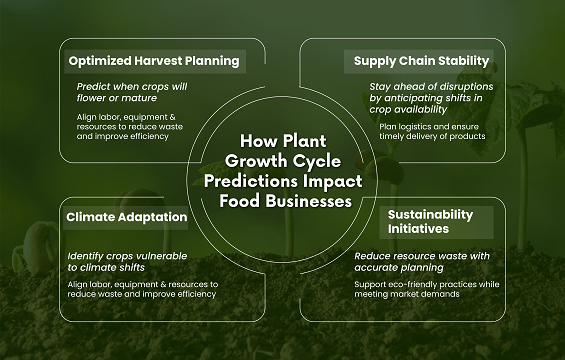
Below are the key benefits of how the prediction of plant growth cycles can help food businesses:
Accurate predictions of when crops will flower and mature allow businesses to streamline their operations. Farmers can align labor, machinery, and resources with peak harvest times, reducing waste and improving efficiency.
For large food companies, disruptions in the supply chain can be costly. Phenological forecasting provides a roadmap for anticipating shifts in crop availability, ensuring that logistics are adjusted well in advance.
As climate change accelerates, the ability to predict phenological changes becomes a critical tool for adaptation. Businesses can identify which crops are most vulnerable to shifts in timing and invest in alternative varieties or regions to secure their supply.
Predicting phenological changes also supports sustainability goals. By reducing waste, optimizing resources, and planning for climate resilience, food businesses can contribute to a more sustainable food system.
Moreover, the data fueling this study isn’t just coming from research labs—it’s also sourced from citizen scientists meaning it opens up exciting opportunities for food businesses to collaborate with these networks. By supporting citizen science initiatives, companies can also gain access to localized, real-time data that complements broader predictive models.
Smart Food Safe stands as an indispensable partner for food businesses striving to stay ahead of climate trends and phenological shifts. Smart Food Safe’s Smart Farm ensures that enterprises not only adapt to these changes but thrive in the face of them. Here’s how:
1. Real-Time Data Integration
Leveraging integrated digital technology, Smart Food Safe captures real-time data from various sources, including predictive phenological models and localized field reports. This data empowers businesses to make informed decisions swiftly and efficiently.
2. Proactive Supply Chain Management
By integrating predictive analytics, Smart Food Safe helps businesses anticipate disruptions in supply chains due to phenological variations. This enables seamless adjustments to logistics, ensuring product availability and reducing losses.
3. Enhanced Farm and Crop Management
Through its customizable dashboards, Smart Food Safe allows agronomists and farm managers to monitor field activities, schedule operations, and adjust crop cycles based on predictive insights. This ensures that harvests align with optimal resource utilization and market demands.
4. Sustainability and Compliance
Smart Food Safe facilitates adherence to sustainability goals by optimizing resource usage and reducing waste. It also ensures compliance with good agricultural practices (GAP) by providing a centralized system for documentation and audits.
5. Risk Mitigation and Profit Maximization
The platform supports risk assessment by forecasting potential vulnerabilities in crop schedules and yields. With tools like field mapping and post-reap records, Smart Food Safe aids in managing these risks, ultimately driving profitability.
Smart Farm can be your aid while incorporating the findings from the latest study to be one-step ahead always and tackle climate change related bottlenecks in your food production.

 French
 Spanish
 Portuguese