


 English
▾
English
▾
English
▾
English
▾
Being the second most populated country in the world, China is also the largest producer of agri-foods worldwide (about 1,095 million metric tonnes), and the largest importer of agricultural products. This makes China one of the world’s largest producers and consumers of food, hence facing the immense responsibility of ensuring the safety of its food supply.
Recognizing the critical role food safety plays in public health and international trade, China has built a strong legal framework, centered on the Food Safety Law of the People’s Republic of China (FSL). Here we explore the evolution of China’s food safety laws’ evolution, implementation, and significance in fostering public health, consumer confidence, and global trade relations.
China’s journey to establish holistic food safety legislation began with the enactment of the Food Safety Law of the People’s Republic of China in 2009. This initial framework addressed key areas like food production, processing, distribution, and sales, setting a foundation for more stringent laws in the future.
Over the years, the FSL has evolved through significant amendments, reflecting the government’s resolve to tackle emerging food safety challenges.
2009: Introduced the first national framework for food safety, focusing on regulatory oversight and consumer protection.
2015: Strengthened enforcement mechanisms, introduced harsher penalties for violations, and implemented a traceability system for food products.
2018: Added regulations on food additives and mandatory labeling to enhance transparency and safety.
2021: Further refined the law to keep pace with technological advancements and global food safety trends.
Effective enforcement of food safety laws requires a well-structured system of governance. In China, multiple agencies work in coordination to ensure compliance. The regulatory hierarchy is as given below:
State Council: Oversees national food safety strategies and policies.
State Administration for Market Regulation (SAMR): Implements laws, conducts inspections, and enforces penalties for violations.
National Health Commission (NHC): Develops and updates food safety standards.
Food Safety Commission: Coordinates efforts across different government bodies.
Below is a detailed interpretation of the Food Safety Law of the People’s Republic of China’s food safety standards to help businesses and stakeholders understand their implications:
Food safety standards are developed with a clear objective: to protect public health. These standards are designed to be:
Food safety standards are compulsory. This means:
Food safety standards cover diverse aspects critical to consumer health and product safety:
The administrative department of health under the State Council:
To streamline food safety measures:
National food safety standards are developed:
In the absence of national standards, local governments can establish local food safety standards:
When neither national nor local standards exist:
These internal standards:
Food safety standards are made available free of charge to ensure transparency and accessibility for all stakeholders, including consumers, businesses, and regulatory bodies.
China’s role as a major player in global trade necessitates strict import and export controls to uphold food safety. Both exporters sending food to China and importers bringing goods into the country must comply with regulations set by the General Administration of Customs of China (GACC). These include registration with GACC and product inspections and labeling in accordance with Chinese standards.
The Belt and Road Initiative (BRI) has further streamlined customs processes and enhanced food safety measures for trade. This initiative builds stronger global partnerships and economic growth while maintaining high safety standards.
China’s influence on global food safety standards has grown through strategic partnerships. As a key member of the Food and Agriculture Organization (FAO), China shares its expertise with other nations, particularly those in developing regions.
On March 12, 2024, the National Health Commission (NHC) and the State Administration for Market Regulation (SAMR) of China issued a significant update to the country’s National Food Safety Standards (Guo Jia Biao Zhun) (GB Standards). This release includes 47 newly established standards and 6 amendments. Among the newly introduced standards are:
1 standard for dairy products (notably the GB 19644-2024, “Standard for Milk Powder and Modified Milk Powder”),
1 standard for food contact materials,
7 standards for food testing methods,
16 standards for microbial testing methods, and
22 standards addressing food additives and nutritional fortifiers, including the revised GB 2760-2024, “Standard for the Use of Food Additives.”
These changes represent a step forward in ensuring food safety and regulatory compliance in China. Businesses and stakeholders operating in China are encouraged to familiarize themselves with the updated GB Standards and conduct detailed reviews to ensure compliance with these new regulations.
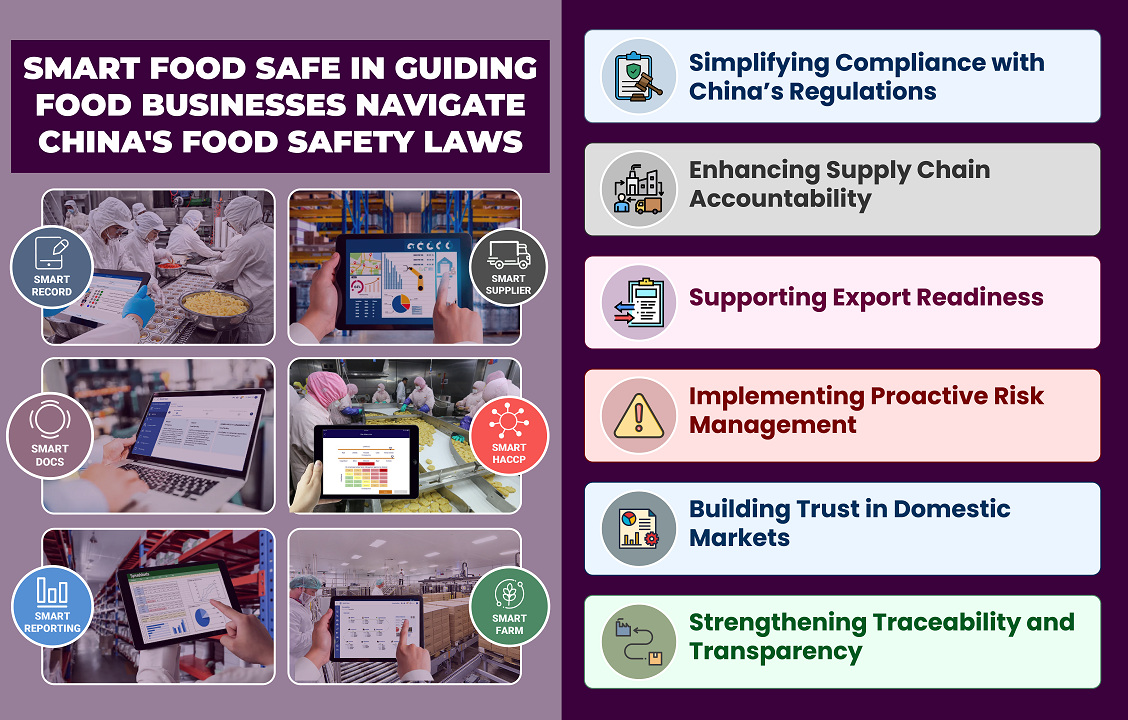
In the regulatory environment for China’s food industry, Smart Food Safe is a food safety management software platform that can be instrumental in guiding food businesses to enforce the necessary food safety standards with precision and ease via tech-driven solutions, achieving digital food safety compliance.
Features like digital record management, audit readiness solutions, and real-time monitoring enable efficient adherence to regulatory standards. For exporters to China, the platform simplifies documentation and integrates global food safety standards, ensuring alignment with China’s import requirements. For domestic businesses, traceability solutions enhance transparency and credibility by digitalizing product records. Smart Food Safe also streamlines supply chain processes with task assignments, tracking, and auditable trails, fostering accountability. These capabilities reduce errors, improve decision-making, and position businesses for success in China’s regulated food market.

 French
 Spanish
 Portuguese