


 English
▾
English
▾
English
▾
English
▾
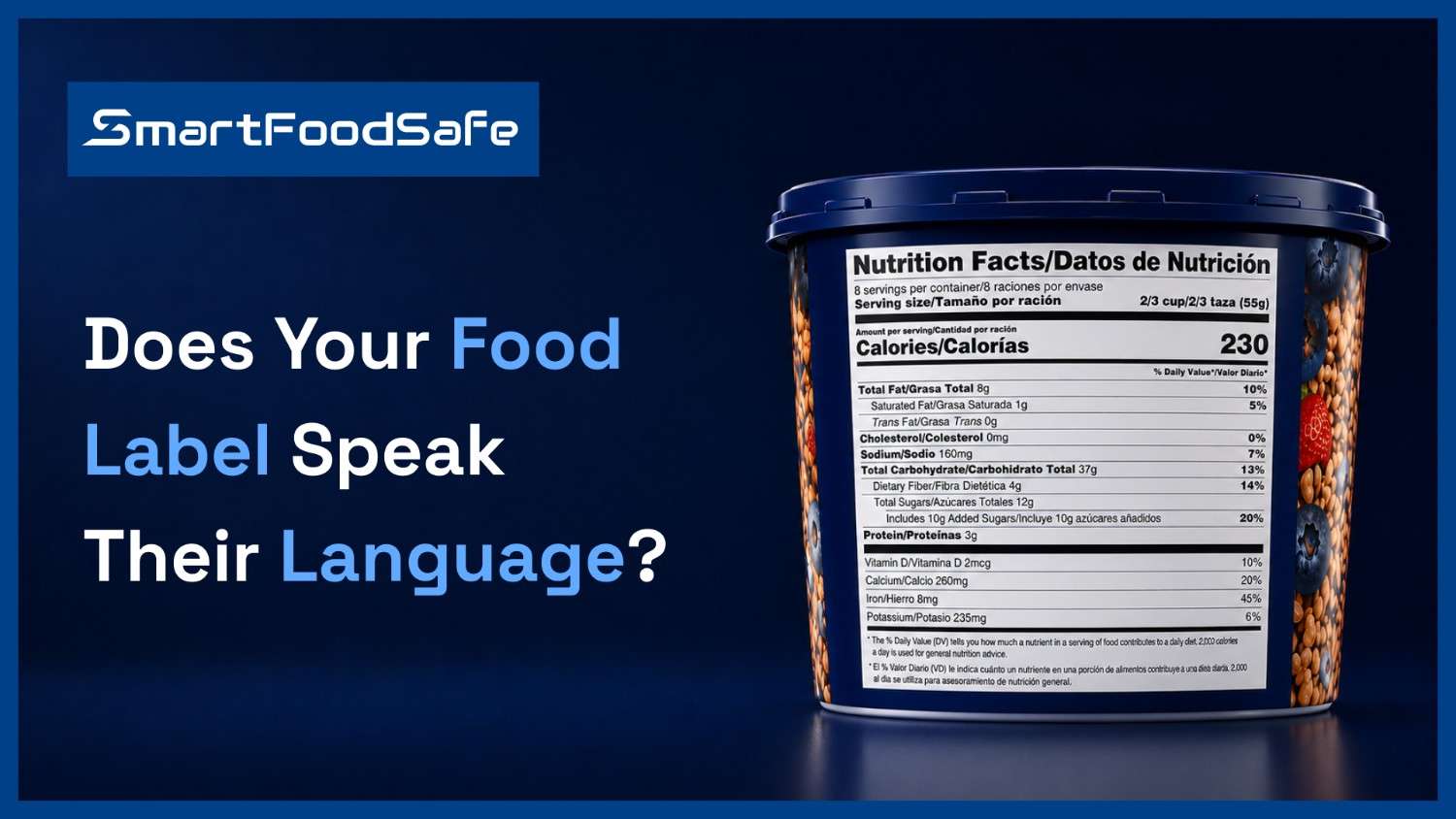
What is the most important element on a food label? It isn't the logo, the Nutrition Facts panel, or even the ingredient list. It's the language through which that information is communicated.
The true value of a food label lies not only in the information it contains but in the consumer's ability to understand it. When language becomes a barrier, critical food safety information loses its purpose.
Bilingual food labeling bridges this communication gap. It ensures that critical food safety information reaches a broader audience, empowers consumers to make informed decisions, and enables food businesses to meet compliance obligations while serving increasingly diverse and global markets.
The primary purpose of food labels is to help consumers make safe and informed purchasing decisions.
When consumers cannot understand label information, they may unknowingly expose themselves to allergens, prepare products incorrectly, or misuse foods that require specific storage conditions.
Bilingual food labeling addresses this challenge by presenting mandatory information in two languages, typically the official or commonly spoken languages of the market where the product is sold, such as English and French in Canada. In some regions, manufacturers may adopt multilingual labeling to meet the language requirements of multiple markets or diverse consumer populations. By making critical food safety information accessible, these labels help consumers make informed decisions while supporting regulatory compliance and international trade.
Effective bilingual labeling strengthens:
In today's global food industry, the ability to communicate clearly is just as important as the quality of the product itself.
In countries with multiple official languages or diverse linguistic populations, governments require mandatory food information to be available in the language(s) consumers can understand to ensure equal access to food safety information for all consumers.
Some well-known examples include:
Canada is one of the best-known examples of mandatory bilingual food labeling. Most mandatory food label information must appear in both English and French, reflecting the country's two official languages. This includes the product name, ingredient list, allergen declarations, Nutrition Facts table, storage instructions, and other required information.
Belgium has three official languages: Dutch, French, and German. Labeling requirements depend on the region where the product is sold, and many manufacturers use multilingual labels to serve consumers across the country.
Food labels in Switzerland commonly include German, French, and Italian, allowing manufacturers to communicate with consumers across the country's multilingual population.
India's Food Safety and Standards (Labelling and Display) Regulations generally require mandatory food information to be provided in English or Hindi. Many manufacturers also include regional languages to better serve local markets.
Across Gulf Cooperation Council (GCC) countries, including the United Arab Emirates and Saudi Arabia, mandatory food information is generally required in Arabic. Many manufacturers also include English, making bilingual labels common for imported and internationally distributed products.
The European Union does not require bilingual labels across all Member States. Instead, mandatory food information must appear in the official language or languages required by the country where the product is marketed. Consequently, many manufacturers voluntarily adopt multilingual packaging to distribute products efficiently across several European markets.
Many food manufacturers also choose to include multiple languages voluntarily. Doing so helps simplify international distribution, improve accessibility, strengthen consumer trust, and reduce the need for market-specific packaging.
Unlike Canada and several other international markets, the U.S. Food and Drug Administration (FDA) does not generally require food labels to be bilingual.
However, manufacturers may voluntarily include additional languages on food labels. When they do, the FDA requires that all mandatory labeling information appearing in another language must also be provided in that language, unless a specific exemption applies.
Mandatory information includes:
This requirement helps ensure consumers receive complete and consistent information regardless of the language they read.
Puerto Rico: A Practical Example
Puerto Rico illustrates how FDA bilingual labeling works in practice. Although it is a U.S. territory, Spanish is the primary language spoken by most consumers. As a result, many food products sold in Puerto Rico display mandatory information in both English and Spanish. When manufacturers choose to include Spanish on FDA-regulated food labels, the required labeling information must also appear in Spanish, ensuring consumers receive the same essential food safety information in both languages.
A food label is one of the first and most important food safety tools a consumer interacts with. When essential information is available in two languages, it becomes easier to identify potential risks, follow safety instructions, and make informed purchasing decisions.
Bilingual labeling enhances food safety by improving understanding of:
Not every element on a food label requires translation, but all mandatory food safety information should be communicated in the required language(s). This includes the product name, ingredient list, allergen declarations, Nutrition Facts, storage and preparation instructions, and warning statements. Translating these elements accurately helps consumers understand what they are buying, identify potential health risks, handle food safely, and make informed purchasing decisions.

For food manufacturers, bilingual food labeling is more than a compliance requirement. It is a key enabler of international market access. Every export market has its own language and labeling regulations, and meeting these requirements from the outset helps businesses reduce compliance risks, streamline packaging operations, and bring products to market more efficiently.

Canada requires most mandatory food label information to appear in both English and French, including the common name, ingredient list, allergen declarations, Nutrition Facts table, net quantity, and dealer identity. For manufacturers exporting from markets such as the United States, an English-only label is generally not sufficient for retail sale.
By designing bilingual labels during product development rather than after production, businesses can avoid costly artwork revisions, speed up regulatory compliance, and enter the Canadian market with greater efficiency. More importantly, the same structured labeling process can be adapted for other multilingual markets, making future international expansion simpler and more cost-effective.
Implementing bilingual food labeling requires careful coordination across regulatory, quality, packaging, and product development teams. Maintaining accuracy and compliance across multiple language versions presents several operational challenges, including:
Accommodating multiple languages while maintaining readability can be difficult, particularly on smaller packages.
Technical food terminology, allergen declarations, and regulatory statements require precise translations to avoid errors and ensure compliance.
Language, formatting, and mandatory labeling requirements vary across countries, making compliance more challenging for exporters.
Keeping every language version aligned after ingredient, allergen, or formulation changes can be difficult without a centralized review process.
Adding additional languages while preserving font size, layout, and visual clarity requires thoughtful packaging design.
Regulatory, quality, marketing, and packaging teams must work together to review and approve labels, increasing the complexity of the labeling process.
Successful bilingual labeling requires a structured process that combines regulatory knowledge, accurate translations, and robust document management to ensure every language version remains consistent and compliant.
To implement bilingual labeling effectively, food businesses should follow these best practices:
Translation should be considered during label design, not added after the artwork is complete. Planning for multiple languages early helps avoid layout issues, improves readability, and reduces costly redesigns.
Food labels contain technical and regulatory terminology that requires more than literal translation. Working with translators experienced in food regulations helps ensure ingredient names, allergen declarations, nutrition information, and mandatory statements are translated accurately and consistently.
Centralizing product specifications, ingredient data, nutrition information, and allergen details helps ensure every language version is generated from the same approved information. This minimizes inconsistencies and simplifies future updates.
Both language versions should be easy to read and presented with equal prominence, while meeting the formatting and legibility requirements of the destination market.
Even minor changes to ingredients, allergens, or nutrition values should trigger a review of every language version of the label to ensure information remains accurate and compliant.
Food labeling regulations continue to evolve across global markets. Businesses should regularly review changes to language requirements, labeling standards, and implementation timelines to ensure ongoing compliance and avoid costly product recalls or market disruptions.
Managing bilingual labels across multiple products and markets can become increasingly complex. Digital food labeling and compliance platforms help manufacturers centralize product information, manage document versions, streamline label reviews, and maintain consistency across multiple language versions, making regulatory compliance more efficient and scalable.
As food products move across borders and consumer markets become increasingly diverse, food labeling is evolving beyond two languages. While bilingual labeling remains a regulatory requirement in many regions, manufacturers expanding globally are increasingly adopting multilingual labeling strategies to serve multiple markets with greater efficiency.
At the same time, innovations such as digital labels, QR codes, and cloud-based label management are transforming how food information is delivered and maintained. Regardless of the technology, the objective remains unchanged: ensuring consumers can access accurate, understandable, and compliant information wherever a product is sold.
Businesses that establish robust bilingual labeling processes today will be better prepared to scale into multilingual markets as regulations and global trade continue to evolve.
Managing food labels across multiple products, languages, and markets requires more than accurate translations. It demands centralized product data, automated calculations, controlled workflows, and country-specific compliance.
Smart Label, part of the Smart Food Safe platform, helps food manufacturers simplify bilingual and multilingual labeling by bringing recipe formulation, nutrient analysis, ingredient management, allergen declarations, and label creation into a single centralized platform.
Key capabilities include:
By maintaining a single source of truth, Smart Label helps reduce labeling errors, accelerate product launches, simplify compliance, and ensure consistency across every language version.
Looking to streamline bilingual and multilingual food labeling? Discover how Smart Food Safe helps you create accurate, market-ready labels faster while supporting regulatory compliance across global markets.
Takeaway Message: Speaking the Consumer's Language Is Speaking the Language of Food Safety
No, requirements vary by country. Some nations mandate bilingual labeling, while others require labels in at least one official language understood by local consumers. Businesses exporting internationally should always verify the labeling requirements of their destination market before launching a product.
The U.S. FDA does not generally require bilingual food labels. However, if mandatory labeling information appears in a second language, that required information must generally also be provided in that language in accordance with FDA labeling regulations.
Canada is one of the best-known examples, requiring most mandatory food information to appear in both English and French. Other multilingual countries, such as Belgium and Switzerland, also have language-specific labeling requirements. Many exporters voluntarily use bilingual or multilingual labels to simplify distribution across multiple markets.
Yes. Clear communication of ingredients, allergens, nutrition information, storage conditions, and preparation instructions helps consumers make informed decisions and reduces the risk of food safety incidents caused by language barriers.
Managing bilingual or multilingual food labels across different markets can be challenging without a centralized system. Food labeling and compliance software such as Smart Food Safe helps manufacturers organize product specifications, ingredient data, document control, and labeling workflows in one platform. By maintaining accurate product information and supporting version control, businesses can simplify label updates, improve regulatory compliance, and reduce the risk of errors when expanding into global markets.
Start by understanding the regulations of each target market, use professional translators with food labeling expertise, maintain standardized terminology, validate translations through regulatory review, and implement digital document and label management systems to ensure consistency across all language versions. These practices help improve compliance, reduce costly labeling errors, and accelerate international market access.

 French
 Spanish
 Portuguese