


 English
▾
English
▾
English
▾
English
▾
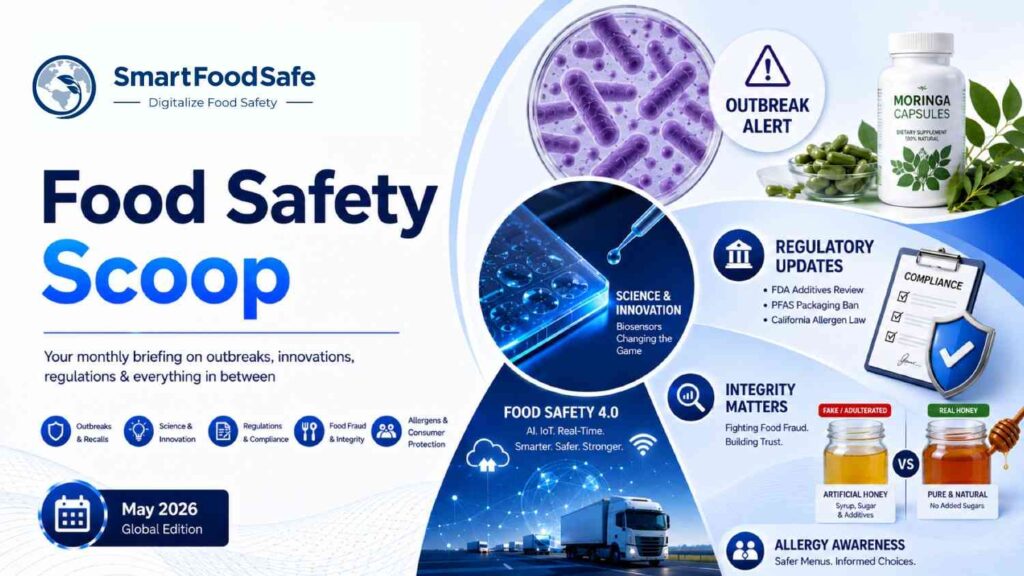

How did a trending wellness capsule become the most dangerous thing in your medicine cabinet?
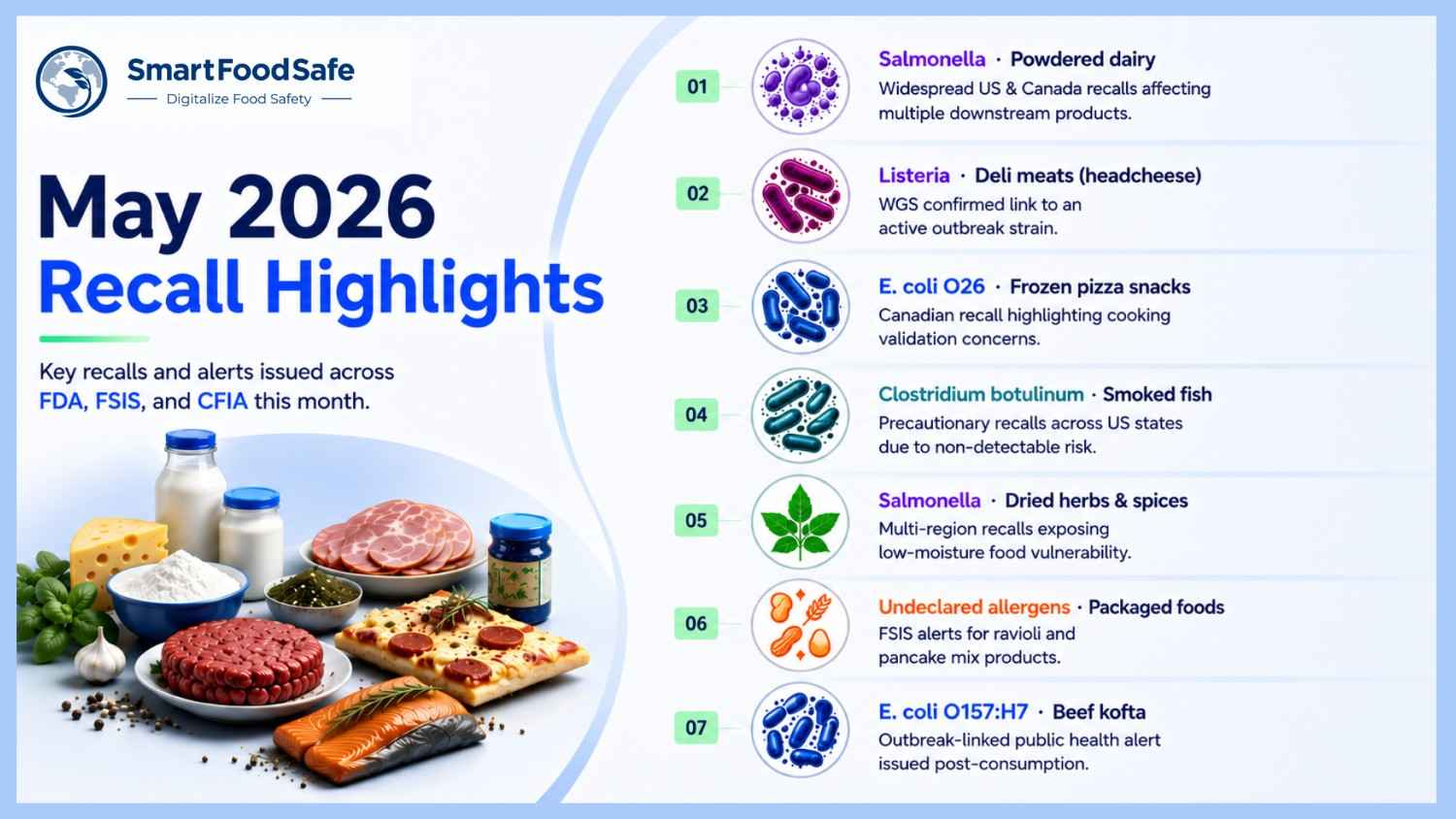
May added yet another chapter to what has become 2026's most alarming food safety serial. As of May 27, the FDA and CDC confirmed that a reopened moringa investigation now spans 119 cases across 36 states, with 32 hospitalisations. Simultaneously, a fresh third outbreak linked to a separate Missouri-based product added 18 more confirmed cases across 14 states.
The February outbreak was particularly concerning, involving an extensively drug-resistant Salmonella strain resistant to commonly used treatments. Marketed through Amazon, TikTok Shop, and other online channels, the contaminated capsules reached consumers who trusted them as health products.
The outbreak adds renewed urgency to the debate over whether dietary supplements should undergo stronger pre-market safety reviews.
The FDA's long-awaited Executive Summary on the ByHeart botulism outbreak landed in May. The findings were deeply unsettling.
Of all the food safety stories that carried into May, this is the one that should weigh most heavily. The FDA's Executive Summary on the infant botulism outbreak linked to a powdered infant formula product revealed a deeply concerning finding: contamination may have begun as early as March 2022 — the month the product first reached the market — and went undetected for more than three years.
Every one of the 48 infants was hospitalized. All received BabyBIG, the only treatment for infant botulism globally, manufactured exclusively in California. The youngest were just 16 days old.
The outbreak was not identified until November 2025, when California's Infant Botulism Treatment and Prevention Program detected an unusual cluster and alerted the CDC.
The FDA's WGS analysis identified 17 strains of Clostridium botulinum across patient samples, finished product, and raw ingredients. The Codex Committee on Food Hygiene, representing 50 countries, has since initiated a formal risk assessment on spore-forming pathogens in powdered infant formula.
The central question remains: if contamination began in 2022, how many cases were missed before surveillance systems connected the pattern?
One of the most exciting food safety innovations of the month came from researchers at Worcester Polytechnic Institute, who developed a palm-sized biosensor capable of detecting Salmonella enterica in food samples without incubation, bacterial culturing, lengthy wait times, or advanced laboratory equipment.
"We have a solid surface that can be used anywhere in the food supply chain, from farm to fridge, to detect foodborne bacteria with minimum human intervention," said Associate Professor Yuxiang Liu, who led the research.
With smartphone-based readouts already in development, the technology has the potential to move pathogen detection out of the lab and into the supply chain, shrinking the time between contamination and response.
Machine learning, smart packaging, and real-time monitoring are reshaping how the industry keeps food safe.
A comprehensive review published in Food Safety and Health this month documented where AI has stopped being theoretical and started being operational. AI-powered portable biosensors can now detect Salmonella in poultry products in real time in under 30 minutes. Hybrid deep learning models paired with hyperspectral imaging are identifying pesticide residues in leafy vegetables at over 95 percent accuracy. Blockchain-integrated AI systems are monitoring aflatoxin contamination in nuts, combining rapid detection with auditable supply chain records.
The global AI-in-food-safety market is growing at over 30 percent annually. The challenge is no longer whether the technology works — it is making it accessible, affordable, and regulator-approved at the scale needed to protect a food supply that feeds eight billion people.
The FDA signalled a major shift in approach by reopening the conversation around food additives that have been considered safe for decades.
On May 12, the US FDA finalised its new Food Chemical Safety Post-Market Assessment Program and simultaneously launched formal reassessments of two additives: BHT (butylated hydroxytoluene) and ADA (azodicarbonamide).
Neither additive is being removed from shelves. Instead, the FDA is seeking updated safety data, exposure estimates, and use information, with submissions due by July 13, 2026.
The significance extends beyond BHT and ADA. The FDA has positioned this as part of a broader, proactive review program, signalling that even long-approved GRAS status ingredients may be re-evaluated as new scientific evidence emerges.
The EU PPWR PFAS ban is 73 days away. Packaging manufacturers are adapting, and exporters should be too.
From August 12, 2026, the EU's Packaging and Packaging Waste Regulation comes into full force, banning PFAS in food-contact packaging above defined concentration limits. PFAS — per- and polyfluoroalkyl substances — are the chemicals that make fast food wrappers grease-resistant, microwave popcorn bags moisture-proof, and sandwich papers non-stick. They are also persistent in the environment and the human body, which is why they are called forever chemicals.
There is no grandfathering provision. Packaging that exceeds the new PFAS limits cannot be placed on the EU market after the deadline, regardless of when it was manufactured. The rules also apply to imported packaging, meaning exporters worldwide need compliance documentation in place well before August.
The transition does not stop with PFAS. EU restrictions on bisphenol A (BPA) in most food-contact materials take effect in July 2026, marking one of the most significant shifts in food packaging regulations in recent years.
Food allergies affect over 32 million Americans. They are serious, frequently misunderstood, and in 2026 finally getting some regulatory attention to match the scale of the problem.
May marks National Asthma and Allergy Awareness Month in the US, and this year's campaign from the Food Allergy and Anaphylaxis Connection Team (FAACT) delivered a message that resonates far beyond the allergy community: "Invisible No More: food allergies may be unseen, but they should never be unnoticed."
It captures one of the most challenging realities in food safety. A person with a severe food allergy or celiac disease may show no visible signs of vulnerability, yet a single labelling error, ingredient mix-up, or cross-contact incident can trigger life-threatening consequences.
FARE also used the month to launch Advocacy Days at state capitols in New York and California, pushing for legislation that improves daily life for people managing food allergies. The AAFA's daily action calendar gave supporters one concrete step to take each day of May, from sharing personal stories to contacting lawmakers about research funding.
A major deadline is fast approaching, and it marks a first for the United States.
Effective July 1, 2026, California's Allergen Disclosure for Dining Experiences (ADDE) Act will require restaurant chains with 20 or more locations nationwide to clearly identify the Top 9 allergens on their menus — whether printed, digital, or both. Signed into law by Governor Gavin Newsom in October 2025, the legislation gained renewed attention throughout Allergy Awareness Month as businesses prepared for compliance.
California is the first US state to require allergen disclosures on restaurant menus, bringing dining transparency closer to the standards long established for packaged foods. While similar requirements have been in place across the European Union since 2014, restaurant allergen information has remained inconsistent in much of the US.
As Senator Caroline Menjivar, who lives with severe food allergies, noted: "Soon, the millions of Californians with food allergies will be able to fully enjoy dining out without fear at these qualifying restaurants."
Of 102 Honey Samples Tested, Not All Were as Pure as the Label Suggested.
The FDA released its FY25 honey adulteration results this month, offering a reminder that food fraud often hides in products consumers trust the most. Of 102 honey samples tested — 54 domestic and 48 imported — 4 percent were found to contain undeclared corn or sugarcane syrups used to dilute the product and reduce costs.
To uncover the fraud, the FDA used stable carbon isotope ratio analysis, a technique that detects carbon signatures inconsistent with genuine floral honey. The agency also confirmed it is developing more advanced analytical methods to strengthen future detection efforts.
While violation rates have fallen from roughly 10% in 2021–22 to 4% today, the findings show that honey fraud remains a persistent issue and continued vigilance is still needed.
This is not a distant spectre lurking on some imagined horizon. The February 2026 moringa outbreak made it clear that antimicrobial resistance (AMR) is already at the table of food safety, quietly reshaping outcomes once considered routine.
Yet within this sobering reality lies a measure of reassurance. Science is not static, nor is vigilance. With stronger surveillance systems, faster diagnostics, and a regulatory mindset that finally treats AMR not as an adjacent concern but as a central one, there is every possibility that we may yet stay a step ahead of this evolving challenge.
The situation is serious — undeniably so — but it is not beyond the reach of collective action, provided we choose to act with the urgency it deserves.
That wraps up this month's Food Safety Scoop. Stay informed, stay curious, and as always, pay attention to what's on your plate.

 French
 Spanish
 Portuguese