


 English
▾
English
▾
English
▾
English
▾
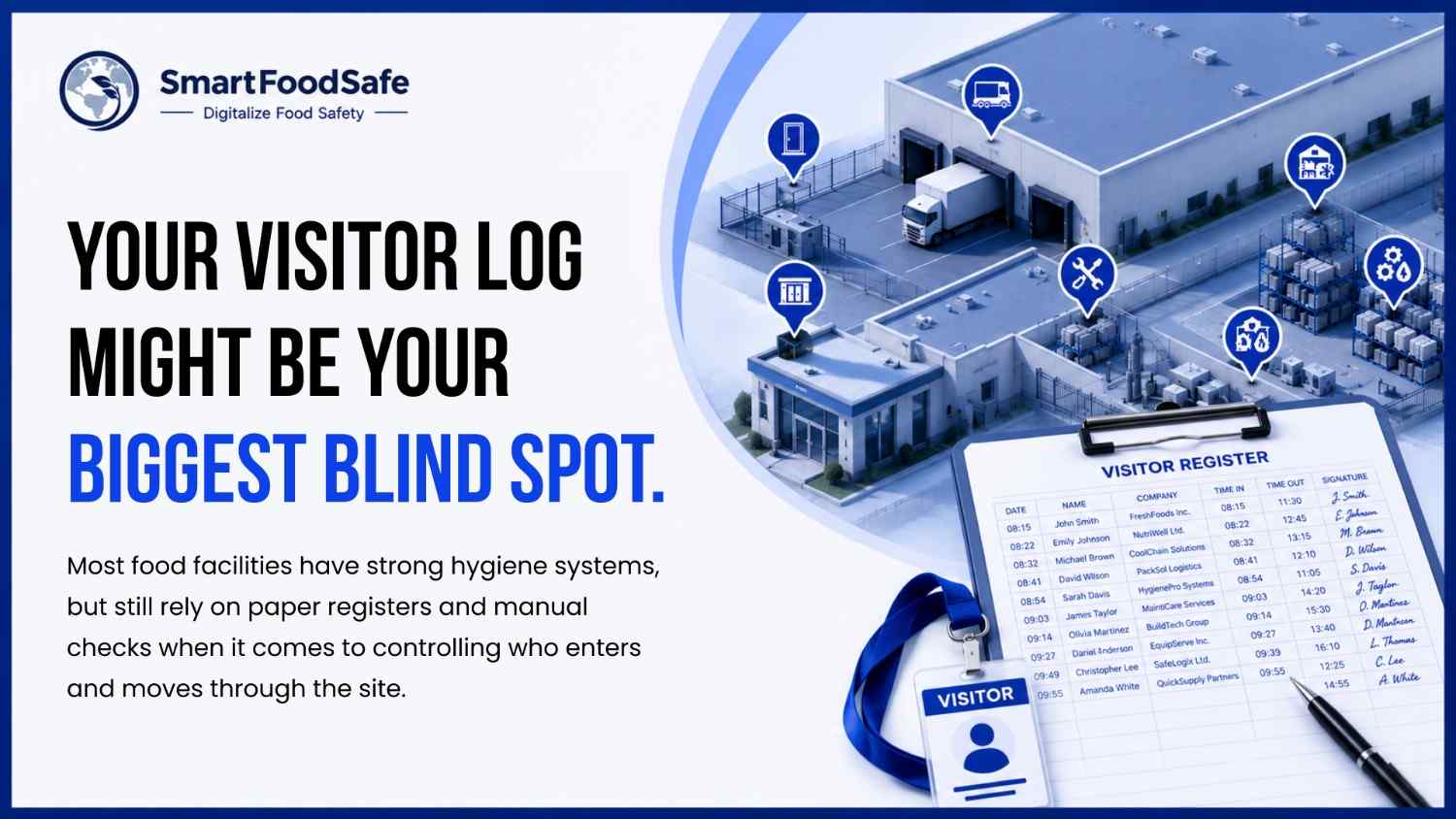
In modern food safety systems, food defense under frameworks such as those guided by the U.S. Food and Drug Administration includes not only production controls but also protection of the facility itself, including entry points, movement of people, and access to sensitive areas.
It addresses both intentional and unintentional risks across the entire operation. Uncontrolled movement within production areas can lead to contamination, traceability issues, and audit gaps. While hygiene and testing systems are strong in most organizations, gaps often remain in how people enter and move within the site, making site security and access management essential.
Site security is therefore a key part of food defense strategy, built on clear and controlled access for every individual entering the facility.
Effective food defense depends on controlling people movement across the facility. Food facilities have multiple access points that require equal visibility and control across all zones. This includes:
Every entry point introduces a level of risk if movement is not properly monitored and documented. Even a small lapse in access control can create challenges around contamination prevention, traceability, and compliance readiness.
Without structured access management, food facilities may face:
For this reason, site security becomes an important compliance and food defense requirement tied directly to operational control and facility integrity.
Food manufacturing environments are dynamic spaces where multiple categories of people enter daily. Each group presents different levels of risk and therefore requires distinct access controls.
Employees are the most frequent internal movement group. While trained in hygiene and safety protocols, unrestricted internal movement can still lead to:
Visitors may include auditors, inspectors, clients, or corporate teams. They often lack facility-specific hygiene training, making controlled supervision essential.
Contractors work on maintenance, repairs, or installations. Their access is often intermittent but involves high-risk zones such as:
These include delivery personnel, cleaning services, pest control teams, and raw material suppliers. Their interaction with unloading zones and storage areas makes them a critical control point in food defense systems.

As food facilities become more regulated and operationally complex, paper visitor logs and manual gate registers are no longer enough to support modern food defense requirements. This is why many organizations are strengthening site security with digital visitor management system software that brings greater visibility, traceability, and control across every facility entry point.
Modern systems help manage:
In food defense, knowing exactly who entered the facility, where they accessed, and when they exited is critical for maintaining site security, compliance readiness, and operational accountability.
Smart Visitor helps food facilities manage and monitor who enters the site, where they go, and how access is approved across different operational areas.
Instead of relying on manual registers or disconnected entry processes, Smart Visitor brings everything into one centralized system that is easier to track, manage, and audit.
It helps facilities:
The platform is designed to support access control across the entire facility, including production zones, warehouses, loading docks, maintenance areas, and other sensitive operational spaces.
By digitizing access management, Smart Visitor helps food organizations improve site security, reduce visibility gaps, and maintain better compliance control across day-to-day operations.
Many facilities still approach security as something that only needs to be managed at the main entrance. But in reality, food operations have multiple access points that require the same level of visibility and control.
These include:
Each of these areas can become a risk point if access is not properly monitored.
Smart Visitor helps facilities manage access across the entire site, not just at one location. By supporting facility-wide access control, it helps organizations maintain better visibility, stronger traceability, and more consistent security across all operational areas.
By extending visibility and control beyond the front desk, Smart Visitor strengthens the overall resilience of food defense systems.

Food facilities have spent years strengthening hygiene systems, production controls, and sanitation practices. But as food defense expectations continue to evolve, visibility into who enters the facility is equally noteworthy.
A visitor log today serves as an important part of facility operations, helping organizations strengthen site security, improve traceability, and maintain better readiness for audits and inspections.
With Smart Visitor, food organizations can bring that control into one connected system, helping teams manage access more confidently across every operational area.
Request a Smart Visitor demo and simplify how your organization manages site security, compliance tracking, and visitor access across every entry point.

 French
 Spanish
 Portuguese