


 English
▾
English
▾
English
▾
English
▾
Halal certification is no longer viewed as just a religious requirement. For food manufacturers, QA/QC teams, halal auditors, and brand owners, it has become a key benchmark for food integrity, cross-contamination prevention, operational transparency, and international compliance.
As the global halal food market continues to grow, consumers are asking deeper questions about how food is sourced, processed, stored, and handled. A halal logo alone is no longer enough. Businesses are now expected to prove that halal integrity is protected at every stage of the supply chain, from raw ingredients to final distribution.
This is one of the main reasons halal certification is increasingly shaping modern food standards worldwide, alongside global frameworks such as the Codex General Guidelines for Use of the Term Halal and OIC/SMIIC halal standards.
Many people assume halal certification only focuses on ingredient approval. In reality, halal certification evaluates the full manufacturing environment.
It examines:
A product may contain halal-approved ingredients, but if it comes into contact with non-halal substances during production or storage, its halal status can still be compromised. That is why halal compliance goes far beyond formulation. It is about protecting halal integrity at every operational stage. The FAO/WHO Codex halal guidelines also emphasize preventing direct contact with non-halal food during preparation, processing, transportation, and storage.
Halal standards are built around principles such as:
For manufacturers, this means halal certification is not a one-time audit exercise. It is an ongoing system of monitoring, prevention, and accountability.
The halal food industry is no longer a niche segment. It is becoming a major part of global food trade and influencing how manufacturers approach quality assurance, traceability, and compliance.
Standard-setting bodies are working toward greater harmonization through frameworks like OIC/SMIIC halal standards, which are developed through technical committees and consensus-based processes. JAKIM, Malaysia's halal authority, also maintains an official halal portal and recognized foreign halal certification body framework.
Today, halal certification is closely linked to:
For many food businesses, halal compliance has evolved into a broader quality strategy rather than only a religious certification.
One of the most critical challenges in halal food manufacturing is cross-contamination. Even trace exposure to non-halal substances can compromise halal integrity.

Cross-contamination can happen at multiple stages of production and often occurs because of operational gaps or weak control systems.
Common sources of halal cross-contamination include:
In many facilities, contamination risks are hidden inside routine processes. A single missed cleaning step or a storage error can affect compliance and consumer trust.
Raw materials arriving from multiple suppliers can introduce contamination risks if verification systems are weak.
Common risks include:
Strong supplier approval and ingredient traceability are essential for maintaining halal compliance from the beginning.
Shared machinery is one of the most common causes of halal contamination in food production facilities.
High-risk equipment may include:
Without validated sanitation procedures, residue from non-halal products can remain on equipment surfaces. The Codex halal guidance also allows shared facilities only when necessary measures prevent contact between halal and non-halal foods.
Employees play a major role in protecting halal integrity.
Common operational gaps include:
Even strong systems can fail if teams are not trained and monitored properly.
Halal compliance risks continue even after production is complete.
Common issues include:
This is why halal standards extend beyond production and into the entire supply chain.
Preventing halal contamination requires a proactive approach. Businesses that successfully maintain halal integrity usually build contamination control directly into their operational workflows.
Whenever possible, facilities should use separate equipment and clearly segregated areas for halal and non-halal products.
Best practices include:
Physical separation significantly reduces contamination risks.
Cleaning procedures should be consistently verified through proper validation, monitoring, and documentation to ensure sanitation practices effectively prevent contamination risks.
Effective sanitation programs should include:
Halal compliance depends heavily on operational awareness.
Employees should be trained on:
Consistent training helps reduce human error and improve accountability across teams.
Supplier management is a major part of halal assurance.
Manufacturers should:
Strong traceability systems make it easier to identify and manage risks before they affect production.
Halal Critical Control Points are the stages in production where the risk of halal contamination is highest. These points require strict monitoring, preventive controls, and immediate corrective action if issues occur.
Examples of halal critical control points include:
Identifying these points helps facilities move from reactive compliance to preventive risk management.
A Halal Assurance System is the structured framework that helps businesses maintain halal compliance consistently over time.
Rather than relying only on final inspections, a Halal Assurance System creates ongoing monitoring and verification throughout operations.
A strong system typically includes:
For QA/QC teams, a Halal Assurance System improves consistency, accountability, and audit readiness across departments.
Halal certification is evolving alongside broader food industry trends. Today, halal compliance is increasingly connected with sustainability, ethical sourcing, clean-label production, and advanced traceability systems.
Emerging trends influencing halal standards include:
As consumer expectations continue to grow, halal certification is becoming part of a wider movement toward responsible and transparent food production.
For brands, halal certification strengthens consumer trust. For exporters, it creates access to growing international markets where halal compliance is increasingly expected.
Smart Food Safe helps food businesses strengthen halal compliance through improved traceability, digital documentation, audit readiness, corrective action management, and operational visibility. By supporting stronger food safety and monitoring processes, Smart Food Safe helps manufacturers maintain halal integrity more consistently across production and supply chain operations.
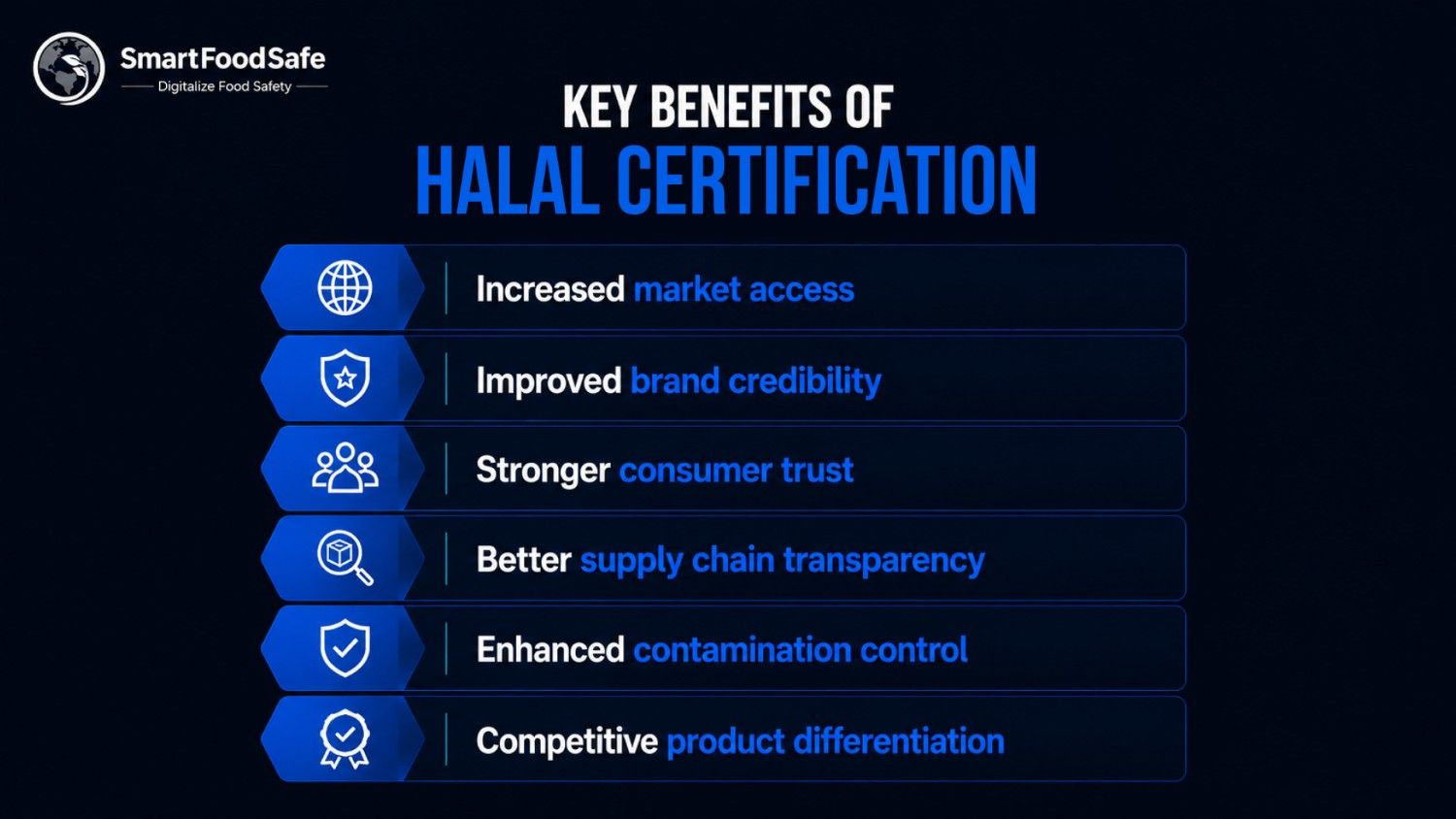
Halal certification is shaping modern food standards because it focuses on much more than ingredients alone. It emphasizes operational discipline, contamination prevention, traceability, accountability, and consumer trust across the entire supply chain.
For manufacturers, QA/QC teams, halal auditors, and food brands, the challenge is no longer simply obtaining halal certification. The real challenge is maintaining halal integrity consistently through sourcing, production, storage, packaging, and distribution.
As global food systems continue to evolve, businesses that invest in stronger halal assurance systems, preventive controls, and transparent operational practices will be better positioned to meet rising compliance expectations and build long-term consumer confidence.

 French
 Spanish
 Portuguese