


 English
▾
English
▾
English
▾
English
▾
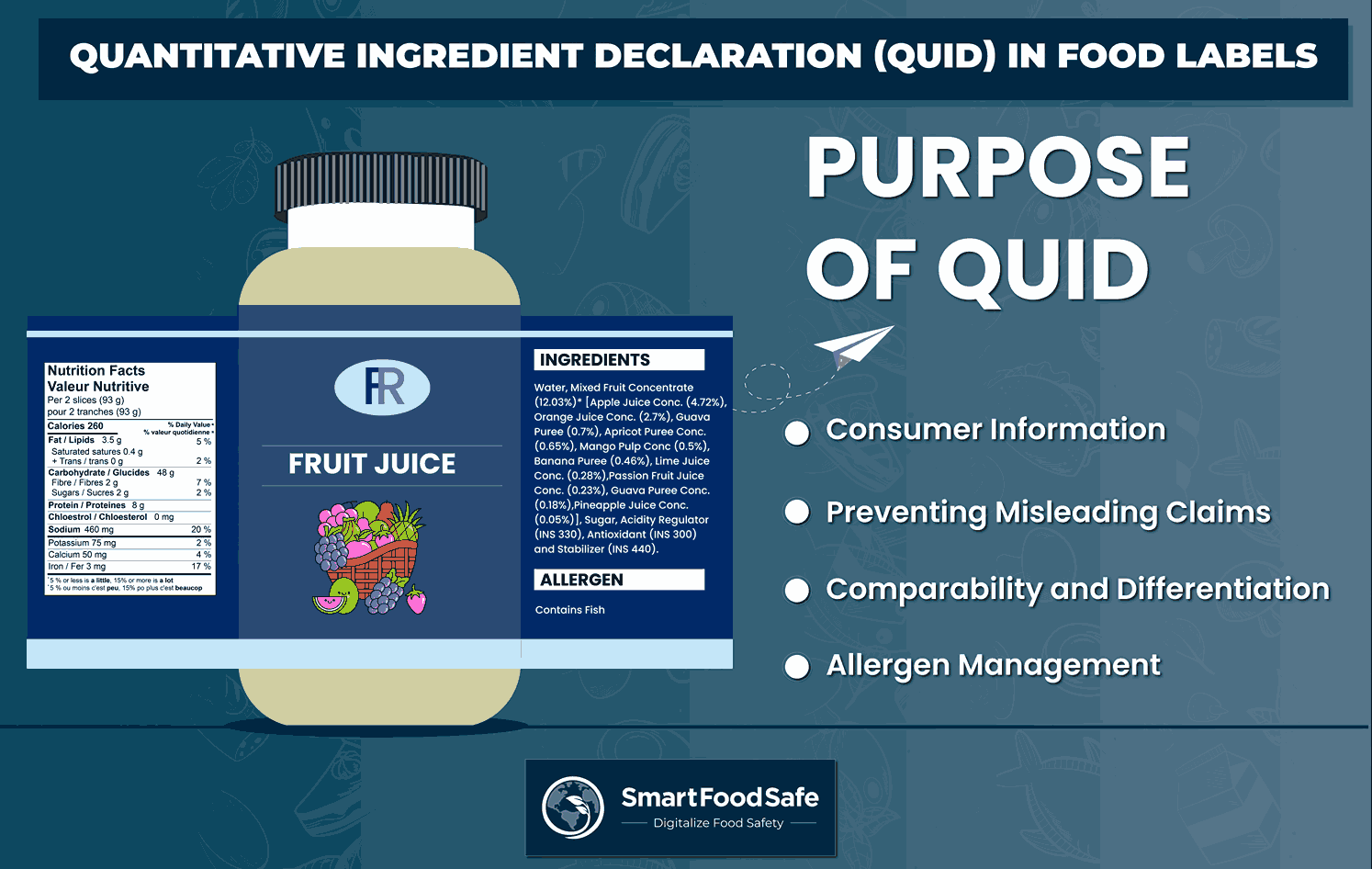
QUID, an abbreviation for Quantitative Ingredient Declaration, holds substantial significance in food labeling, as it allows for highlighting the presence or absence of certain ingredients, aiding consumers in making informed choices about what they eat to stay healthy. The Food Safety Authority of Ireland has elaborated on some guidelines regarding the inclusion of QUID in food labels. Let’s have a look.
The concept of QUID refers to the declaration of the quantity, typically in percentage terms, of an ingredient or a category of ingredients used in the production or preparation of a food item. This requirement applies to all food products, including beverages, encompassing those exempt from regular ingredients listing unless specifically excluded.
In today’s consumer-driven market, transparency and clarity in product labeling are pivotal in building trust between consumers and food manufacturers. By incorporating QUID in food labels it serves to perform the following objectives:
QUID is applied in the following scenarios:
However, there are exceptions when QUID doesn’t apply:
QUID is calculated depending on the recipe at the mixing bowl stage. It involves dividing the weight of the ingredient to be declared by the total weight of all ingredients, then multiplying by 100 to determine the percentage. However, adjustments are made for changes like moisture loss during cooking.
Dealing with Values Exceeding 100%: If the calculated QUID exceeds 100% due to processing alterations (e.g., water loss), a declaration is made based on the weight of the ingredient used to prepare 100g of the finished product.
Concentrated or Dehydrated Products: For ingredients used in concentrated or dehydrated forms, their quantities may be indicated based on their proportions before concentration or dehydration. This applies especially in cases where reconstitution occurs during manufacturing.
Labeling the QUID Value: The declared QUID value is an average quantity considering manufacturing variations. It should be rounded to the nearest whole number or, if below 5%, to the nearest 0.5 decimal place.
Integrating QUID in food labels can present several hurdles, some of which can be addressed with technology:
Accurate Measurement: Determining precise quantities of ingredients in complex formulations can be challenging. Technology such as advanced sensors, spectrometers, or imaging systems can be employed to measure ingredients accurately, ensuring compliance with labeling regulations.
Recipe Variability: Food formulations often vary due to factors like seasonal variations in raw materials or changes in suppliers. Using data analytics and machine learning, companies can create models that predict variations and adjust ingredient quantities accordingly to maintain adequacy in label information.
Real-Time Data Integration: Technology can enable real-time monitoring and data integration from different production stages. This includes data from suppliers, manufacturing processes, and quality control, ensuring that ingredient quantities on labels reflect the most up-to-date information.
Label Design & Space Constraints: Sometimes, fitting all required information within limited label space can be a challenge. Utilizing QR codes or RFID tags linked to online databases can provide extensive information without cluttering the physical label, allowing consumers to access detailed ingredient quantities through their smartphones.
Regulatory Compliance: Staying compliant with evolving regulations can be complex. Technology can aid in automating compliance checks and updates, ensuring that labels consistently adhere to the latest labeling requirements.
Data Security & Integrity: As information is gathered and transmitted digitally, maintaining data integrity and security is vital. Implementing blockchain or other secure database technologies can ensure the traceability and authenticity of ingredient information throughout the supply chain.
Consumer Education: Understanding complex ingredient declarations can be challenging for consumers. Technology can assist in creating interactive tools or apps that simplify ingredient information, providing explanations or visual representations to enhance consumer understanding.
Leveraging technological advancements in label management can prominently aid in tackling challenges with using QUID in food labels by enhancing efficiency throughout the labeling process. Automated systems equipped with AI and machine learning algorithms ensure compliance with ever-evolving regulations, reducing human error and mitigating risks of mislabeling. These technologies enable real-time updates, facilitating quick adjustments to ingredient lists or allergen information and ensuring consumers have access to precise and up-to-date data, fostering trust and loyalty in brands.
Smart Food Safe‘s Smart Label can streamline and consolidate the various processes involved in food label management, elevating the whole process. Using an extensive ingredient database, Smart Label simplifies and consolidates the creation of accurate, regulation-compliant nutritional labels. This innovative platform enables food manufacturers, processors, and distributors to access vital information like nutrition facts and allergens effortlessly, ensuring precise label details.
With its user-friendly interface, streamlined import of ingredient data, and automated label updates reflecting ingredient or regulatory changes, Smart Label makes label design and tracking changes a breeze. Its advanced features, including automatic recipe analysis, label generation, and multilingual support, facilitate compliance with evolving industry standards. For instance, it seamlessly integrates QR code technology into food labels, optimizing efficiency while upholding the safety and authenticity of food products. Ultimately, Smart Label saves valuable time and resources, enhancing regulatory adherence and product integrity.

 French
 Spanish
 Portuguese